

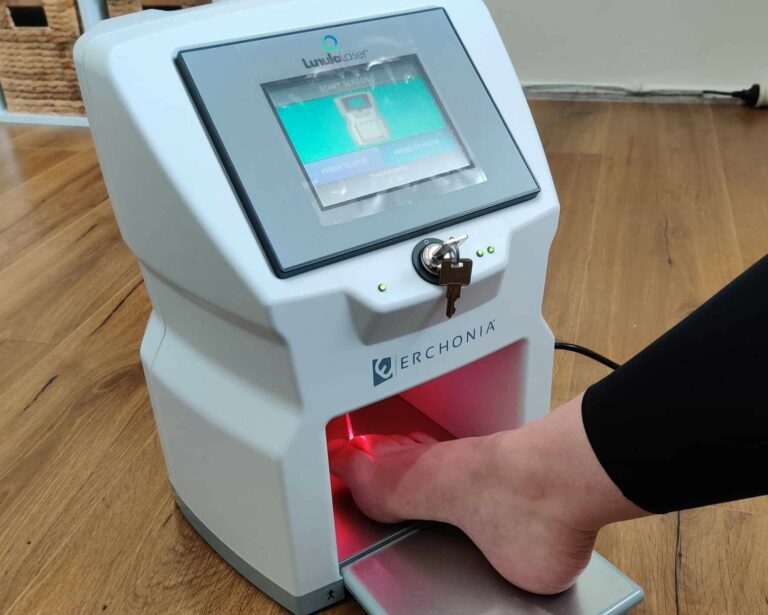
Laser treatment for toenail fungus has become one of the most popular options in podiatry clinics. But is it the right choice for you?
That depends on your situation. This guide breaks down the pros and cons of laser treatment for fungal nails, explains the difference between hot and cold laser, and helps you decide whether it makes sense for your feet.
How Laser Treatment Works
Laser targets the fungal organisms living in and under your nail. The goal is to damage or destroy the fungus without harming the surrounding skin or nail bed.
There are two main types of laser used in podiatry: hot laser and cold laser. They work in different ways, and the results are not the same.
Hot Laser vs Cold Laser — What’s the Difference?
This is where the decision matters most. Not all laser treatments are equal, and understanding the difference can save you time and money.
Hot Laser
Hot laser uses high-frequency energy to burn the fungus. Here’s what you should know:
- Success rate sits around 40–60%
- Treatment can be painful due to the heat
- Sessions take over an hour for 10 nails
- Only one nail treated at a time
- Can damage the nail bed if heat is too high
- Not suitable for children or people with diabetes
- Closed shoes may feel uncomfortable after treatment
Cold Laser (Lunula)
Cold laser is the newer generation of fungal nail laser. At ModPod Podiatry, we use the Lunula cold laser system — and it works in a different way.
It uses two rotating laser beams:
- A blue laser targets the fungal cell wall and weakens it
- A red laser stimulates your immune cells to attack and destroy the weakened fungus
The result is a treatment that works with your body rather than relying on heat alone.
Here’s what makes it different:
- Success rate between 75–90%
- Pain-free — no heat, no discomfort
- Each session takes about 20 minutes
- Treats all 10 toenails at the same time
- No downtime — wear socks and shoes straight after
- Safe for children and people with diabetes
- Improves nail bed circulation
Is Laser Treatment Worth It for Toenail Fungus?
It depends on where you are in your treatment journey and your overall health.
You’re Just Starting Out
If you haven’t tried anything yet, a topical anti-fungal may be a reasonable first step. It’s the lowest-cost option. But keep in mind that topical treatments have a success rate of only 5–10%. If you don’t see changes after two to three months, it’s time to consider something more effective.
Tip: take a photo of your nail before you start any treatment. It removes the guesswork when you check progress later.
Topical Treatments Haven’t Worked
If you’ve already tried over-the-counter products without results, laser is a strong next step — especially cold laser. The jump in success rate from topical (5–10%) to cold laser (75–90%) is significant.
You’re Hesitant About Oral Medication
Oral anti-fungal medication has a success rate of around 65–75%, but it comes with potential side effects including liver toxicity. If you’d rather avoid systemic medication, cold laser offers a comparable or better success rate without the risks.
You’ve Had Hot Laser That Didn’t Work
If hot laser failed, cold laser is still a good option. The two technologies work in different ways, so a poor result with hot laser does not rule out success with cold laser.
You Have Health Conditions
Your overall health affects how well any treatment works. People with poor circulation, diabetes, heart conditions, or poor diet may see lower success rates — sometimes as low as 40–50% even with cold laser. It’s worth discussing your specific situation with a podiatrist before committing.
We sometimes recommend seeing a nutritionist alongside treatment if skin and nail infections are significant.
What About Cost?
Pricing for fungal nail laser treatment varies depending on how many nails are affected and how severe the infection is. A mild infection may need four sessions, while a more advanced case could need up to eight.
For a full breakdown of what laser treatment costs, read our guide on the cost of laser nail fungus removal.
Not Sure If You Have a Fungal Nail?
Before committing to any treatment, it helps to know what you’re dealing with. Try our free AI Nail Scanner — it gives you an indication of whether your nail shows signs of fungal infection.
If you visit one of our five Sydney clinics, our podiatrists assess your nails visually under magnification. Visual diagnosis by an experienced podiatrist is reliable and means treatment can start the same day — no waiting weeks for results.
The Bottom Line
Fungal nail laser treatment is worth it for most people — especially if topical products have failed or you want to avoid oral medication. Cold laser (Lunula) offers the best combination of effectiveness, safety, and convenience.
The key is choosing the right type of laser. Hot laser has its limits. Cold laser delivers better results with less risk and no pain.
Want to know which treatment is right for you? See our fungal nail treatment options or call (02) 9960 3981.