
Shin stress fracture vs shin splints comes down to what is hurt and how the pain behaves. Shin splints, known as medial tibial stress syndrome, irritate the muscles, tendons and bone surface along your shin. The pain spreads over a strip of your leg and eases as you warm up. A stress fracture is a small crack in the shinbone (the tibia). The pain stays at one spot, builds as you run and does not warm up.
This article shows you how to tell the two apart, what causes each and how recovery differs. It also answers a common worry: can shin splints cause a stress fracture? You get a side-by-side table, four checks to make at home and the signs that mean you should have your shin assessed.
ModPod Podiatry has treated feet, ankles and lower limbs in Sydney for over 20 years. Our podiatrists treat shin pain in runners, dancers and team sport athletes. This guide reflects how we sort out shin pain in clinic.
Why the difference between the two injuries matters
The difference matters because each injury needs a different response. With shin splints, you can stay active if you cut your load. With a stress fracture, the bone needs real rest to heal.
Two injuries, two recovery paths
Shin splints are an overuse problem. Repeated impact inflames the tissue where your leg muscles meet the shinbone. Most people recover in 2 to 6 weeks with the right plan, and you can keep fit with swimming or cycling while you heal.
A stress fracture is a structural injury to the bone. Stress fractures make up roughly 1% to 7% of athletic injuries, so they are less common, but they cost more time. Recovery runs 6 to 12 weeks or more, and you may need a walking boot or crutches.
Treating a crack as shin splints is the costly mistake. Your bone cannot repair while you raise the distance, speed or frequency of your training.
Can shin splints cause a stress fracture?
Shin splints do not turn into a fracture by themselves, but both injuries share one cause. Each comes from load that outpaces recovery. If you run through shin splints, the bone keeps taking stress it cannot handle, and a crack can form.
Shin splints do not become a fracture overnight, but training through them gives a crack the chance to form.
You can have both at once. People ask whether shin splints can cause fractures because a stress fracture is a crack from repeated load, not a break from a fall. Left alone, a stress fracture can grow into a complete break, and some of those need surgery.
How to tell shin splints from a shin stress fracture
Check three things: where the pain sits, what it does as you warm up and whether it hurts at rest. Shin splints spread and ease. A stress fracture pinpoints and builds.
Shin splints vs stress fracture, side by side
| Feature | Shin splints | Shin stress fracture |
|---|---|---|
| Pain area | Broad strip along the inner shin, 5 cm or more | One spot you can cover with a fingertip |
| Pain during a run | Eases as you warm up, returns after | Builds as you run |
| Pain at rest | Fades | Can ache at rest and at night |
| Pain on touch | Tender along a wide area | Sharp tenderness at one point |
| Swelling | Mild or none | Possible swelling at the sore spot |
| Hopping on the leg | Dull ache, if any | Sharp, stabbing pain on landing |
| Typical recovery | 2 to 6 weeks | 6 to 12 weeks or more |
No single sign decides the answer. Use the table as a guide to what to expect, and know that some stress fractures feel like mild shin splints at first.
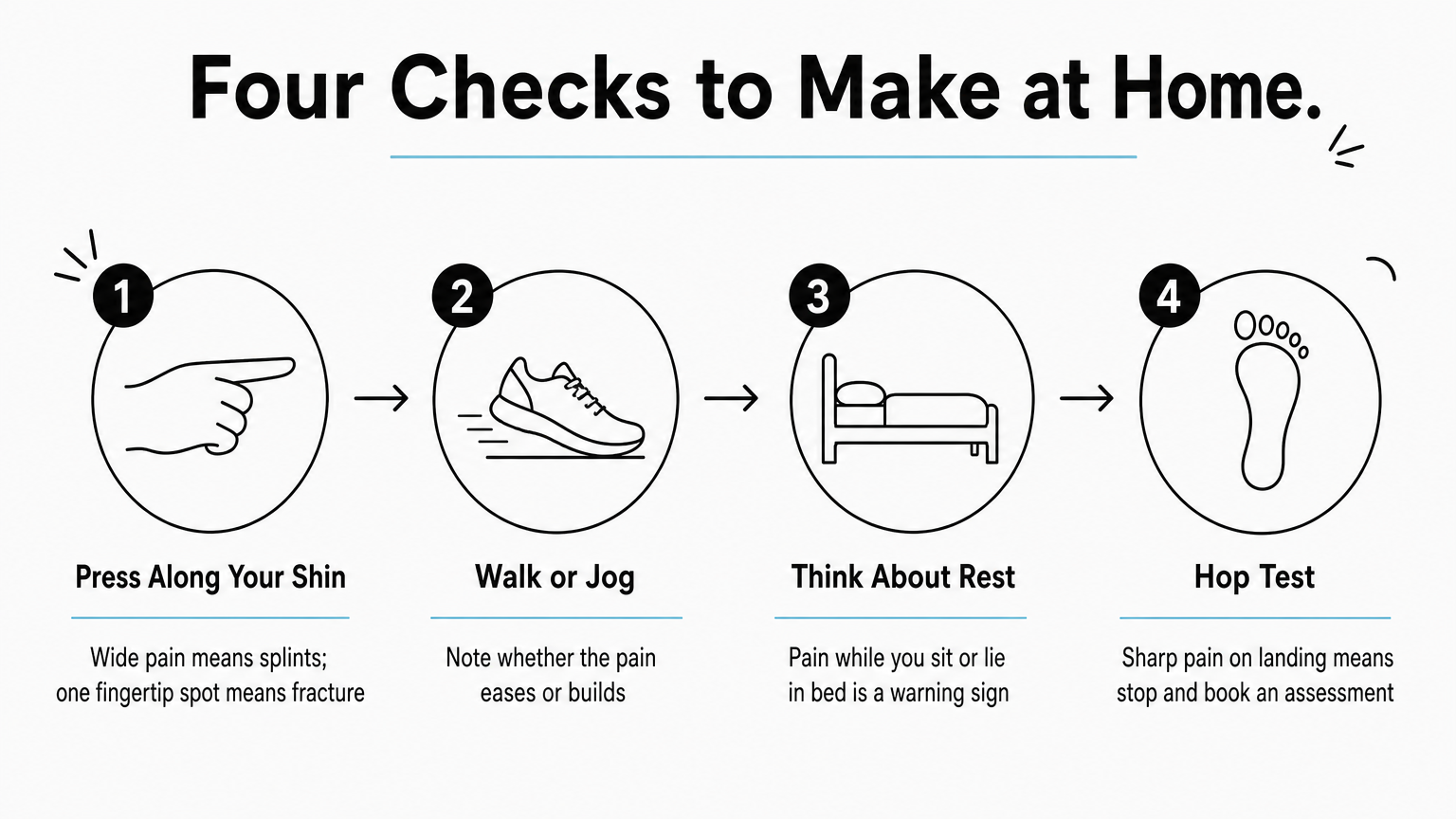
Checks you can make at home
- Press along your shin. Pain over 5 cm or more points to shin splints. A spot you can cover with one fingertip points to a fracture.
- Walk or jog for a few minutes. Note whether the pain eases or builds.
- Think about rest. Pain while you sit or lie in bed is a warning sign.
- Hop on the sore leg. Sharp pain on landing means stop and book an assessment.
These checks guide you, but they do not replace an assessment. X-rays can miss a new stress fracture, so a clear X-ray does not rule one out. A podiatrist reads your history and your exam alongside any imaging.
Pain you can cover with one fingertip deserves more attention than pain that spreads along the shin.
What causes shin splints and stress fractures
Both injuries start when training load rises faster than your body can adapt. Your shin then pays the price.
Training errors that overload the shin
Most cases trace back to a change in routine. Look for these in your own training:
- A sudden jump in mileage, speed or hill work
- New jumping drills, such as plyometrics, with no extra recovery
- A switch from soft ground to concrete or hard roads
- Running shoes worn past about 500 to 800 km
- Too few rest days between hard sessions
A training log makes the pattern clear. Write down distance, surface, shoes and pain for each session. Many people do not notice how fast they ramped up until they see the numbers.
Body factors that raise your risk
Weak calves and glutes, excess foot pronation, and heel striking with overstriding all increase the load on your tibia. Low bone density adds risk for stress fractures in particular. Women are two to three times as likely as men to get one, because bone density peaks in the early 20s and falls faster later, especially around menopause.
Nutrition matters too. Low calcium and vitamin D weaken bone, and a past shin injury raises the odds of another.
Training load starts both injuries, and your mechanics and bone health help decide which one you get.
How treatment and recovery differ
Shin splints need less load and a fix for the cause. A stress fracture needs the bone offloaded until it heals.
Treating shin splints
Cut back on running and jumping, and swap in swimming, cycling or water running. Ice the shin for 15 to 20 minutes, several times a day, for the first few days. Build calf, glute and ankle strength, check your shoes and return to running in steps.

Our Shin Splints Treatment starts with a thorough assessment to find the cause of your pain. Typical recovery is 2 to 6 weeks.
Treating a stress fracture
A stress fracture needs offloading. That can mean a walking boot, a brace or crutches, along with a plan that keeps your fitness up through low-impact work. Expect 6 to 12 weeks or more before you run, depending on the bone and the site of the crack.
Your podiatrist also looks for the cause, such as gait or bone health, so the injury does not return. Shin splints never need surgery. Some stress fractures do, depending on their location and the blood flow around them.
Reduce the load for shin splints, and rest the bone for a stress fracture.
When to see a podiatrist about shin pain
See a podiatrist if shin pain lasts beyond 7 to 10 days of rest and lighter training, or if you notice any red flag below.
Red flags to act on
- Pain at one spot you can pinpoint
- Sharp pain when you hop
- Pain at rest or at night
- A limp
- Swelling over the shin
- Pain that returns each time you restart running
If you limp, stop running. Pushing through a bone injury can turn a small crack into one that needs surgery, and a delayed diagnosis costs you more weeks off your sport.
What happens at your visit
You need no GP referral to see a podiatrist at ModPod Podiatry. Your podiatrist takes your history, assesses your shin, makes a diagnosis and gives you a treatment plan. A biomechanical assessment uses digital video analysis and pressure mapping to study how you walk and run.
Our sports podiatry first visits last about 45 minutes. You can book online at our Sydney CBD, Mosman, Dee Why and Rose Bay clinics, and same-week times are available in most cases. We process health fund rebates on the spot with HICAPS, and Medicare may cover up to 5 visits with a GP Enhanced Primary Care plan.
If your shin pain has a single sore spot, get it assessed before your next run.
Get your shin pain checked
Shin splints spread across the shin and ease as you warm up. A shin stress fracture sits at one spot and builds with every step. Shin splints do not become a fracture on their own, but training through them raises the risk. Both injuries heal best when you catch them early.
If your pain matches the stress fracture column, or has not eased after a week or two of lighter training, do not guess. Book your shin assessment online and a ModPod podiatrist will find the cause and set out your recovery plan.