
If you search for nail fungus laser treatment near me, you want a nearby clinic, a clear view of how the treatment works, and a price you can plan around. Here is the short answer. A podiatrist passes a cold laser over the infected nail. The laser uses no heat, needles or tablets. At ModPod Podiatry you have 4 to 8 weekly sessions of about 12 minutes each, and the clinics sit in Sydney CBD, Mosman, Dee Why and Rose Bay.
Nail fungus, called onychomycosis, is an infection that turns a nail yellow, white or brown. The nail thickens, lifts and crumbles. Cold laser treatment is one way to clear it. The light treats the fungus in and under the nail, and a new clear nail grows out over the following months.
This article covers why people choose laser, how to find a clinic, what happens in a session, what it costs with a worked example, how well it works, and how to stop the fungus coming back. ModPod Podiatry has treated feet in Sydney for over 20 years, and the details below come from how the clinics run this treatment.
Why laser suits stubborn nail fungus
Laser suits you when pharmacy creams and home remedies have failed, or when you want to avoid tablets. It treats the infection with light. You skip the daily routine of paints and the risks of oral medicine. For many people, laser is the next step after everything else has failed.
Why creams and home remedies fall short
Fungus lives in and under the nail, where a cream struggles to reach. The nail plate is hard, and an infected nail gets thicker. A paint or cream has to soak through that layer, and you must apply it every day for months. Many people stop before the nail grows out, and the infection stays.
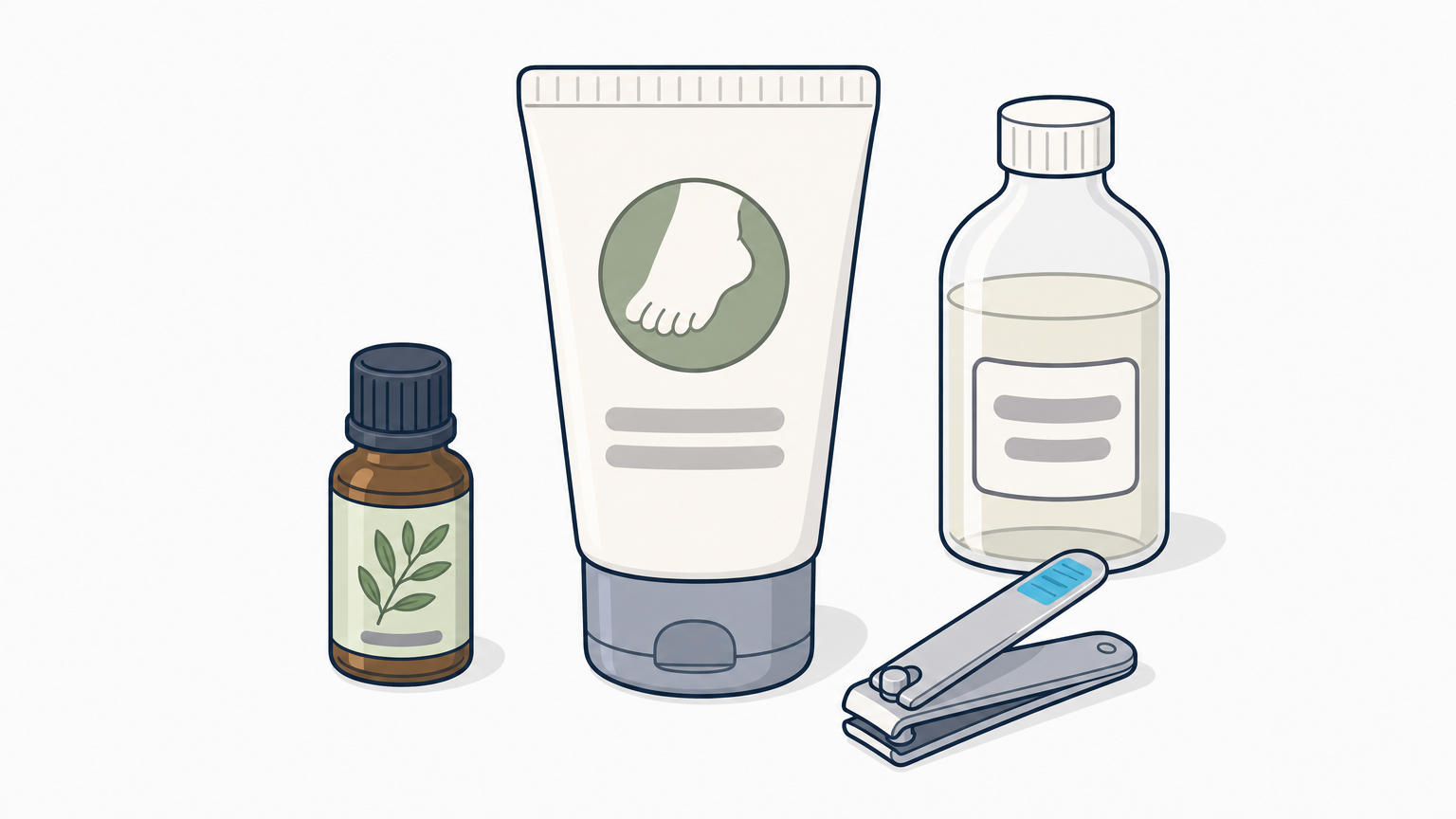
Home remedies such as vinegar soaks or tea tree oil face the same barrier, and the proof for them is weak. If you have spent months on them and the nail is still yellow, thick or crumbly, it is time to see a podiatrist.
Fungus sits where creams cannot reach, so a treatment that works through the nail makes sense.
How laser compares with creams and tablets
You have three main options. This table sets them side by side.
| Option | How you use it | What to weigh |
|---|---|---|
| Pharmacy cream or paint | Apply daily for many months | Suits mild cases. Slow, and the nail must grow out |
| GP-prescribed tablets | Take for several weeks | Can affect the liver and interact with other medicines, so your GP may check your health first |
| Cold laser at a podiatry clinic | 4 to 8 weekly visits of about 12 minutes | No heat, no needles, no anaesthesia, no recovery period. Medicare does not cover it |
ModPod Podiatry treats mild, moderate and severe infections with laser. The laser is meant for people whose fungal nails have not cleared with pharmacy creams or home remedies. Tablets suit some people well, so talk to your GP if you prefer that path.
Signs that point to a fungal nail
Look for these changes in a toenail:
- Yellow, white or brown colour
- A thick nail that is hard to cut
- Crumbly or ragged edges
- A nail that lifts from the nail bed
A podiatrist confirms the diagnosis by looking at the nail. At ModPod Podiatry there are no clippings and no lab tests, and treatment can start the same day. See a doctor soon if you spot a dark streak under a nail, because that needs a different check. If you have diabetes or poor circulation, tell your podiatrist, since nail problems matter more for you.
How to find a fungal nail laser clinic near you
Pick a clinic by its laser, its full price and the times it offers. You need to attend weekly for up to 8 weeks, so choose a clinic you can reach with ease. Then book and say you want laser treatment for a fungal nail.
Five checks before you book
Ask every clinic these questions. The ModPod Podiatry answers sit next to each one.
- Which laser do you use? ModPod uses the Erchonia Lunula cold laser, which the FDA has cleared for treating onychomycosis.
- Who confirms the diagnosis? A podiatrist should look at the nail first. At ModPod this is a visual check.
- What does one session cost, and how many will I need? Work out your total before you start. ModPod lists $205 for the initial session and $160 for each follow-up.
- Does the price change with the number of nails? At ModPod it does not. The price is the same for one nail or all ten.
- Do I need a referral? At ModPod you do not.
Choose a clinic you can reach every week, because a missed session slows your progress.
ModPod Podiatry clinics across Sydney
ModPod Podiatry runs four clinics. Pick the one nearest your home or work, since you will return each week.
| Clinic | Address | Opening times |
|---|---|---|
| Sydney CBD | Suite 506/66 Hunter Street, Sydney NSW 2000 | Mon and Tue 8am to 6pm, Wed 8am to 5.30pm, Thu and Fri 8am to 5pm |
| Mosman | Shop 2/59 Harbour Street, Mosman NSW 2088 | Sat 8am to 12.30pm |
| Dee Why | Suite 4103/834 Pittwater Road, Dee Why NSW 2099 | Mon to Wed 8am to 6pm, Thu and Fri 8am to 5pm, Sat 8am to 12pm |
| Rose Bay | 668a New South Head Road, Rose Bay NSW 2029 | Mon 8am to 2.30pm, Thu 8am to 6pm, Fri 1pm to 6pm, Sat 8am to 1pm |
The CBD clinic is a 1 minute walk from Martin Place Metro Station and 5 minutes from Wynyard Station. Wilson Parking at 1 Bligh Street is the closest car park. The Mosman clinic is just off Military Road, near Spit Junction. The Dee Why clinic is in the Dee Why Grand Commercial Tower.
You can book online or by phone. Same-week appointments are usually available, and the team offers same-day times when possible. If you cannot find a suitable time online, call and the team will fit you in. You can read more on the fungal nail laser treatment page.
What happens in a fungal nail laser session
A session is short and painless. You sit, the podiatrist holds the laser over your foot for about 12 minutes, and you walk out and carry on with your day. Treatment can begin at your first visit.
Your first visit
Your podiatrist asks about your history and looks at the affected nails. They confirm the fungus by sight, with no clippings or lab tests. They explain the plan, including how many sessions you may need. The initial session includes nail preparation for the laser, so allow a little more time than for later visits.
Because the diagnosis is visual, you often leave with the first treatment done. That matters if you have waited months to deal with the nail.
How the cold laser works
The Lunula is a cold laser. It shines 405nm violet light over the nail and the skin around it. It makes no heat, uses no needles and needs no anaesthesia. You feel nothing, and you need no recovery period. You can wear your normal shoes and keep to your normal routine straight after.
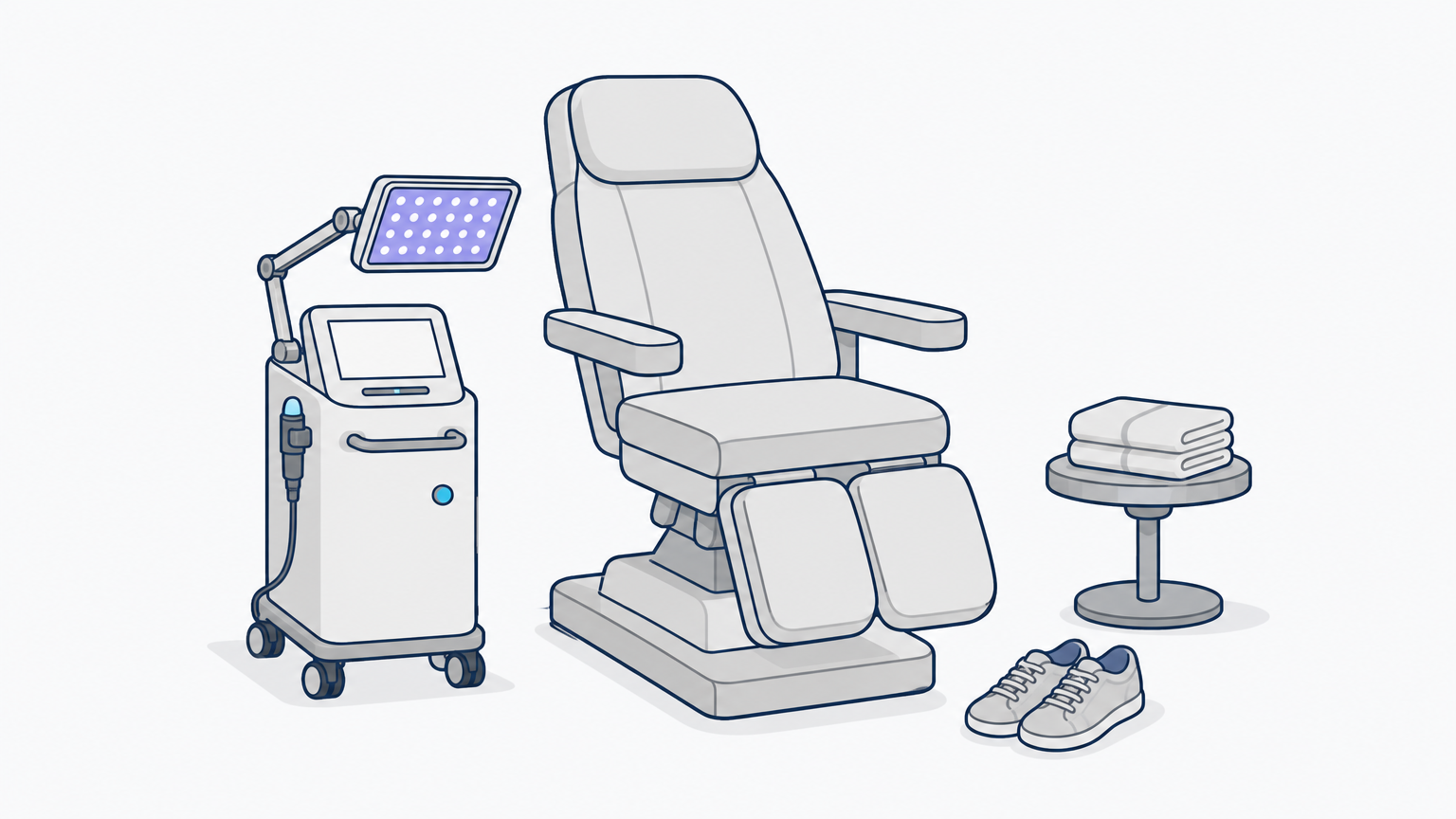
A session is 12 minutes of painless light, with no downtime afterwards.
Your treatment timeline
Your podiatrist sets the number of sessions from the severity of the infection and how your nails respond. Most plans run 4 to 8 sessions, one week apart. The table shows what to expect over time.
| Stage | What you can expect |
|---|---|
| Weeks 1 to 8 | 4 to 8 weekly sessions of about 12 minutes |
| 4 to 6 weeks after you start | New clear nail growth appears at the base of the nail |
| 9 to 12 months | The nail grows out in full and the damaged nail leaves |
The old, damaged part of the nail does not turn clear. It grows forward and you trim it away. Judge your progress by the new growth at the base, not by the tip.
What fungal nail laser treatment costs
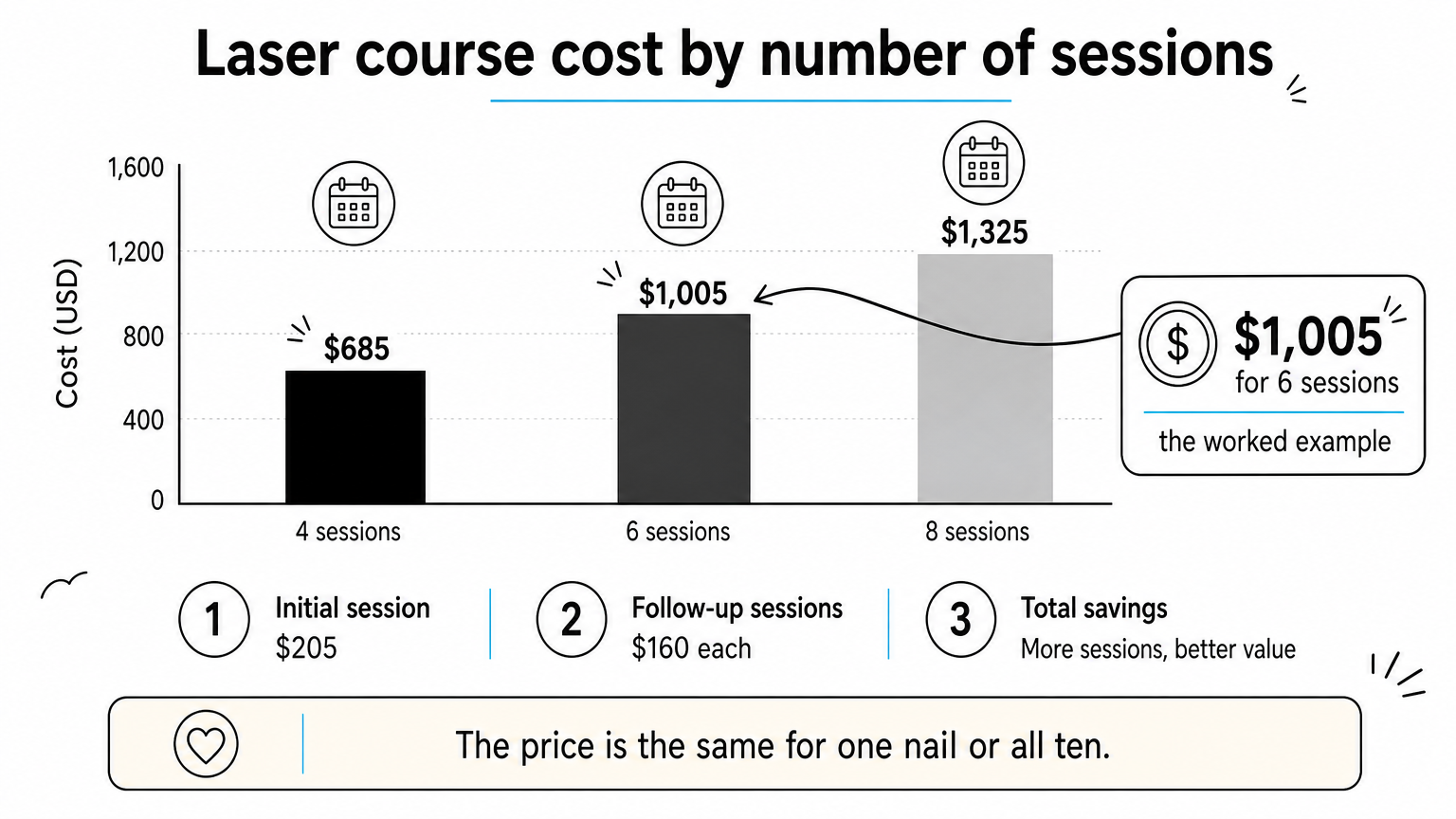
You pay $205 for the initial session and $160 for each follow-up session, so a full course of 4 to 8 sessions costs $685 to $1,325. The number of sessions sets your total. The number of nails does not.
Price per session and a worked example
The initial session includes nail preparation for the laser. The price is the same whether you treat one nail or all ten. Here is how the total builds up.
| Sessions in your plan | Working | Total |
|---|---|---|
| 4 | $205 + 3 × $160 | $685 |
| 6 | $205 + 5 × $160 | $1,005 |
| 8 | $205 + 7 × $160 | $1,325 |
Take a typical case. Your big toenail and the next toenail are infected, and your podiatrist plans 6 sessions. You pay $205 for the first visit and $160 for each of the other five. That comes to $1,005 over six weeks. If the plan covered all ten toenails, the figure would stay the same.
ModPod Podiatry lists a new patient consult at $135 and an existing patient consult at $120. Ask the team when you book how your first visit is set up, so you know your full cost before you arrive.
Medicare, health funds and payment options
Medicare does not cover laser treatment for fungal nails. ModPod Podiatry does not bulk bill. You get a receipt, or you claim on the spot with HICAPS if your private health fund covers podiatry. Rebates vary with your level of cover, so check your extras limit. The health fund codes are F004 for the initial session and F014 for follow-ups, which your fund can use to tell you the rebate.
You can pay by EFTPOS or credit card. ModPod Podiatry also accepts Afterpay, which splits the cost into 4 instalments. The first fortnightly payment comes from your debit card on the day of your visit, so have the funds ready. Pensioners can ask about reduced fees.
The cost depends on how many sessions you need, not on how many nails you treat.
How well laser treatment for nail fungus works
ModPod Podiatry reports a success rate of 75 to 90 percent with the Lunula laser. That is a strong result, and it also means some nails do not clear. Your outcome depends on the infection and on how you look after your feet.
What the success rate means
The Lunula laser has FDA clearance for treating onychomycosis. That is a US regulatory status. It shows the device passed a review for this use, and it is not a promise about your nail. A rate of 75 to 90 percent means most people see the infection clear, and a smaller group needs more time or a different approach.
Nail fungus is hard to treat with any method. Toenails grow slowly, so a full answer takes months. Be wary of any clinic that promises a cure in a set time or guarantees a result for every nail.
What shapes your result
Several factors change how your nails respond:
- How severe the infection is when you start
- How thick the nail is and how long you have had the problem
- Whether you finish all the planned sessions
- Whether you treat athlete’s foot and care for your shoes and socks
ModPod Podiatry treats mild, moderate and severe infections. A severe case may take more sessions, and the plan can change as your nails respond.
How to check your progress
New clear nail growth shows at the base of the nail from about 4 to 6 weeks. Take a photo of the nail each month in the same light. Compare the clear band at the base and look for any spread of colour.
Judge your result by the new nail at the base, because the old nail will not turn clear.
Call your podiatrist if the nail becomes painful, red or swollen, or if you see discharge. Those signs point to something other than fungus alone. A full nail takes 9 to 12 months to grow out, so patience is part of the plan.
How to keep nail fungus from coming back
You lower the chance of reinfection by keeping your feet dry, treating athlete’s foot, and caring for shoes and tools. Laser clears the infection, but the fungus lives in damp places and spreads easily. Good habits protect your new nail as it grows.
Daily habits that protect the new nail
Follow these steps while the nail grows out:
- Dry your feet well after a shower, especially between the toes
- Change your socks daily and after exercise
- Choose socks that wick moisture
- Rotate your shoes so each pair dries between wears
- Wear thongs in public showers, pools and change rooms
- Cut your nails straight across and keep them short
Sweaty feet in closed shoes give fungus the damp it likes. If your feet sweat a lot, ask your podiatrist for advice.
Treat the source and the tools
Athlete’s foot, called tinea, is a fungal skin infection that spreads to nails. Treat any rash or peeling between your toes at the same time. Do not share nail clippers, files or towels. Keep your own tools clean.
Book a review if the fungus returns or if a second nail shows changes. Early treatment is quicker and easier than waiting until the whole nail is thick.
Treat the skin as well as the nail, because athlete’s foot feeds the next nail infection.
Your next step
Nail fungus laser treatment uses a painless cold laser, 4 to 8 weekly sessions of about 12 minutes, and a full nail grows out over 9 to 12 months. The cost depends on sessions, from $685 for 4 to $1,325 for 8. Medicare does not cover it, and health fund rebates vary.
You do not need a referral, and treatment can start at your first visit. Pick the clinic that fits your week, and keep your feet dry as the nail grows. When you are ready, book your fungal nail laser appointment online at the ModPod Podiatry clinic nearest you.