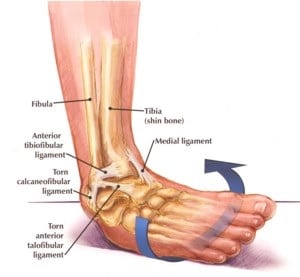
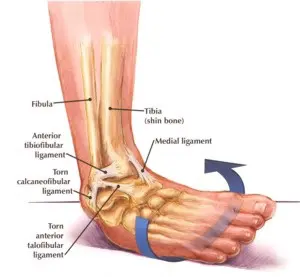
Your ankles are highly complex joints that are kept safely in place by their ligaments. Ligaments are strong, stretchy bands of connective tissue, which is mostly made up of collagen. Torn ligaments in the ankle are one of the more serious ankle injuries managed by our Sydney podiatrists. Since connective tissue has a low vascularisation and as a result doesn’t get much blood flow, torn ankle ligaments can take a long time to heal.
Ankle ligaments become injured when they are stretched beyond their normal range. This usually occurs after your ankle twists inward or outward suddenly, generating a sprained ankle. Stepping or jumping over an uneven surface can also sprain your ankle. We see torn ankle ligament injuries regularly at our ModPod Podiatry clinics across Sydney, including Dee Why, Mosman, and the CBD.
Sprained ankles can range from very mild injuries to severe trauma, in which there are torn ligaments in the ankle. Torn ankle ligaments can be partial or complete, and depending on their severity, they can require surgical treatment.
Types of Torn Ankle Ligaments
There is some degree of ligament damage in all ankle sprains, but they can be classified in three grades depending on how serious the injury is.
Grade I: ankle ligaments become partially stretched, and only micro-tears appear on the tissue.
Grade II: these injuries cause a partial tear in one of the ankle’s ligaments. They are also characterised by an abnormal degree of laxity in the ligaments.
Grade III: these are the worst possible ankle sprains. These injuries involve a completely torn ligament in the ankle. The avulsion of the ligament and/or ankle fractures can also occur. These injuries are very severe and usually require surgical treatment.
Treatment for Torn Ankle Ligaments in Sydney
The treatment for torn ligaments in ankle sprains can vary greatly depending on the severity of the injury. After the initial trauma, it’s always a good idea to apply ice and compression to the ankle while you make your way to the doctor. A podiatrist will order the necessary imaging tests to determine the grade of your sprain, the exact location of the ligament tears, and the type of treatment you will need to follow.
Almost all ankle sprains can be treated without surgery with a combination of rest, immobilisation, rehabilitation exercises and orthotics. However, fully torn ligaments in ankle sprains tend to require surgery.
Ankle Ligament Reconstruction (ALR) is one of the most common procedures used to treat torn ligaments in your ankle. In some cases, your doctor will perform an arthroscopy first to inspect the joint and pinpoint the exact location of the injury. The ALR itself is a relatively simple procedure that will help your ankle become stable again, and it is typically an outpatient procedure.
After the ALR, your ankle will need to be in a cast for a few weeks. Following this period, your podiatrist will refer you to a physiotherapist to begin a physical rehabilitation programme. Want to learn more about ankle ligament anatomy then read on.
Frequently Asked Questions
How do I know if I have torn a ligament in my ankle?
Common signs of a torn ankle ligament include significant swelling, severe bruising, intense pain, and feelings of instability in the ankle joint. You may also find it very difficult or impossible to bear weight. A clinical examination and imaging (ultrasound or MRI) are typically required to confirm torn ligaments. Our Sydney podiatrists at ModPod can organise appropriate investigation and management.
Can a torn ankle ligament heal without surgery?
Yes. The majority of torn ankle ligaments — including many Grade III tears — can heal successfully without surgery with appropriate conservative treatment. This includes rest, bracing, rehabilitation exercises, and orthotics. Surgery is generally reserved for cases that fail conservative management or where chronic instability develops. Our Sydney podiatrists can advise on the best approach for your injury.
How long does it take for a torn ankle ligament to heal?
Grade I and II ligament injuries typically heal within two to eight weeks with appropriate management. A completely torn (Grade III) ankle ligament may take three to six months or longer, particularly if surgery is required. Our experienced Sydney podiatry team will give you a realistic timeline based on your specific injury.
What is ankle ligament reconstruction surgery?
Ankle Ligament Reconstruction (ALR) is a surgical procedure that repairs or tightens damaged ankle ligaments to restore joint stability. It is often performed as a day surgery (outpatient) procedure. After surgery, a period of immobilisation is followed by physiotherapy rehabilitation. Our podiatrists at ModPod in Sydney work closely with surgeons to support your pre- and post-surgical care.
Can orthotics help with torn ankle ligaments?
Custom foot orthotics can provide additional ankle support during rehabilitation from torn ligaments, and can address any underlying biomechanical factors that may have contributed to the injury. Our Sydney podiatrists at ModPod Podiatry are experienced in orthotic prescription for ankle ligament injuries.
Should I use an ankle brace after tearing ankle ligaments?
Yes. An ankle brace or support is commonly recommended during the rehabilitation phase following a torn ankle ligament to provide stability and reduce the risk of re-injury. Your Sydney podiatrist will advise on the most appropriate type of brace for your situation.
Does ModPod Podiatry treat torn ankle ligaments across Sydney?
Yes. Our experienced podiatrists see patients with torn ankle ligaments at clinics in Dee Why, Mosman, Rose Bay, North Ryde, and the Sydney CBD (Hunter Street). Book online or call us on (02) 9960 3981.
Book an Appointment for Torn Ankle Ligaments with Our Sydney Podiatrists
Torn ankle ligaments require proper assessment and management to heal well and avoid long-term instability. The caring, expert team at ModPod Podiatry is here to help. With clinics across Sydney in Dee Why, Mosman, Rose Bay, North Ryde, and the CBD, top-quality ankle care is always within reach. Book online today or call (02) 9960 3981.
That sharp, aching pain along your shinbone after a run isn’t something you should push through. Shin splints (medial tibial stress syndrome) usually show up