
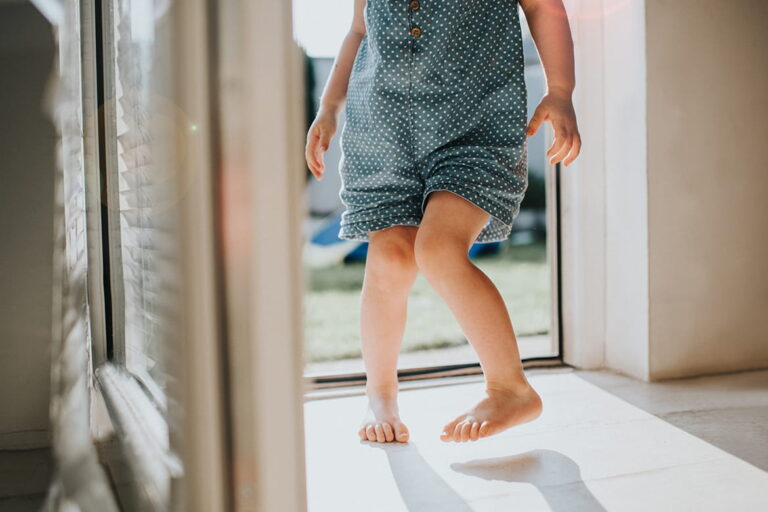
If your child stands with their knees touching but their ankles apart, they have knock knees. The medical term is genu valgum, and it’s one of the most common reasons parents visit a podiatrist about their child’s legs.
The good news: knock knees are a normal part of leg development in young children. Most kids grow out of them without any treatment. But in some cases, knock knees persist, cause pain, or signal an underlying problem that needs attention.
This guide explains what’s normal, what’s not, and when to get your child assessed.
What Are Knock Knees?
Knock knees describe a leg alignment where the knees angle inward and touch each other while the ankles stay apart. When your child stands with their knees together, you’ll see a gap between their ankles.
A small degree of knock knee alignment is normal in adults too — most people have a slight inward angle at the knee. In children, though, this angle can look dramatic, and that’s what brings parents in for a check.
Genu valgum affects both legs in most children. When it appears on one side only, or when the angle is much larger on one side, that warrants a closer look.
The Normal Leg Alignment Timeline
Children’s leg alignment follows a predictable pattern as they grow. Understanding this timeline helps you know whether your child’s knock knees fit the normal range.
Birth to 18 months: Most babies are bowlegged. Their legs curve outward at the knees. This is normal and results from their position in the womb.
18 months to 2 years: The legs straighten as the child starts walking and bearing weight.
Ages 2 to 4: The pendulum swings the other way. The knees drift inward, and knock knees develop. This peaks around age 3 to 4, when the inward angle can look quite pronounced.
Ages 5 to 7: The legs gradually straighten again toward the adult alignment — a slight inward angle of about 5 to 7 degrees.
This bowlegs-to-knock-knees-to-straight sequence is driven by normal bone growth and weight-bearing forces. It happens without any treatment in the vast majority of children.
When Knock Knees Are a Concern
While most knock knees resolve on their own, certain signs suggest your child may need professional assessment. Watch for these red flags:
The angle is severe. If the gap between your child’s ankles is more than 8 to 10 centimetres when their knees are touching, the degree of genu valgum is beyond the typical range.
It’s getting worse after age 4. Knock knees should start improving after age 4. If the angle is increasing rather than decreasing, something else may be at play.
It persists past age 7 or 8. By this age, most children’s legs have straightened. Persistent knock knees in older children may need treatment to prevent joint stress during the teenage growth spurt and beyond.
It’s asymmetric. When one leg angles inward much more than the other, the cause may be localised — a previous injury, a growth plate issue, or a structural difference that needs investigation.
Your child has pain. Knock knees in the normal developmental range shouldn’t hurt. Knee pain, thigh pain, or pain around the ankles during activity is a reason to get assessed.
Your child trips or falls often. Significant knock knees can change the way a child walks and runs. Frequent tripping, clumsiness, or reluctance to join in physical activity may be related to their leg alignment.
In rare cases, knock knees can be caused by rickets (vitamin D deficiency), metabolic bone conditions, or previous fractures near the growth plate. Your podiatrist or GP can help rule these out.
The Flat Feet Connection
Here’s something many parents don’t realise: flat feet and knock knees are closely linked. In many children, the feet are driving the knee position — not the other way around.
When a child has flat feet, their arches collapse inward. This causes the ankles to roll inward (overpronation). That inward roll at the ankle creates a chain reaction up the leg — the shin bone rotates inward, which pushes the knee into a more knock-kneed position.
You can see this clearly when you watch a child with flat feet walk from behind. The ankles lean in, the lower legs angle inward, and the knees follow.
This is why treating the feet can improve the knee alignment. When you control the overpronation at the foot and ankle, you reduce the inward force that’s pushing the knees together. It doesn’t work in every case — some knock knees are purely skeletal — but for many children, addressing flat feet makes a measurable difference to their leg alignment.
If your child has both flat feet and knock knees, a podiatrist can determine whether the two are connected and whether treating the feet will help the knees.
How a Podiatrist Assesses Knock Knees
A thorough assessment looks at the whole picture — not just the knees. At ModPod Podiatry, we use a structured approach to work out what’s driving your child’s alignment and whether treatment is needed.
Standing alignment check: We measure the intermalleolar distance — the gap between the ankle bones when the knees are touching. This gives us an objective number to track over time.
Digital video analysis: We record your child walking and running, then review the footage in slow motion. This reveals how their feet, ankles, knees, and hips move during real activity. It’s far more useful than a static standing check alone.
Foot and ankle assessment: We check arch height, ankle position, joint range of motion, and muscle strength. This tells us whether overpronation is contributing to the knock knee position.
Footwear review: Worn-out or poorly fitting shoes can make overpronation worse. We check your child’s current shoes for wear patterns and support.
Growth and development history: We ask about milestones, activity levels, any pain, and family history. Some alignment patterns run in families.
For most children, this assessment is quick and painless. We can usually tell you on the day whether your child’s knock knees fall within the normal range or need intervention.
Treatment Options
Treatment depends on the cause, the severity, and your child’s age. Here’s what we typically recommend:
Monitoring
For children under 5 with mild to moderate knock knees and no pain, the best approach is often to watch and wait. We’ll measure the intermalleolar distance and reassess every 6 to 12 months to make sure the alignment is improving as expected.
Orthotics
When overpronation is driving the knock knee position, custom orthotics can help. Orthotics sit inside your child’s shoes and control the foot and ankle position. By reducing the inward roll at the ankle, they reduce the inward force at the knee.
Orthotics don’t change bone structure. What they do is improve the alignment of the foot during walking and running, which takes stress off the knees and allows the legs to function in a straighter position. For children whose knock knees are biomechanical rather than skeletal, this can make a real difference.
Exercises and Strengthening
Targeted exercises can support better alignment. We often prescribe exercises that strengthen the hip abductors (the muscles on the outside of the hip) and the gluteal muscles. These muscles help control the inward drift of the knee during walking and running.
For younger children, we keep exercises simple and play-based. For older kids and teenagers, a more structured program works well.
Footwear Changes
Good shoes support good alignment. We recommend shoes with a firm heel counter, a flexible forefoot, and enough room for orthotics if needed. Flat, floppy shoes or worn-out runners can make overpronation worse, which in turn worsens the knee angle.
Referral
In rare cases — severe knock knees, asymmetric alignment, or suspected metabolic or skeletal conditions — we refer to a paediatric orthopaedic surgeon for further investigation. Surgery is uncommon and reserved for cases that don’t respond to conservative management.
For most children, a combination of monitoring, orthotics, and exercises is enough to guide their legs toward healthy alignment as they grow.
When to Book an Appointment
If your child’s knock knees worry you, a quick assessment can give you clarity. It’s worth booking a children’s podiatry appointment if:
• Your child is over 4 and the knock knees aren’t improving
• The ankle gap is large or seems to be getting wider
• One leg is more affected than the other
• Your child has pain in their knees, legs, or feet
• Your child trips frequently or avoids physical activity
• Your child also has flat feet
At ModPod Podiatry, our children’s podiatry team sees kids with knock knees every week. We have 5 clinics across Sydney — in the CBD, Mosman, Dee Why, Rose Bay, and North Ryde — so there’s a location close to you.
Book a children’s podiatry appointment at ModPod and get a clear answer about your child’s leg alignment.