
Natural home remedies for nail fungus can help a mild infection, but the research is small and few remedies clear an established one. Vicks VapoRub and tea tree oil have the most support and suit a patch of yellow at the nail tip. An essential-oil blend with oregano suits you if you can keep a 12-month routine. Vinegar soaks and garlic have the weakest backing, so use them as extras.
You have a thick, yellow or crumbling nail and want to treat it without a prescription. That makes sense. The fungus lives under the nail plate, and creams and oils struggle to reach it. This guide lists five remedies from most to least supported. Each entry shows what the evidence says, how to use the remedy and what risks to watch. A final section tells you when to stop and see a podiatrist.
ModPod Podiatry has treated feet in Sydney for over 20 years, and fungal nails are part of that work. We want you to try a safe remedy if it fits, and to know when it has run its course.
1. Vicks VapoRub
What the evidence says
Vicks VapoRub has the best human data of any home remedy for toenail fungus, and that data is modest. The ointment contains camphor, eucalyptus oil and menthol, which fight fungus in lab tests. A small human study found it helped some people. A 2022 review of natural treatments reported improvement in many cases, and some people cleared the infection after regular use. Most had no side effects.
The trials were small and short, so read the results as a good sign, not proof. VapoRub suits you if one or two nails have a mild infection and you have no diabetes or immune condition. It costs little, and you can buy it at any pharmacy or supermarket.
Vicks VapoRub is cheap, simple and has some human data, which makes it the first remedy to try.
How to use it
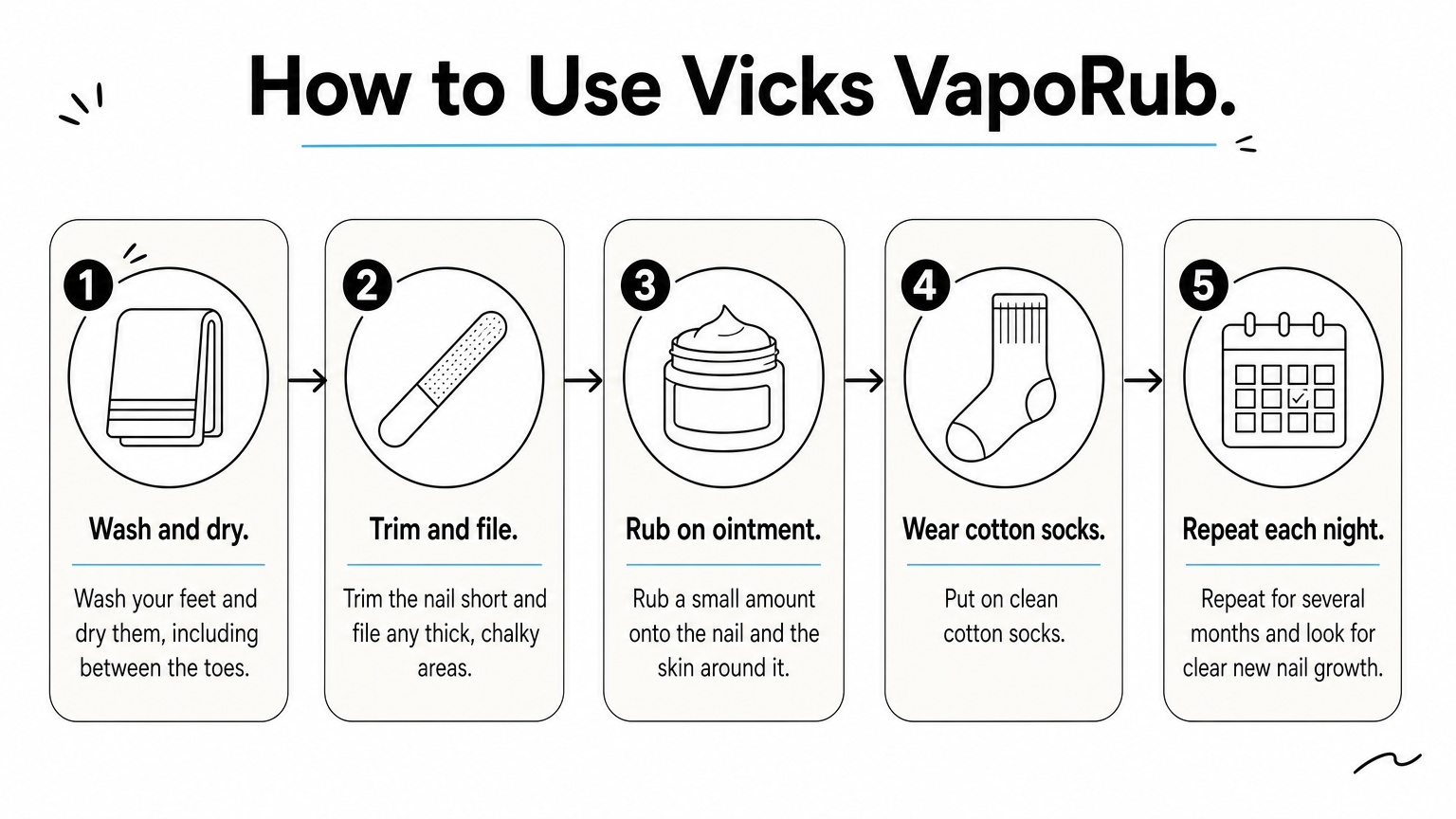
Apply a thin layer once a day. Do it at night, so cotton socks can hold the ointment in place.
- Wash your feet and dry them, including between the toes.
- Trim the nail short and file any thick, chalky areas.
- Rub a small amount onto the nail and the skin around it.
- Put on clean cotton socks.
- Repeat each night for several months. Judge the result by clear new nail growing from the base.
2. Tea tree oil
What the evidence says
Tea tree oil comes from the leaves of an Australian tree and has antiseptic and antifungal effects in the lab. The US National Center for Complementary and Integrative Health says small clinical studies suggest it may help against toenail fungus. Researchers have not run enough trials to say it works, so the result is mixed.
Some people react to the oil with skin irritation or an allergy. Test a drop on a small patch of skin first. Tea tree oil suits you if you want a plant-based option for a mild infection and your skin tolerates it. Do not swallow it, because it is toxic when swallowed.
Tea tree oil may help a mild infection, but no trial proves that it clears one.
How to use it
Use a cotton swab to apply a thin layer to the nail twice a day. Twice a day for a year means about 730 applications. Build it into your day, such as after your morning shower and before bed.
- Test one drop on your inner forearm and wait 24 hours before you use it on the nail.
- Clean and dry the nail, then swab the nail and its edges.
- Let the oil dry before you put on socks.
- Use a fresh swab each time, so you do not spread fungus to other nails.
- Stop if you see redness, pain or swelling.
3. Oregano oil and essential-oil blends
What the evidence says
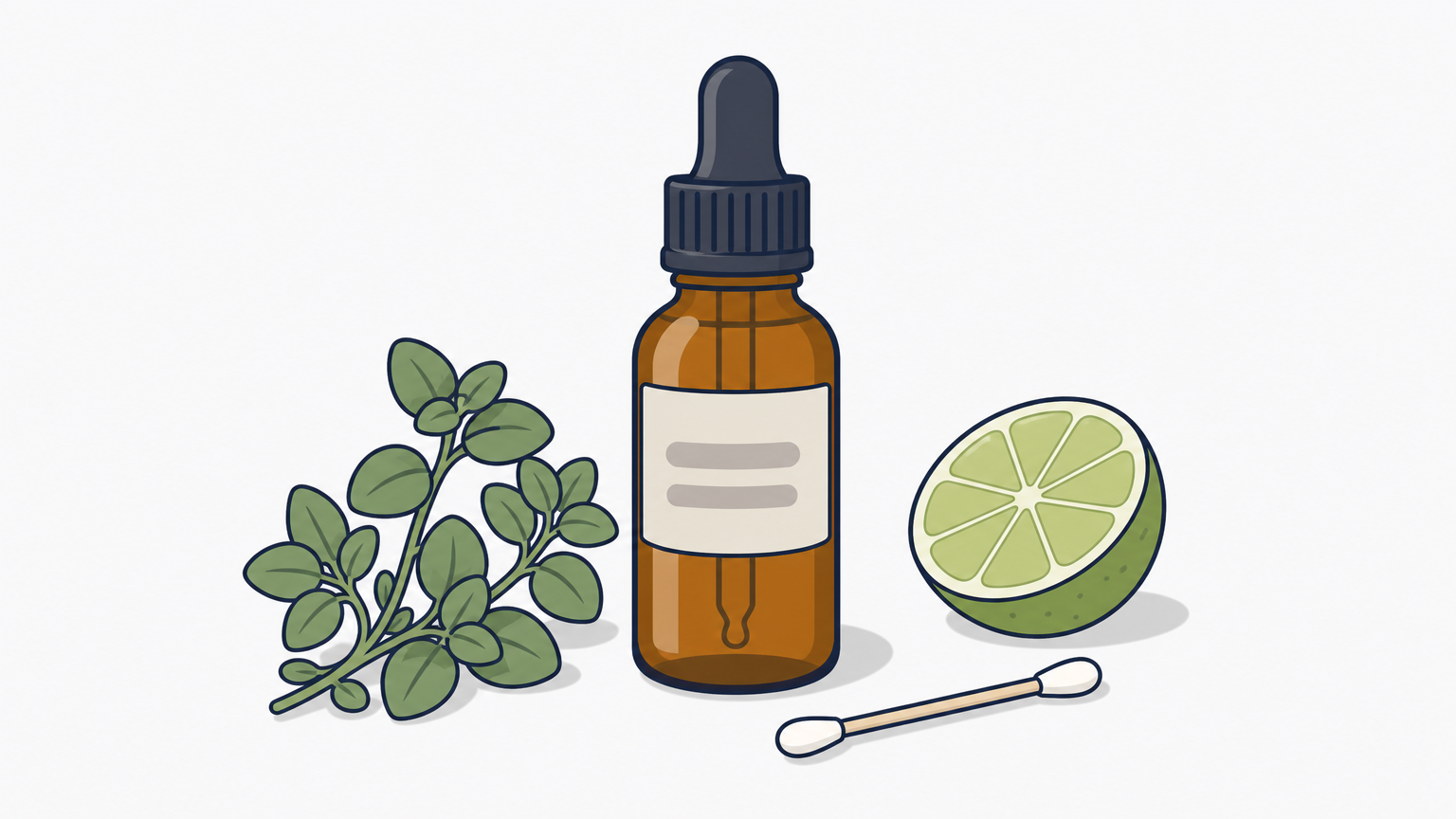
Oregano oil has antifungal properties in lab tests, and the best result for natural oils comes from a blend. In a 2019 open study of 20 people with mild to moderate infection, a nail oil with vitamin E and tea tree, oregano and lime essential oils improved the nails of most people over 12 months. The oil was safe to use.
The study had no control group, and the blend was a made product, not a home mix. Oils this strong can irritate skin, and mixing two raises the risk. Choose this remedy if your infection is mild to moderate and you can stay with it for a year. Pick a ready-made nail oil over a home mix, because the maker sets the strength.
The best result for natural oils came from a tested blend used for 12 months, not from a drop now and then.
How to use it
Apply oregano oil or a ready-made blend to the nail twice a day with a cotton swab. Follow the label on a ready-made product.
- Patch test on your skin before the first use.
- Apply to the nail and the skin at its edge.
- Do not layer oregano oil and tea tree oil yourself. Combining them raises the chance of irritation.
- Stop if the skin burns, swells or blisters.
- Keep the routine for the full 12 months, and check the base of the nail for clear growth.
4. Apple cider vinegar soak
What the evidence says
Apple cider vinegar slows microbe growth in lab dishes, but no strong trial shows that it clears nail fungus. Its acidity and plant compounds act on microbes in a dish. Studies on vinegar soaks suggest they may help when you pair them with a topical treatment. Clinical studies have not shown that it works alone.
A vinegar soak suits you if you want a low-cost extra beside another treatment. Skip it if your skin is cracked or broken, because the acid stings.
Treat vinegar as a support act for another treatment, not as a cure.
How to use it
Mix equal parts apple cider vinegar and warm water in a basin. Soak your feet for up to 30 minutes.
- Pour equal parts vinegar and warm water into a basin.
- Soak the feet for up to 30 minutes.
- Dry your feet well, including between the toes. Damp skin helps fungus grow.
- Apply your other nail treatment to the dry nail.
- Stop the soaks if your skin turns red or dry.
5. Garlic
What the evidence says
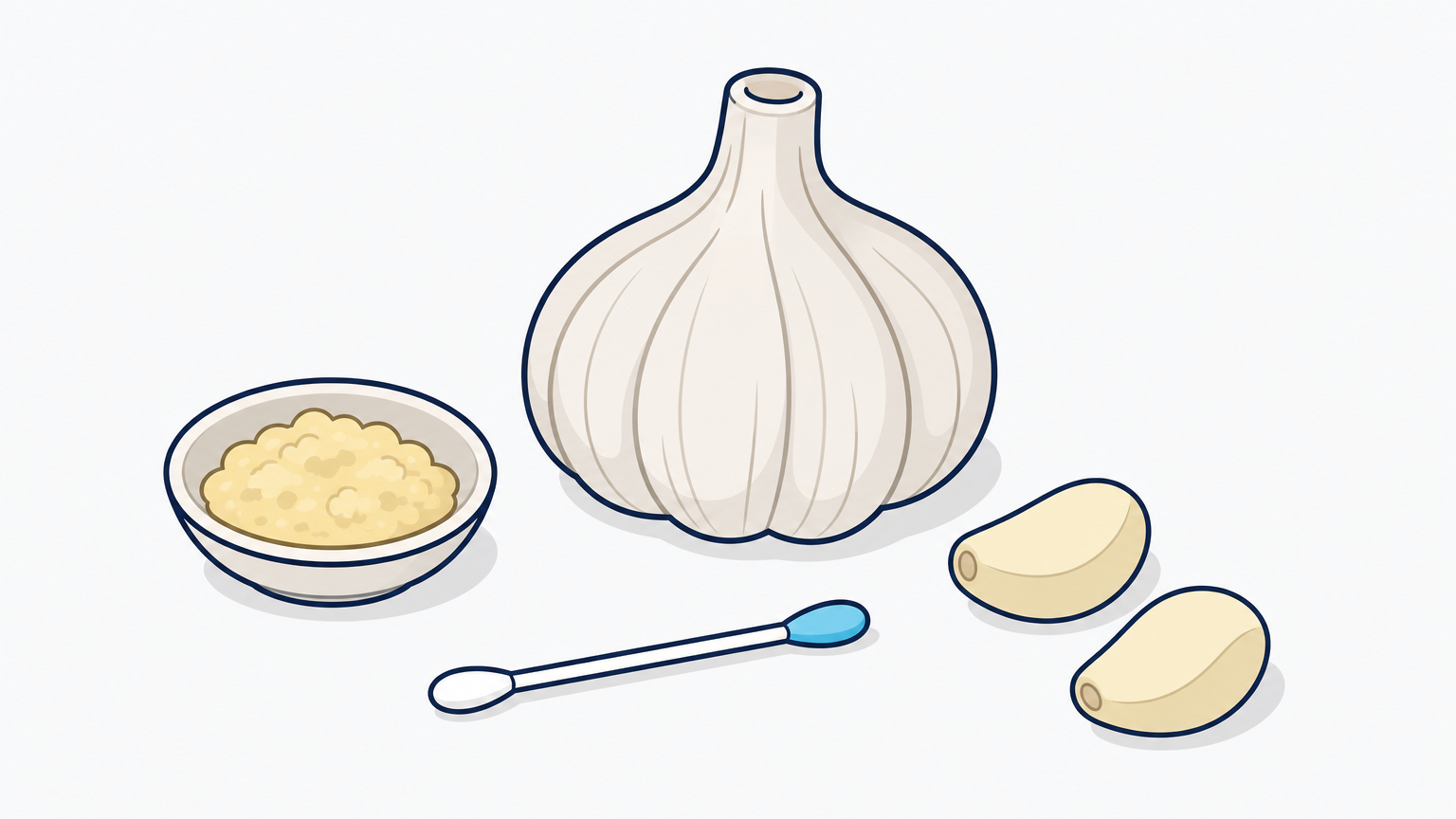
Garlic shows antifungal action in the lab. A 2019 study found that garlic extract may help against the yeasts that infect nails. Another study found a garlic extract can help beside other antifungal treatments. Researchers say more work is needed before anyone can call it a treatment.
Garlic suits you if you want a kitchen remedy for a mild infection and accept that it is a weak option. Raw garlic can burn the skin, so check the area during each use.
Rely on garlic as an extra, not as a plan.
How to use it
Crush a clove into a paste and apply it to the nail for 30 minutes a day. A garlic extract oil is another form that you can rub into the nail.
- Wash and dry the nail first.
- Spread the paste on the nail only, and keep it off broken skin.
- Check the skin after 10 minutes. Rinse the paste off at once if it stings or burns.
- Rinse after 30 minutes and dry the foot well.
When natural remedies are not enough
What natural remedies can and cannot do
Natural remedies work best on mild, early fungus at the tip of one or two nails. They struggle when the infection sits under a thick nail or spreads to the base, because oils and ointments cannot reach it. A toenail takes 12 to 18 months to grow out, so a clear nail needs that long if the remedy works. Judge progress by the new, clear nail growing from the cuticle, not by the old tip.
| Remedy | How you use it | Strength of evidence | Main risk |
|---|---|---|---|
| Vicks VapoRub | Once a day, with cotton socks | Small human studies | Skin irritation |
| Tea tree oil | Twice a day, with a cotton swab | Small studies, mixed results | Irritation or allergy |
| Oregano oil blend | Twice a day, for 12 months | One small open study | Irritation, higher when you combine oils |
| Apple cider vinegar soak | Up to 30 minutes in a soak | Lab data, weak clinical data | Dry or stung skin |
| Garlic paste | 30 minutes a day | Lab data | Skin burns |
Fingernail fungus follows the same rules, with one change. Yeast is a more common cause in fingernails than in toenails, so the cause can differ. Keep your hands dry, wear cotton-lined gloves for wet work, and ask your GP about a fingernail that does not improve. Podiatrists treat feet.
Signs you need a podiatrist
Book an assessment when any of these apply:
- You have diabetes, poor circulation or a weak immune system. Talk to a doctor before you use any home remedy.
- The nail shows no clear new growth after about three months of steady use.
- The nail thickens, lifts or hurts in your shoes.
- The skin around the nail turns red, swollen or sore, or you see pus or smell an odour.
- A dark streak appears on the nail and you did not injure it.
- You are unsure that fungus is the cause. Psoriasis, injury and a separated nail can look the same.
If the nail shows no clear new growth after three months, book an assessment instead of buying another remedy.
What a podiatrist can do
At ModPod Podiatry, a podiatrist diagnoses a fungal nail by looking at it. You need no clippings or lab tests, and treatment starts the same day. You do not need a GP referral.
One option is the Lunula cold laser. The treatment is painless, takes about 12 minutes and has no downtime. A course runs over several sessions, and your podiatrist sets the number. The first session costs $205 and includes nail preparation. Each follow-up costs $160. If your private health cover includes podiatry, you can claim on the spot with HICAPS. Our clinics are in Sydney CBD, Mosman, Dee Why and Rose Bay.
Your next step with nail fungus
Five remedies have some support for nail fungus: Vicks VapoRub, tea tree oil, oregano blends, vinegar soaks and garlic. None has strong proof. All work best on mild infections that you treat for months. Pick one, apply it on schedule, test your skin first and watch for clear nail growing from the base. Stop if your skin reacts, and see a doctor first if you have diabetes or a weak immune system.
If the nail is thick, painful or unchanged after about three months, the home routine has done what it can. A podiatrist can confirm the cause and start treatment on the day you visit. You can book an appointment online at any of our four Sydney clinics.