
If you walk with your toes pointing outwards, or you’ve noticed it in your child, you’ve probably typed orthotics for duck feet into Google looking for a straightforward answer. Out-toeing, the clinical term for duck feet, is common, and plenty of people online claim that the right insole will straighten your gait for good. Before you buy anything, it helps to know what orthotics can actually change and what they can’t.
The honest answer is that orthotics can support and manage duck feet, particularly when the cause sits in the foot or lower limb rather than the hip. They won’t rotate your bones back into alignment, but they can reduce pain, improve foot function, and take pressure off joints that are compensating for the altered walking pattern. Whether they help you depends heavily on what’s driving your out-toeing in the first place.
In this guide, we’ll unpack what causes duck feet, when custom orthotics genuinely make a difference, and what other treatment options are worth considering alongside them. We’ll also cover what a proper podiatric assessment looks like, so you know what to expect before committing to any device.
Why out-toeing is worth addressing
Duck feet often gets dismissed as a harmless quirk, something a child will simply grow out of or an adult has always had. That dismissal is where the trouble starts. Out-toeing changes how weight moves through your foot with every step, and over months and years that altered loading pattern can drag other joints into the problem. It’s rarely just a foot issue by the time someone books an appointment. It’s a knee that clicks, a hip that aches after long walks, or an arch that’s flattened under the strain of compensating.
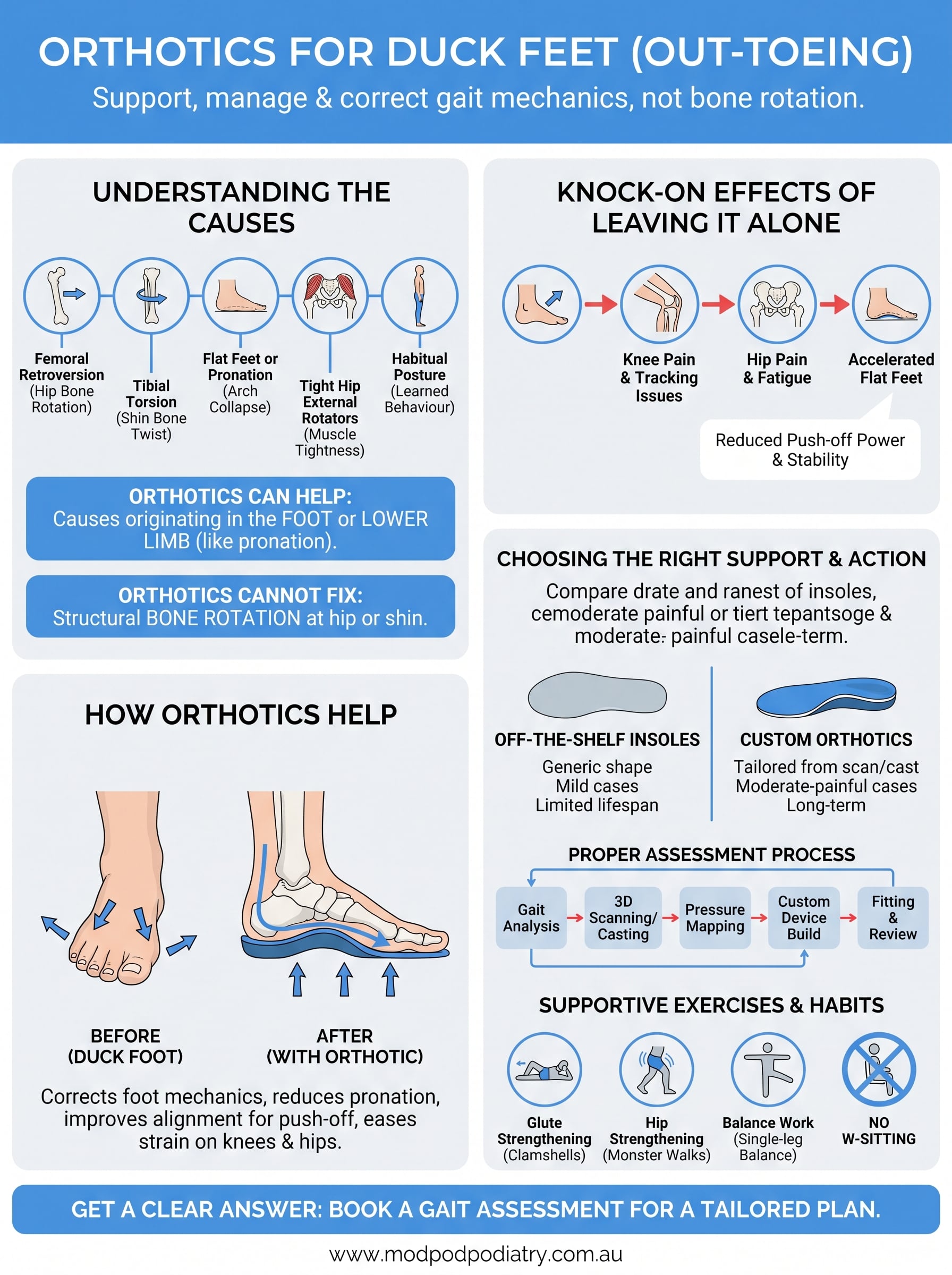
What typically causes duck feet
Understanding the cause matters because it tells you what orthotics can realistically fix. Out-toeing can originate almost anywhere along the leg, and the source changes the treatment plan completely.
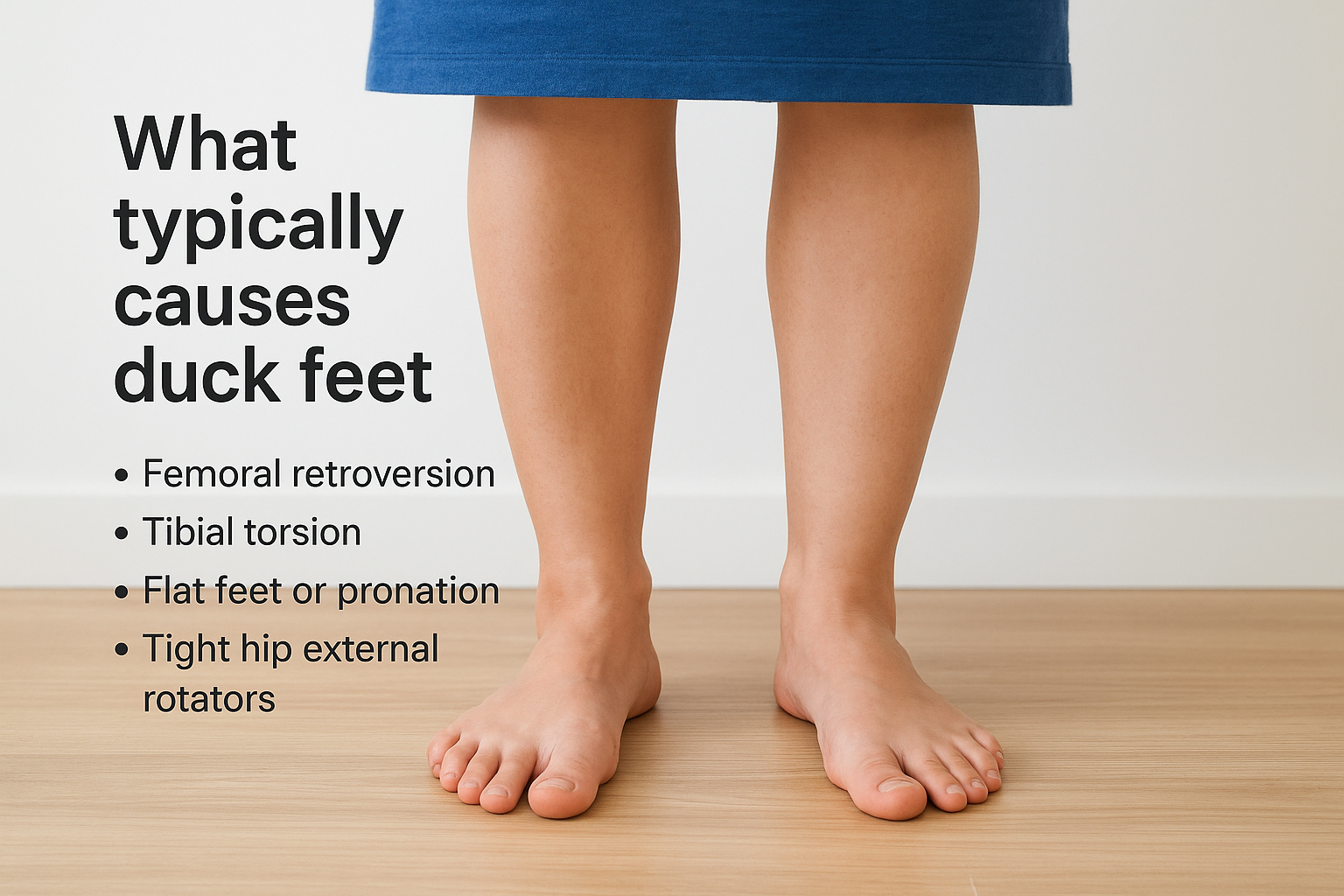
- Femoral retroversion: the thigh bone sits rotated outward at the hip, common in toddlers and often self-corrects
- Tibial torsion: the shin bone twists outward below the knee, sometimes persisting into adulthood
- Flat feet or pronation: the arch collapses inward, forcing the foot to rotate out to find stability
- Tight hip external rotators: muscular tightness pulls the leg into an outward-facing position
- Habitual posture: some people simply learn to stand and walk this way over years, without any structural cause
Only some of these respond to orthotics. If the rotation sits in the hip or shin bone, no insole will change the angle of the bone itself. If it’s coming from the foot, an orthotic has a genuine job to do.
Duck feet is rarely just one problem. It’s usually a chain reaction that starts at the hip or foot and ends up at the knee.
The knock-on effects of leaving it alone
Pain is usually what brings people through the door, but it’s rarely the first sign. Reduced push-off power during walking and running often shows up before any discomfort does, because an out-toed foot can’t drive forward efficiently. Runners frequently notice they tire faster or feel unstable on uneven ground long before they’d describe themselves as being in pain.
Secondary issues build from there. Excess strain on the inner ankle and arch can accelerate fallen arches and flat feet. The knee cap can start tracking incorrectly, which shows up as anterior knee pain in active adults and teenagers alike. In children, a persistent out-toeing gait can affect balance and coordination during sport, sometimes leading to a reluctance to participate that has nothing to do with fitness and everything to do with an awkward, tiring stride.
When it’s worth getting assessed
Not every case needs intervention. A toddler with mild out-toeing and no pain is usually fine to monitor. But certain signs point to booking a proper podiatric gait assessment rather than waiting it out:
- One foot turns out noticeably more than the other
- Pain in the foot, ankle, knee or hip during or after activity
- Visible flattening of the arch alongside the outward rotation
- A child avoiding running or sport without an obvious reason
- The gait has stayed the same or worsened past age seven or eight
Getting it looked at early doesn’t just settle your curiosity. It gives you an actual diagnosis instead of a guess, which matters enormously when you’re deciding whether orthotics belong in the plan at all.
How orthotics help correct a duck-footed gait
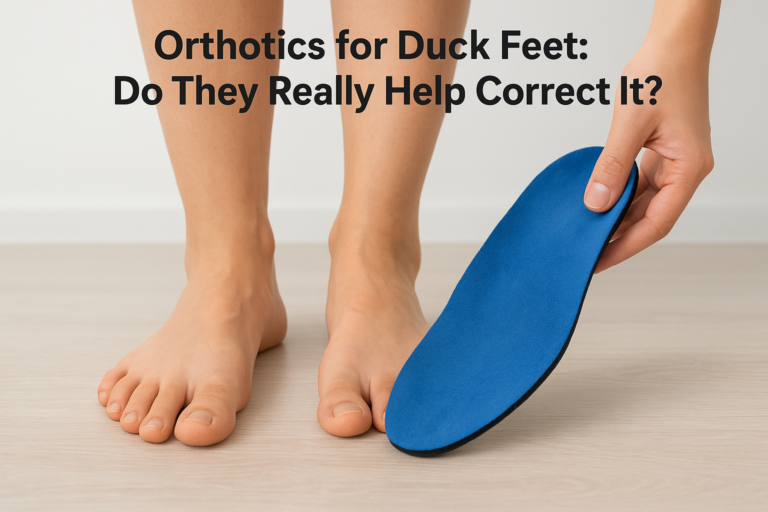
Once a podiatrist has worked out where your out-toeing actually comes from, the real value of orthotics for duck feet becomes clear. They don’t reshape bones, but they do change how force travels through your foot with every step, which is often enough to unwind a chain of compensation that’s been building for years. A well-made device sits under the arch and heel to guide the foot into a more neutral position, reducing the rotational drift that pulls the whole limb outward.
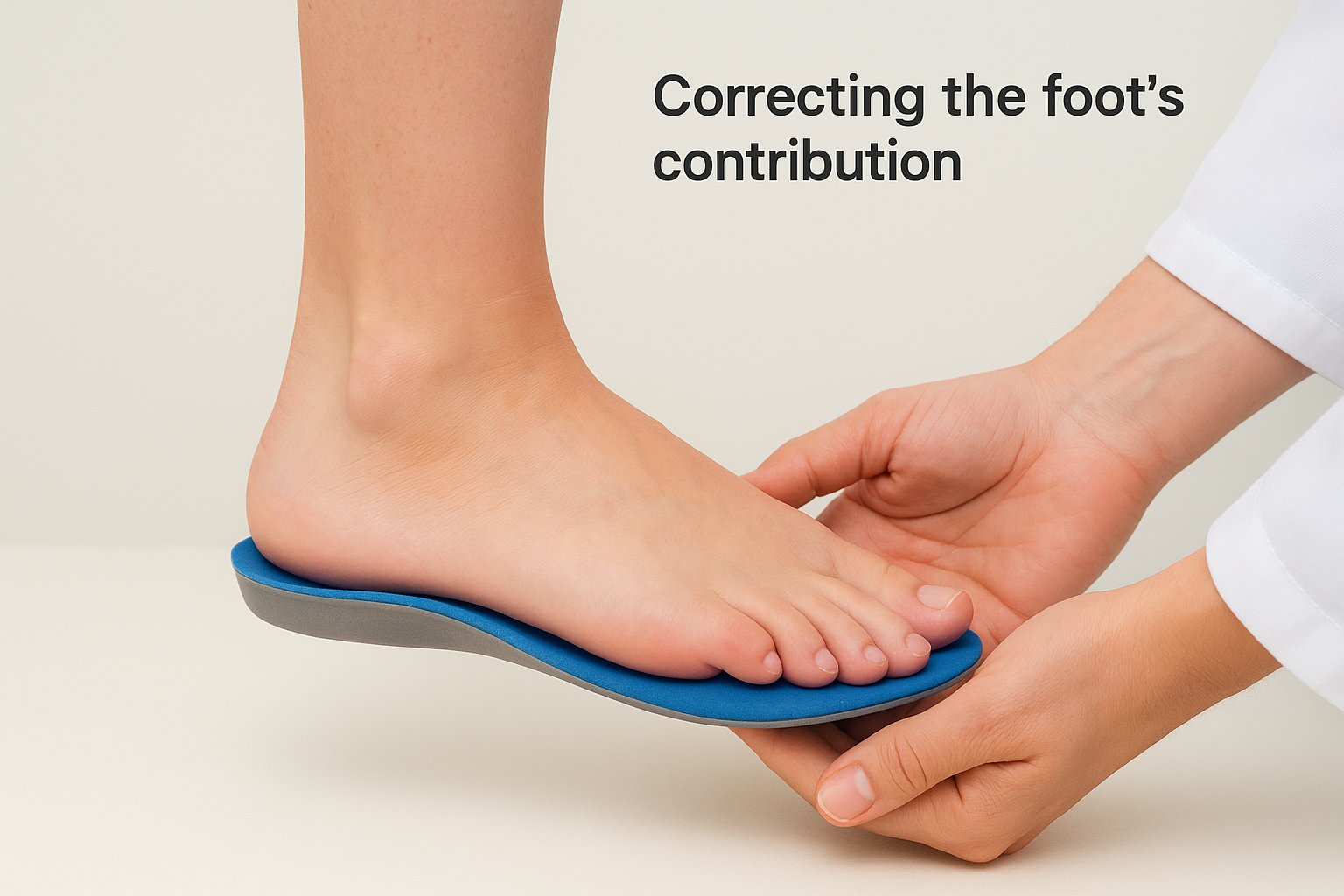
Correcting the foot’s contribution
When pronation or a collapsed arch is feeding the out-toeing, a custom orthotic gives the foot something firm to push against instead of rolling inward and rotating out to compensate. This changes the mechanics of the entire gait cycle, not just the foot itself.
- Reduces excess pronation, so the foot doesn’t need to rotate outward for stability
- Improves push-off power by aligning the foot before the toe-off phase
- Distributes pressure more evenly across the sole, easing strain on the inner ankle
- Supports the arch through activity, lowering fatigue during longer walks or runs
An orthotic can’t turn a bone, but it can stop the foot from rotating to make up for one.
Easing the strain further up the chain
Beyond the foot itself, orthotics take pressure off the joints that have been quietly absorbing the consequences of an altered stride. Knees that track poorly because of foot rotation often settle once the foot underneath them stops compensating. Hips that ache after standing all day can also benefit, since a stable foot base reduces the constant small adjustments the hip makes to keep you balanced.
Parents often ask whether this means orthotics will fix a child’s out-toeing for good, just as they do with the opposite pattern, pigeon toes in children. Realistically, they manage the symptoms and mechanics rather than reversing a bony rotation at the hip or shin. That said, when a out-toeing gait is driven mainly by foot posture, plenty of children and adults see real, lasting improvement in how they walk and how their legs feel afterwards. Our podiatrists build each device around the specific findings from your gait analysis, rather than handing out a generic insole and hoping it fits the problem.
Choosing the right orthotics for duck feet
Not every insole marketed online will do anything for out-toeing, and picking the wrong one can waste months. The difference between a generic insole and a properly built device comes down to how well it matches the specific way your foot moves, not just how it feels underfoot in the shop.
Off-the-shelf versus custom orthotics
Over-the-counter insoles can ease mild discomfort, but they’re built to a generic shape rather than your foot’s actual pressure pattern. Custom orthotics are moulded or scanned from your own foot and adjusted for the exact degree of pronation or rotation showing up in your gait.
| Feature | Off-the-shelf insoles | Custom orthotics |
|---|---|---|
| Fit | Generic shape, limited sizing | Built from your foot’s own scan |
| Correction level | Mild cushioning or arch support | Targeted control of pronation and rotation |
| Best suited for | Very mild, non-progressive cases | Moderate to noticeable out-toeing with pain or fatigue |
| Lifespan | 6 to 12 months | Several years with adjustments |
| Cost | Lower upfront | Higher upfront, often HICAPS-eligible |
A generic insole cushions the symptom. A custom device is built to correct the actual mechanics causing it.
What a proper fitting should involve
A good fitting process rules out guesswork. 3D scanning of your feet and pressure plate analysis show exactly where load concentrates through your stance and swing phases, which tells the podiatrist how much correction the device needs and where.
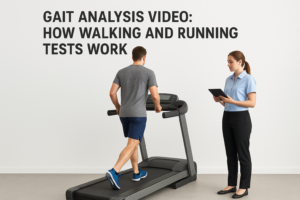
- A full gait assessment, walking and ideally running if you’re active
- Pressure mapping to see where your foot loads unevenly
- A 3D scan or cast to build the orthotic shell to your exact foot shape
- A fitting review a few weeks in, since the bedding-in period matters
- Adjustments if the correction feels too aggressive or too mild
Explaining your history matters too. Mention whether the out-toeing started young, whether it’s worsened, and whether pain shows up in a specific joint. That detail changes how firm or flexible the device needs to be. If you’re unsure where to start, our team walks you through the process during a custom orthotics consultation, using the same scanning and pressure analysis described above rather than a one-size-fits-all mould.
Exercises and habits that support your orthotics
Orthotics do the mechanical work, but they work best alongside exercises that address the muscles pulling your leg outward in the first place. Out-toeing driven by tight hip external rotators or weak glutes won’t fully settle with an insole alone, because the device manages the foot while the muscle imbalance above it keeps feeding the pattern. Pairing the two gives you a far better shot at a lasting change than either approach on its own.
Strengthening what’s pulling you out of alignment
Targeted hip and glute strengthening retrains the muscles that control leg rotation during walking and running. A physiotherapist or podiatrist can tailor these to your specific findings, but the basics that most people benefit from include:
- Clamshells: build glute medius strength to control hip rotation
- Monster walks with a resistance band: reinforce a straighter leg path during gait
- Single-leg balance work: improves control through the stance phase, where out-toeing often shows up most
- Hip flexor and rotator stretches: loosen tightness that pulls the leg into an outward-facing position
Orthotics manage the foot. Strength work retrains the muscles that put it in that position to begin with.
Habits worth building into daily life
Beyond structured exercises, small daily habits reinforce the correction your orthotics are working towards. Walking barefoot on firm, flat ground for short stretches at home helps you notice and self-correct foot position without relying entirely on the device. Sitting posture matters too, especially for kids who spend hours in the classic "W-sit" position, which tightens the hip rotators and worsens out-toeing over time. Swapping that for cross-legged sitting removes a habit that actively works against everything the orthotic is trying to fix.
Consistency beats intensity here. A ten-minute strength routine done most days outperforms an intense session once a fortnight, particularly for children whose bones and joints are still developing. For adults managing a long-standing out-toeing gait, pairing orthotics with even light, regular hip and glute work tends to produce noticeably better results at follow-up assessments than orthotics used in isolation. If you’re not sure which exercises suit your specific gait pattern, that’s exactly the kind of detail worth raising at your fitting, since the wrong exercise for your particular cause can do very little or, occasionally, work against the correction altogether.
Getting the right support for your feet
Orthotics won’t rotate a bone back into place, but for the right cause, they genuinely change how your foot loads and how the rest of your leg copes with each step. Duck feet deserves a proper look rather than a guess bought online, because the wrong device treats the wrong problem and wastes months you didn’t need to lose. Pair a well-fitted orthotic with targeted strength work and you’ve got a plan that addresses both the mechanics and the muscles driving them.
If you’ve noticed out-toeing in yourself or your child and want a clear answer instead of another forum thread, book a gait assessment with one of our podiatrists. We’ll scan your feet, map your pressure pattern, and build a plan around what’s actually happening in your stride. Start by booking an assessment at a clinic near you.