
You’ve noticed a firm lump in the arch of your foot, and it’s not going away. Maybe it’s tender when you stand for long periods, or maybe you only feel it when you press on it directly. Either way, you want to know what’s causing it, and whether it’s something to worry about. Understanding plantar fibroma causes is the first step to working out what to do next.
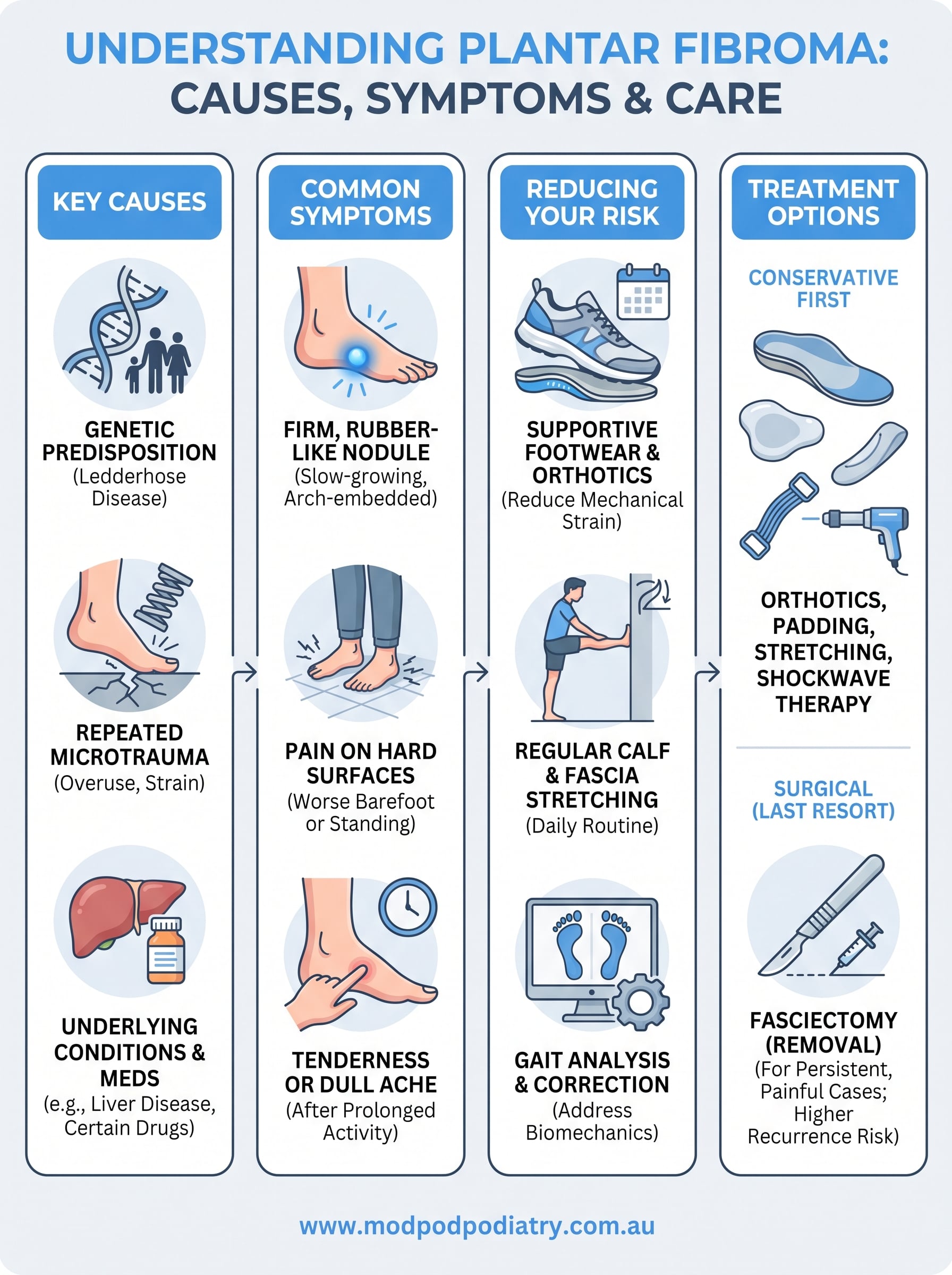
A plantar fibroma is a benign growth of fibrous tissue in the plantar fascia, the thick band running along the sole of your foot. Nobody knows the exact trigger in every case, but genetic predisposition, repeated microtrauma, and certain underlying health conditions all play a role in why this tissue thickens and forms a nodule.
In this article, we’ll walk through the main causes behind plantar fibromas, the symptoms that typically accompany them, and how our podiatrists at ModPod diagnose and treat this condition across our Sydney clinics. If you’re dealing with a persistent lump or unexplained arch pain, this guide will help you understand what’s happening and what your treatment options look like.
Why the cause of your plantar fibroma matters
Knowing what’s behind your lump changes how you and your podiatrist approach treatment. A fibroma caused by a genetic tendency towards thickened connective tissue behaves differently to one caused by repeated mechanical stress from years of running or standing on hard floors. Get the plantar fibroma causes right, and you can target the actual driver rather than just chasing the symptom.
Genetic predisposition and Ledderhose disease
Some people are simply more prone to fibrous tissue overgrowth. This condition, sometimes called Ledderhose disease, tends to run in families and is linked to the same collagen abnormality seen in Dupuytren’s contracture of the hand. If a parent or sibling has had plantar fibromas, your own risk climbs noticeably. This genetic thread also explains why fibromas often appear in both feet at once, and why they can multiply over time rather than staying as a single isolated nodule.
A lump caused by genetics rarely disappears with rest alone, which is exactly why an accurate diagnosis matters more than guesswork.
Repeated microtrauma to the plantar fascia
Other cases trace back to mechanical overuse. Every step you take puts tension through the plantar fascia, and repetitive strain, tight calf muscles, or an abnormal gait pattern can cause tiny tears in that fibrous band. As your body repairs these microtears, scar tissue sometimes builds up faster than it should, forming a nodule. Runners, people in physically demanding jobs, and those who’ve had a previous foot injury are more likely to develop fibromas through this pathway.
Underlying health conditions and medications
A smaller group of cases link back to broader health issues. Chronic liver disease, epilepsy medications such as phenytoin, and long-term alcohol use have all been associated with plantar fibroma development, likely because they affect how the body produces and regulates collagen. Diabetes and thyroid disorders can also alter tissue healing in ways that make fibrous overgrowth more likely.
| Cause category | Typical trigger | Why it matters for treatment |
|---|---|---|
| Genetic (Ledderhose disease) | Family history of fibrous tissue disorders | Higher recurrence risk, may affect both feet |
| Mechanical microtrauma | Repetitive strain, tight calf, poor gait | Orthotics and biomechanical correction often help |
| Medical/medication-related | Liver disease, epilepsy drugs, diabetes | May need coordination with your GP |
Working out which category applies to you shapes everything from your conservative treatment options to how closely we monitor for recurrence after any procedure. It also helps set realistic expectations. A fibroma driven by genetics may need ongoing management rather than a one-off fix, while a mechanically caused nodule often responds well once the underlying strain pattern is corrected. Rather than treating every lump the same way, your podiatrist will look at your history, your gait, and sometimes your broader health picture before recommending a plan that actually addresses what’s causing the tissue to thicken in the first place.
How to reduce your risk of developing a plantar fibroma
You can’t rewrite your genes, but you can influence the mechanical side of the equation, and that’s where most practical prevention happens. Reducing strain on the plantar fascia lowers the chance of the microtrauma that leads to fibrous nodules, even if it won’t eliminate risk for someone with a strong genetic predisposition.
Footwear and biomechanics matter most
Supportive, well-fitted shoes reduce the repetitive load that damages the plantar fascia over time. Worn-out running shoes, thin-soled flats, and shoes that don’t match your foot type all increase strain with every step, which is where shoe inserts that support the arch can make a difference. Stretching your calves regularly also helps, since tight calf muscles pull on the fascia and increase tension along the arch.
Reducing mechanical strain on the plantar fascia is the one plantar fibroma risk factor you actually have control over.
Practical steps you can start today
Here’s a simple checklist worth building into your routine:
- Replace running or walking shoes every 500 to 800 kilometres
- Stretch your calves and plantar fascia daily, especially before exercise, using simple arch stretches you can do at home
- See a gait analysis podiatrist if you’ve had recurring foot, knee, or hip pain
- Consider podiatrist-prescribed orthotics if you stand or walk for long periods at work
- Manage body weight, since extra load increases fascia tension
- Treat any liver, thyroid, or metabolic condition under your doctor’s guidance
Orthotics deserve a specific mention because they address the mechanical driver directly. Rather than masking discomfort, a properly fitted device redistributes pressure away from the areas doing the most work, which is exactly the kind of repetitive stress linked to fibroma formation. If you’re unsure whether your gait is contributing to a lump you’ve noticed, our team’s custom orthotic service starts with 3D scanning and pressure plate analysis, so you get a picture of what’s actually happening under your feet rather than a guess.
Managing underlying health conditions rounds out the prevention picture. Working with your GP on liver function, blood sugar, or medication side effects addresses the biological contributors that footwear changes alone can’t touch.
Symptoms that often accompany a plantar fibroma
Spotting a fibroma early comes down to knowing what to look for beyond the lump itself. Most people notice a firm, rubbery nodule embedded in the arch that doesn’t move much when you press on the skin around it, and it’s one of several possible causes of pain in the arch of the foot. It’s not the same as a blister or a hardened callus on the sole, since it sits deeper within the fascia itself rather than on the surface.
The lump itself
Size and feel are the biggest giveaways. A plantar fibroma typically measures anywhere from a pea to a golf ball and grows slowly over months rather than appearing overnight. Some people find they have more than one nodule along the same band, particularly when a genetic pattern like Ledderhose disease is behind the growth.
A slow-growing, firm lump that sits within the arch rather than on top of it is the clearest sign you’re dealing with a plantar fibroma rather than a simple callus.
Pain patterns worth noting
Discomfort varies enormously between patients, and that’s one of the trickier parts of this condition. Some people feel nothing unless they press directly on the nodule, while others get sharp, stabbing pain every time they take a step. Barefoot walking on hard floors, standing for long stretches, or wearing thin-soled shoes tend to make symptoms worse for most patients.
Here’s what patients commonly report:
- A firm nodule that feels fixed to deeper tissue
- Tenderness when barefoot on tiled or wooden floors
- Pain that eases with cushioned shoes and worsens with hard, flat ones
- A dull ache after standing for extended periods
- Occasional tingling if the lump presses on a nearby nerve
Noticing changes over time also matters. If a nodule grows quickly, becomes red, or starts affecting your gait, that’s worth getting checked rather than waiting it out. Left alone, an untreated fibroma can alter how you walk, which then puts extra strain on your knees, hips, and lower back. Getting a proper assessment early means you’re addressing the root plantar fibroma causes before compensation patterns set in elsewhere.
When and how podiatrists treat plantar fibromas
Most plantar fibromas don’t need urgent treatment, but that changes once a lump starts growing, causing daily pain, or affecting how you walk. Your podiatrist begins with a physical exam and often diagnostic imaging, such as ultrasound, to confirm the nodule is fibrous tissue rather than a cyst or other growth. This step matters because it rules out anything more serious and confirms you’re dealing with one of the plantar fibroma causes we’ve covered, rather than a different condition altogether.
Conservative options come first
For most patients, treatment starts without surgery. A podiatrist will typically recommend a combination of the following:
- Custom orthotics to offload pressure from the nodule
- Silicone padding worn inside your shoe
- Stretching routines targeting the plantar fascia and calf
- Corticosteroid injections to shrink inflammation around the lump
- Shockwave treatment for stubborn fascia problems to break down excess fibrous tissue
Surgery is the last resort for a plantar fibroma, not the first conversation your podiatrist should have with you.
These conservative measures work well for many people, particularly when the fibroma stems from mechanical overuse rather than a strong genetic pattern. Patients often see a real reduction in pain within a few weeks of consistent offloading and stretching, even if the lump itself doesn’t fully disappear.
When surgery becomes the right call
Surgical removal, known as a fasciectomy, gets reserved for fibromas that keep growing, resist conservative care, or cause pain severe enough to limit daily activity. Because fibromas can recur after surgery, especially with genetic cases like Ledderhose disease, your podiatrist will usually pair any procedure with ongoing orthotic support afterwards to reduce strain on the healing tissue. Recovery involves a period of reduced weight-bearing, followed by a gradual return to normal footwear. If you’re weighing up whether conservative care or a referral for surgical assessment suits your situation, our sports podiatry team can talk you through what fits your specific case.
Looking after your feet from here
Understanding plantar fibroma causes helps you make sense of that lump instead of just hoping it goes away. Whether your fibroma stems from a genetic tendency, years of mechanical strain, or an underlying health condition, the path forward is the same: get it properly assessed rather than guessing at home remedies. Genetics you can’t change, but strain patterns and footwear choices are within your control, and catching symptoms early keeps a manageable nodule from turning into a bigger biomechanical problem down the track.
Verder, no two feet are identical, which is why a proper assessment beats generic advice every time. Our podiatrists across Sydney CBD, Mosman, Dee Why, Rose Bay, and North Ryde use pressure plate analysis and 3D scanning to work out exactly what’s driving your discomfort before recommending a treatment plan. If you’ve found a lump in your arch, book a podiatry assessment at one of our Sydney clinics and get a clear answer this week rather than living with uncertainty.