
To find the right size, measure your child’s longest toe to heel in centimetres, then match that length to a chart that converts Australian, UK, US and EU sizes. Australian children’s shoe sizes follow the UK scale, US sizes run one number higher, and EU sizes track the length of the shoe. This guide gives you the chart and the steps to use it.
Sizing gets confusing fast. An online shop lists US sizes, an imported pair shows EU numbers, and a box says "2 to 3 years" with no foot length at all. Children’s feet also grow quickly, so a wrong guess costs you. Shoes that are too small cause blisters and cramped toes. Shoes that are too big make a child trip and grip with the toes.
At ModPod Podiatry, our podiatrists assess children’s feet at five Sydney clinics, so we know how much a good fit matters. Below, you will learn how the size systems differ, how to measure at home, how to read the chart, how to check the fit, and when to book an assessment.
Why children’s shoe sizes differ between countries
Each region counts from a different starting point and uses a different step, so the same foot gets a different number in each system. The only fixed value is foot length in centimetres, which is why every step below starts there.
How the four systems compare
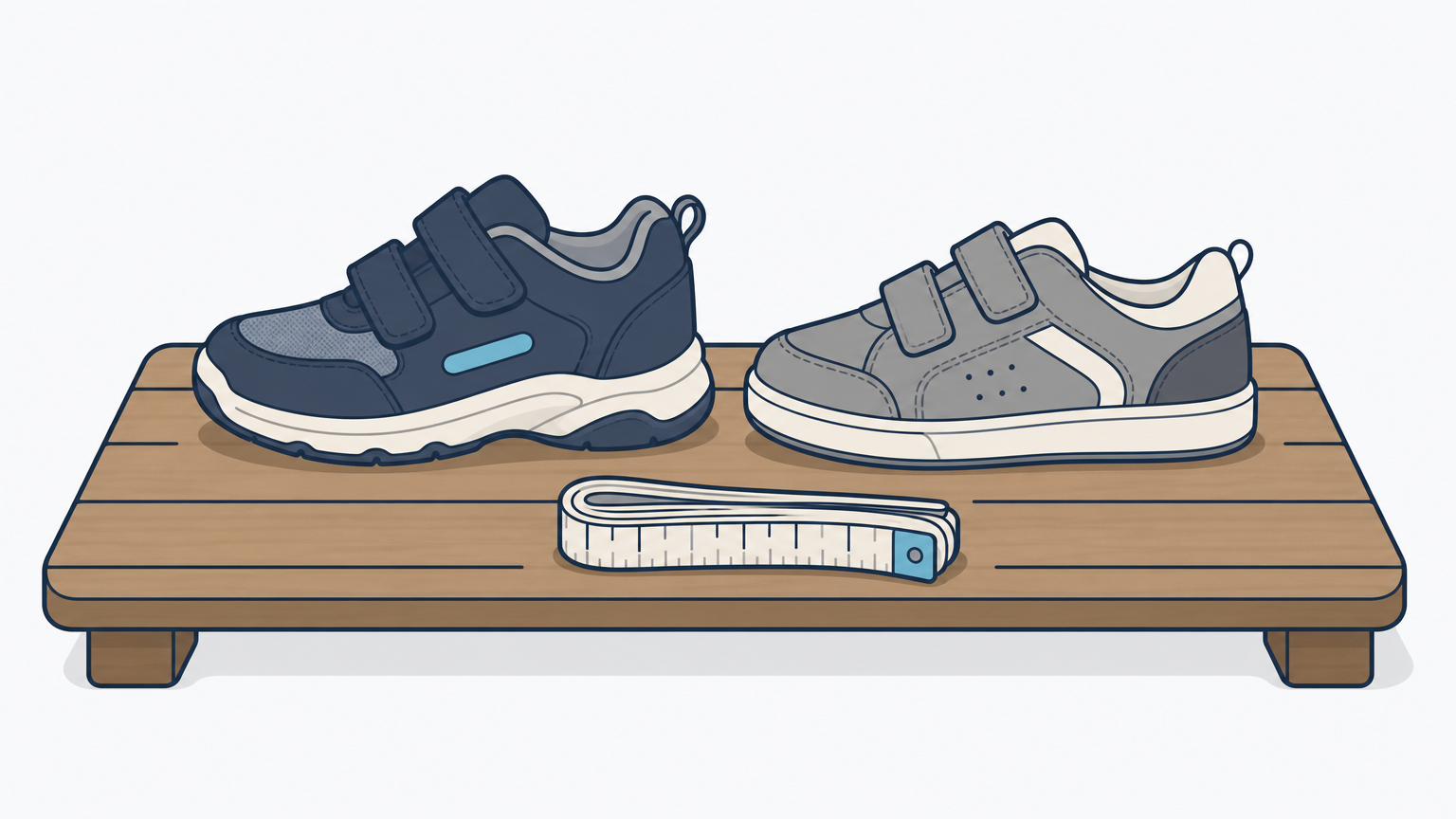
Here is what each system means for a parent shopping in Australia:
- AU and UK: The numbers match. An AU 7 is a UK 7. Each step is about 0.85 cm. Children’s sizes run from 0 to 13, then restart at 1 for youth sizes.
- US: Children’s sizes run one higher than UK and AU. A UK 7 is a US 8. The US count also restarts at 1 after 13.
- EU: Sizes follow the length of the shoe, and each step adds about 0.67 cm. A UK 7 is close to an EU 24.
- Japan and parts of Asia: Many stores list the foot length itself in millimetres or centimetres, so a 145 mm foot is a size 145.
Australian children’s sizes follow the UK scale, and the US adds one.
Why age labels and brand charts mislead
Labels such as "2 to 3 years" are a guess. Two children of the same age can differ by two sizes. Brands also cut shoes on different shapes, so a UK 8 from one maker can fit like a 7.5 from another.
Treat age as a way to browse and foot length as the way to choose. Because sizes restart at 1 after 13, a UK 1 is bigger than a UK 13. Check the number twice before you add a pair to your cart.
Step 1. Measure your child’s foot at home
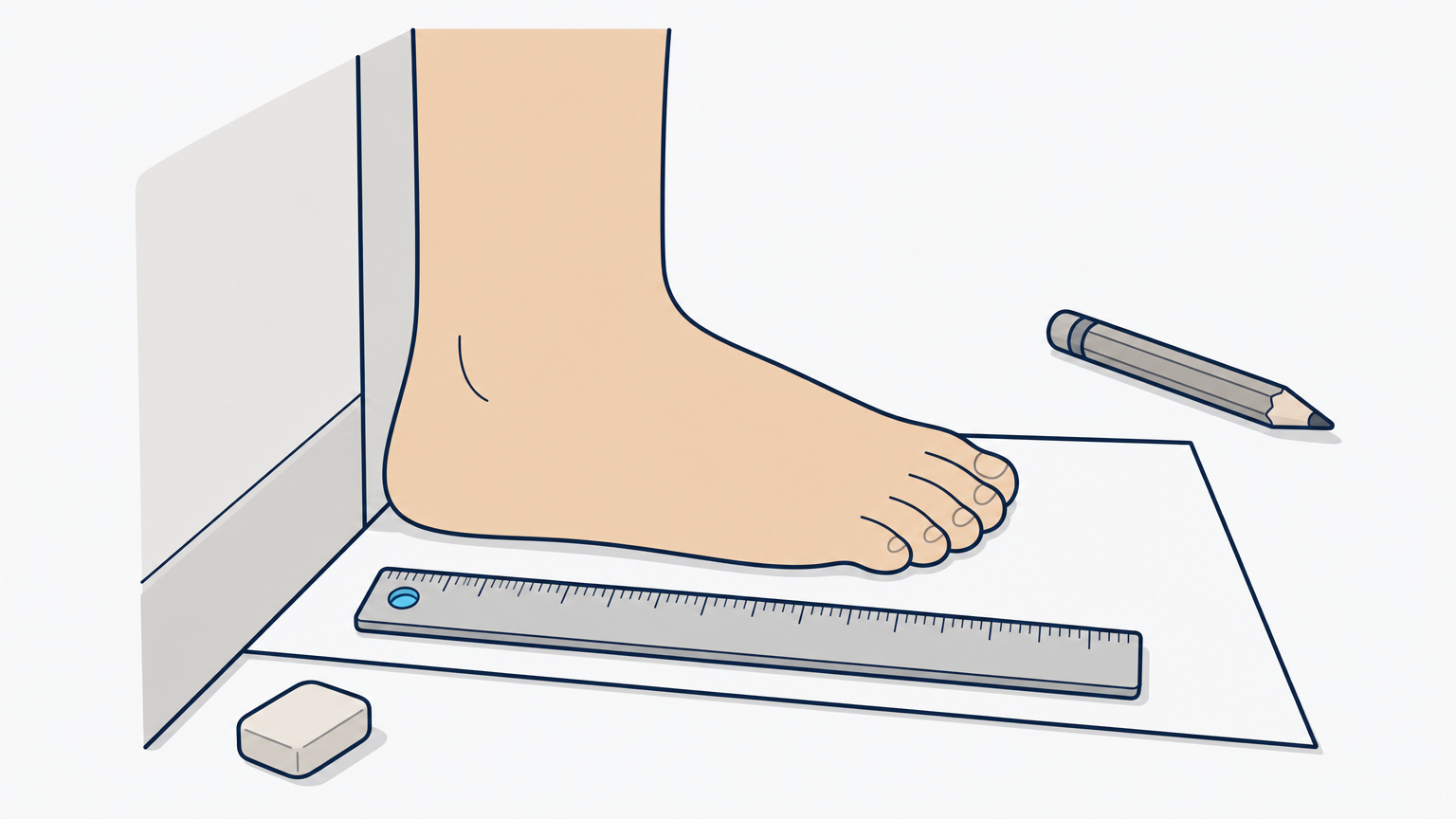
Measure the foot on paper with a ruler, record the length in centimetres, and repeat on the other foot. The job takes five minutes and needs a sheet of paper, a pen and a ruler.
Steps for an accurate measurement
- Measure in the late afternoon or evening, when feet are at their largest.
- Put a sheet of paper on a hard floor with one edge against a wall.
- Have your child stand on the paper, bare feet flat, heel touching the wall.
- Mark the tip of the longest toe. This can be the second toe, not the big toe.
- Measure from the wall to the mark in centimetres. Write it down to the nearest 0.1 cm.
- Repeat with the other foot.
- Measure across the widest part of the foot, near the ball, and note that number too.
Use the longer foot to choose the size. Most children have one foot slightly bigger than the other.
Measure the longer foot in centimetres, and let that one number lead your choice.
Measuring a toddler who will not stand still
Ask a second adult to hold a favourite toy. Trace around each foot with a pen held straight up. A tilted pen makes the outline too big. Then measure from the heel to the longest toe on the outline.
For a child who cannot stand yet, hold the foot flat against the paper with the ankle at a right angle. Take the measurement twice and use the larger result.
Step 2. Convert the measurement with a size chart
Find your child’s foot length in the second column of the chart below, then read across to the AU, UK, US and EU sizes. The chart is a guide. Brands vary by up to one size, so the maker’s own chart wins when the two disagree.
Children’s shoe size chart in cm
| Foot length (cm) | AU/UK | US | EU |
|---|---|---|---|
| 11.0 | 3 | 4 | 19 |
| 12.0 | 4 | 5 | 20 |
| 13.0 | 5 | 6 | 21 |
| 13.5 | 6 | 7 | 23 |
| 14.5 | 7 | 8 | 24 |
| 15.5 | 8 | 9 | 25 |
| 16.0 | 9 | 10 | 26 |
| 17.0 | 10 | 11 | 28 |
| 18.0 | 11 | 12 | 29 |
| 18.5 | 12 | 13 | 30 |
| 19.5 | 13 | 1 | 31 |
| 20.5 | 1 | 2 | 33 |
| 21.0 | 2 | 3 | 34 |
| 22.0 | 3 | 4 | 35 |
The foot lengths are bare-foot measurements. The sizes already include normal toe room, so do not add extra length to your reading.
Two worked examples
Your child’s longer foot measures 14.2 cm. That sits between 13.5 cm (AU/UK 6) and 14.5 cm (AU/UK 7). Pick the larger row: AU/UK 7, US 8, EU 24.
A second child measures 17.4 cm. That falls between 17.0 cm and 18.0 cm, so choose AU/UK 11, US 12, EU 29.
If a store lists only US sizes, subtract one to get the AU size, up to US 13. After that, US 1 equals AU 13, US 2 equals AU 1, and so on.
When a foot falls between two rows, choose the larger size.
Step 3. Check the fit before you buy
Once you have a size, test the shoe on your child’s foot while they stand. A good fit leaves about a thumb’s width in front of the longest toe, which is 1 cm, and holds the heel snug.
The in-shoe fit test
Run through this list with both shoes on:
- Toe room: Press down at the front. You should feel 1 to 1.4 cm between the longest toe and the end of the shoe.
- Heel: It should sit firm and lift only a little when your child walks.
- Width: The shoe should not squeeze the ball of the foot or leave a bulge at the sides.
- Fastening: Velcro or laces should hold the midfoot in place so the foot cannot slide forward.
- Flex: The shoe should bend at the ball of the foot, where the toes join.
Have your child walk across the shop floor. Watch for limping, toe gripping or a child who tugs at the shoe.
A good fit leaves a thumb’s width in front of the longest toe and a snug heel.
Why a bigger shoe does not help
Parents often buy a size or two up so the shoes last longer. A shoe that is too big lets the foot slide, and the toes curl to hold on. It also raises the chance of tripping and heel blisters.
Buy one size at a time and re-measure when the fit gets tight. A well-fitted pair that lasts three months does more good than a loose pair that lasts six.
Step 4. Re-check the size and know when to get advice
Re-measure every two to three months for toddlers and pre-schoolers, and every three to four months for school-age children. Check sooner if you see red marks, blisters or a child who pulls shoes off.
Signs a shoe no longer fits
Look at the foot after your child takes the shoes off. Red marks on the toes or heel mean the shoe is too tight. Socks with worn toes can mean the toes press on the end of the shoe. A child who suddenly dislikes a favourite pair is often telling you the fit has changed.
When a podiatrist can help
A correct size does not solve every foot problem. Book an assessment if your child has any of these:
- Heel pain after sport or play
- Walking on tiptoes
- Toes that turn inward
- Frequent tripping or uneven shoe wear
- Flat feet that cause pain or tiredness
- An ingrown toenail
Our podiatrists treat these concerns in children from first steps through to the teenage years. You do not need a GP referral. Our clinics are in Sydney CBD, Mosman, Rose Bay, Dee Why and North Ryde.
Pain, tiredness or an odd walk in your child is worth a professional look, whatever the shoe size says.
Getting the size right every time
Measure the longer foot in centimetres, find the row on the chart, choose the larger size if the foot falls between two, and check the fit with your thumb. Repeat every few months, because children’s feet change faster than most parents expect.
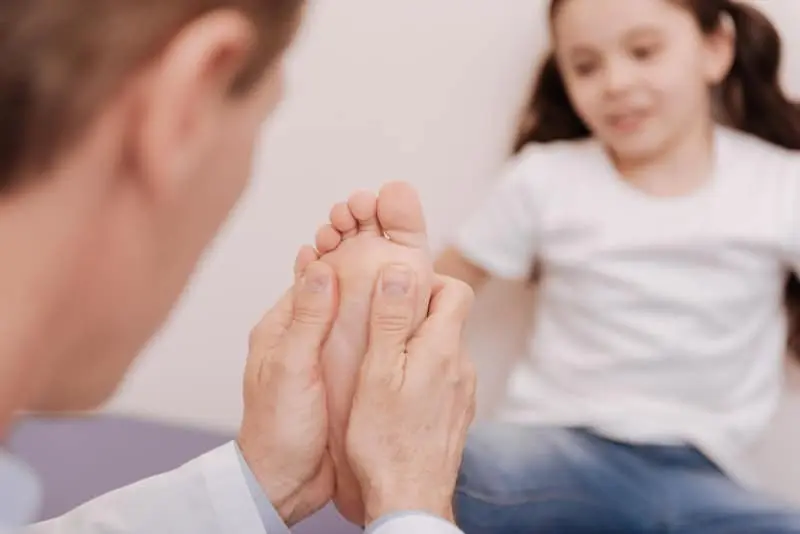
If your child has foot pain, an unusual walk or shoes that wear out in odd places, a podiatrist can find the cause. You can book a children’s podiatry appointment online at any of our five Sydney clinics.