
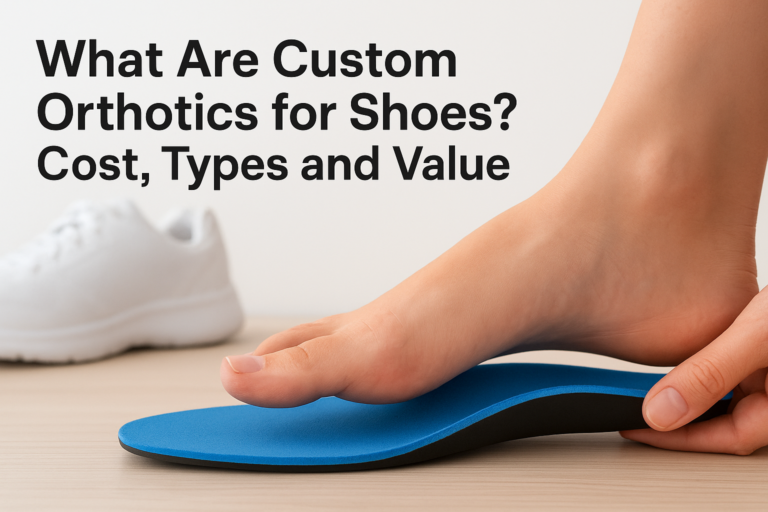
You have probably stood in a chemist aisle looking at a wall of gel insoles, wondering if any of them will fix your sore feet. Then someone mentions custom orthotics for shoes, and the price makes you hesitate. It is a fair question: are they worth it, or is a $40 insole just as good?
Here is the short answer. Custom orthotics are devices made from a scan or mould of your feet, prescribed after a podiatrist assesses how you stand and walk. Off-the-shelf insoles are made for an average foot. In Australia, custom orthotics typically cost between $400 and $700, depending on the materials and design, and many people can claim part of that through private health extras. They are worth it when you have a diagnosed problem such as heel pain, recurring injuries or a foot shape that generic insoles cannot support.
Below, we explain how custom orthotics differ from store-bought insoles, which types suit which shoes, what affects the price, and how the process works. We draw on more than 20 years of fitting orthotics across our Sydney clinics, using 3D scanning and pressure plate analysis.
Why custom orthotics for shoes matter
Your shoes shape how your feet carry load, but they cannot read your feet. A shoe is built on a standard last, so it suits an average foot and everyone else less well. Custom orthotics for shoes change how force travels through your feet, ankles, knees and hips, which is why they matter far beyond comfort.
What custom orthotics actually do
Each foot has 26 bones and 33 joints, and running can load it with two to three times your body weight. If your foot rolls in too far, stays rigid or piles pressure onto one spot, small errors repeat thousands of times a day. A podiatrist prescribes an orthotic to do one or more of these jobs:
- Support the arch or heel so the foot sits in a better position.
- Redistribute pressure away from sore or overloaded areas, such as the ball of the foot.
- Control excess motion at the heel and midfoot while you walk or run.
A good orthotic does not force your foot into shape, it changes the load so overworked tissue can recover.
Because ours are designed from a 3D scan and pressure plate readings, the shape reflects where your feet actually load, not where a textbook says they should. That is the practical difference you are paying for.
Problems they help with
Podiatrists prescribe orthotics most often for these complaints:
- Heel pain and plantar fasciitis
- Shin splints, Achilles pain and runner’s knee
- Pain under the ball of the foot, including early bunion discomfort
- Flat feet, high arches and children’s gait concerns
- Recurring sprains or stress injuries in active people
Not every sore foot needs one, though. Mild, short-lived aches often settle with better footwear, calf stretching or load management, and we will tell you so. Orthotics earn their place when the pain keeps returning or the cause sits in how your foot moves.
Why the shoe matters too
Shoe fit decides whether an orthotic works. A device that is too thick can push your heel out of the shoe, and a shoe with a fixed insole or shallow heel cup will fight it. Custom shoes orthotics are made around the footwear you wear most, whether that is runners, work shoes or school shoes, so the two work as one system. Bring your usual pair to your appointment and we can check depth, heel grip and removable insoles before anything is made.
How to get custom orthotics made and fitted
Getting custom orthotics for shoes usually takes two appointments, about one to two weeks apart. You do not need a GP referral to see a podiatrist, so you can book directly online and often be seen the same week.
The process, step by step
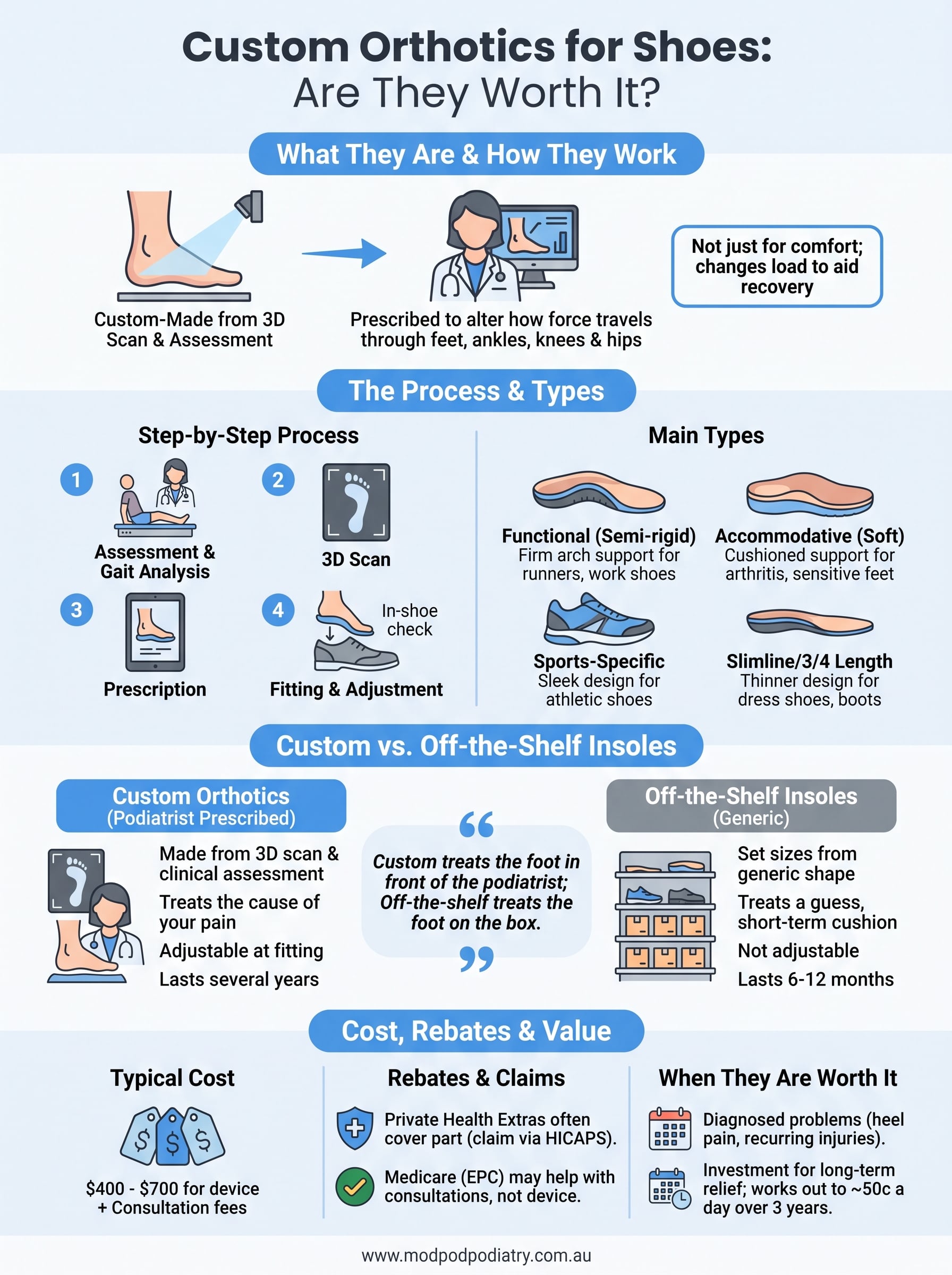
Here is what happens at our clinics. The assessment and scan take about 45 minutes, and the orthotics are then made to your prescription.
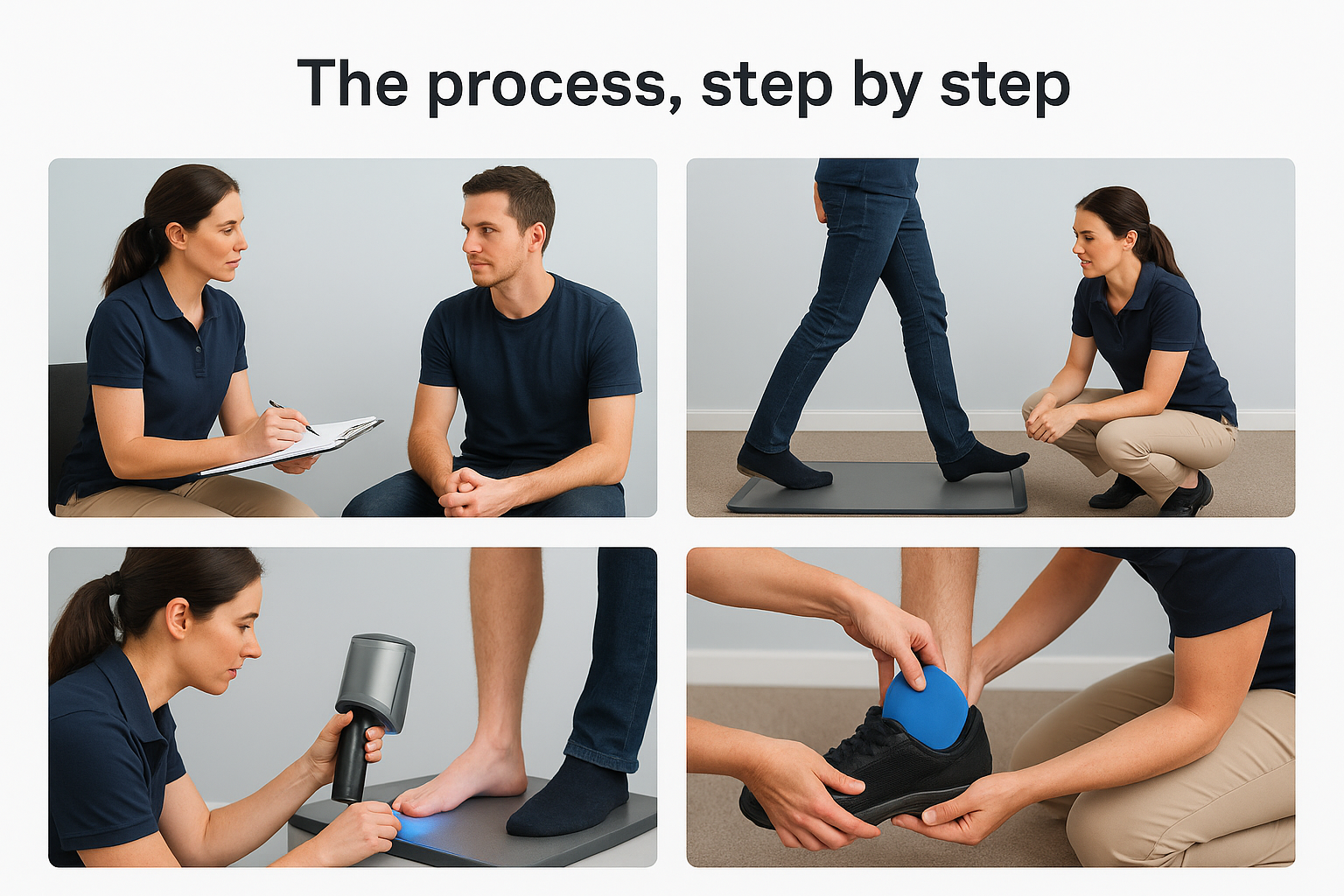
- Assessment. We ask about your pain, history, activity and footwear, then test joint movement, strength and posture.
- Gait analysis. You walk across a pressure plate so we can see where force lands with each step.
- 3D scan. A digital scan captures your foot shape without plaster casts or foam boxes.
- Prescription. We choose the shell material, arch height and top cover to suit your activity and your shoes.
- Fitting. At the second visit we check the orthotics inside your actual shoes and adjust them on the spot.
Bring your shoes and give them time
Bring the pair you wear most, plus any shoe you want the orthotics to fit. We check heel depth and removable insoles before prescribing, because a device that does not fit the shoe will not get worn.
The orthotic is only as good as the assessment and the shoe it goes into.
Expect a break-in period. Wear them for one to two hours on the first day, then add an hour daily over about two weeks. Mild awareness under the arch is normal. Sharp pain, rubbing or blisters are not, so ring us and we will adjust them. We usually review progress at four to six weeks, once your feet have adapted.
Types of custom orthotics and which shoes suit them
Custom orthotics for shoes come in several designs, and the right one depends on your diagnosis and your footwear. We choose the type first, then the material, because a device that suits runners will not always fit a dress shoe.
The main types
Most prescriptions fall into a few groups. Functional devices use firmer shells to control motion, while accommodative ones use softer foam to cushion sore spots.
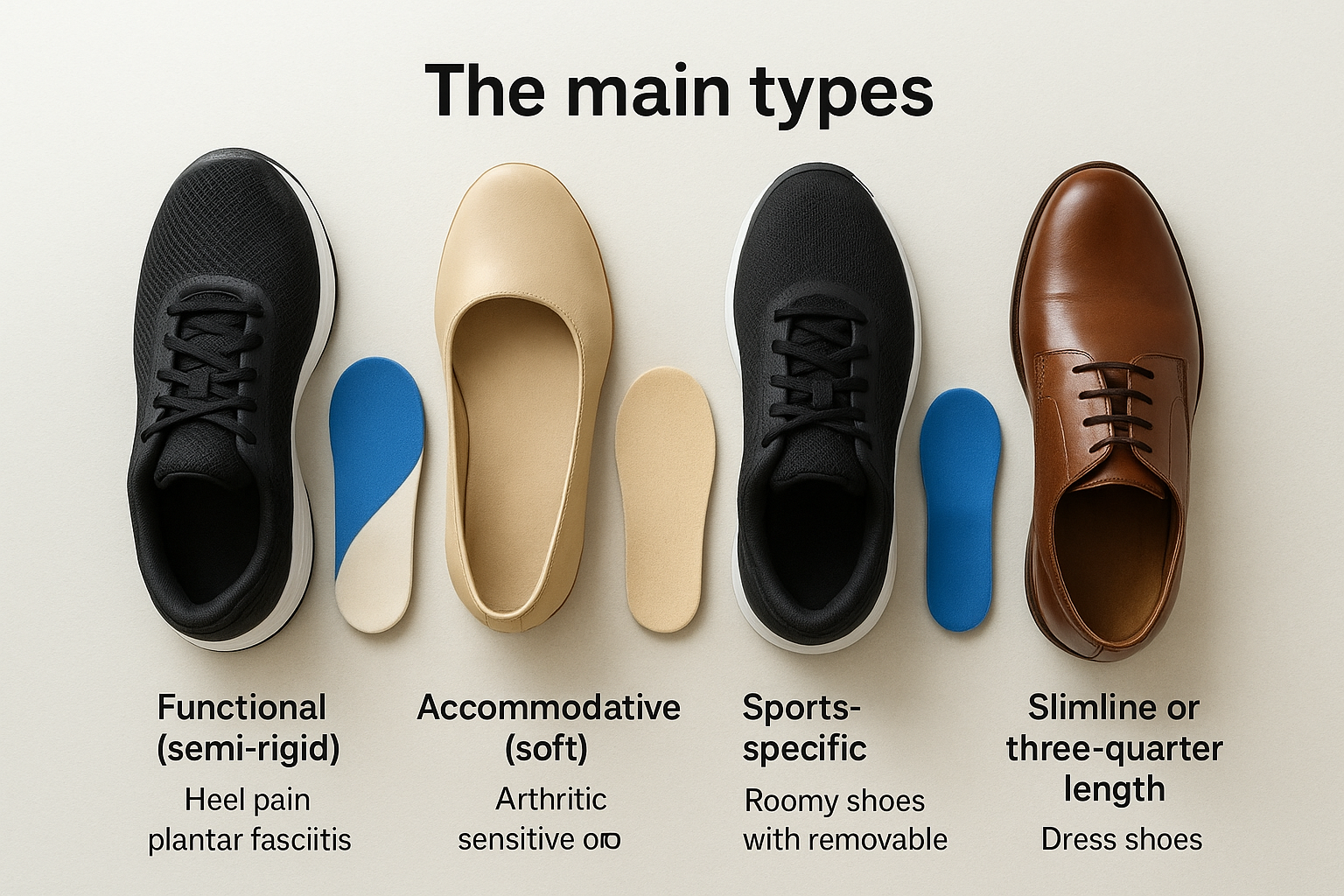
| Type | Best for | Suits these shoes |
|---|---|---|
| Functional (semi-rigid) | Heel pain, plantar fasciitis, tendon overload | Runners, walking shoes, lace-up work shoes |
| Accommodative (soft) | Arthritic, sensitive or high-pressure feet | Roomy shoes with removable insoles |
| Sports-specific | Running, court sports, football, cycling | Sports shoes, boots, cycling shoes |
| Slimline or three-quarter length | Office and everyday wear | Dress shoes, flats, boots |
| Children’s | Growing feet, gait concerns | School shoes, joggers |
Matching the orthotic to your shoes
Depth decides most fits. Runners and lace-up work shoes usually have removable insoles and room for a full-length device, so they take almost any type.
Slimmer footwear needs a compromise. Dress shoes, flats and boots suit three-quarter length devices that stop behind the ball of the foot, often with a thinner shell. Slip-ons and sandals without a firm heel cup rarely hold an orthotic in place.
The shoe you wear most should set the design of the orthotic, not the other way round.
Many people end up with two pairs, a full-length sports pair and a slimline pair for work. Ask us about this at your assessment, so both are made from the same scan and prescription.
Custom orthotics vs off-the-shelf insoles
Off-the-shelf insoles are not a bad product. They come in set sizes cut from a generic foot shape, and for some people that is enough. The real question is whether custom orthotics for shoes do something a pharmacy insole cannot do for your feet.
The key differences
| Custom orthotics | Off-the-shelf insoles | |
|---|---|---|
| Made from | 3D scan and clinical assessment | Standard sizes |
| Chosen by | Podiatrist | You |
| Fit to your shoes | Designed around them | Trimmed to fit |
| Adjustable | Yes, at the fitting | No |
| Typical life | Several years | Often 6 to 12 months |
| Typical cost | $400 to $700 | $30 to $80 |
The biggest gap is the assessment, not the plastic. A podiatrist finds the cause of your pain and shapes the device to treat it, while an insole treats a guess made in a shop aisle.
An insole you pick treats the foot on the box, while an orthotic treats the foot in front of the podiatrist.
When a store-bought insole is enough
Mild, new aches often settle with a basic insole. It works well for short-term cushioning on hard floors, or as a low-risk trial before you spend more.
Move to a podiatrist if the pain returns within four to six weeks, if one foot hurts more than the other, or if the insole flattens quickly. Those signs usually mean your foot needs support that a generic shape cannot give, and guessing again costs more than getting it assessed once.
Cost, rebates and when they are worth it
Most people pay $400 to $700 for a pair of custom orthotics for shoes, plus an initial consultation of $110 to $140. The range is wide because the price follows the design, not a brand name.
What changes the price
Three things move the cost most. Your podiatrist will explain each choice at the prescription stage, so nothing is added without you knowing.
- Shell material: flexible polypropylene sits at the lower end, while carbon fibre or specialised sports shells cost more.
- Design: a simple arch support is cheaper than a device with posting, cushioning layers or offloading zones.
- Extras: premium top covers and heel wedges add to the total.
Rebates you can claim
Private health extras often cover part of the cost, and we claim on the spot through HICAPS, so you only pay the gap. Annual limits vary by fund and cover level, so check your orthotics limit before you book.
Medicare is different. An EPC plan can help eligible patients with podiatry consultations, but it does not pay for the orthotic device itself. Ask your GP whether you qualify.
Your extras usually help with the device, Medicare may help with the visits, and you should confirm both before you pay.
When they are worth the money
Spread the cost over their life and the number looks different. A $550 pair that lasts three years works out at about 50 cents a day, which compares well with repeat consultations, physio bills or weeks off running.
They are worth it when you have a diagnosed problem such as ongoing heel pain, or an injury that keeps returning despite good shoes and rest. They are not worth it for a mild, brand-new ache. In that case, try better footwear first and see us if it has not eased within a few weeks.
Deciding if orthotics are right for you
Custom orthotics for shoes are a clinical treatment, not a shopping upgrade. They are made from a scan of your feet, shaped around the shoes you wear, and prescribed after a proper assessment. If you have a diagnosed problem or pain that keeps coming back, they usually earn their cost over a few years. If your ache is mild and new, start with better shoes and a basic insole, then see how it settles.
Still unsure? One assessment will tell you whether you need orthotics at all, and we will say so plainly if you do not. Our podiatrists scan, test and fit across five Sydney clinics, and you can claim on the spot with HICAPS. Book your orthotics assessment at ModPod Podiatry, then bring your usual shoes along to your appointment.