
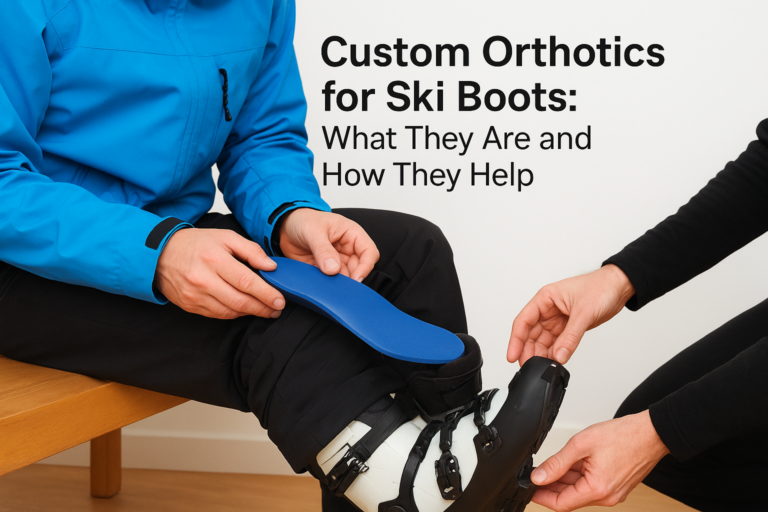
If your feet go numb, cramp, or ache halfway down the first run, your ski boots are probably part of the problem, but the fix might not be new boots at all. Custom orthotics for ski boots are moulded insoles built specifically for your foot shape and how it sits inside a rigid alpine shell, correcting the small gaps and pressure points that off-the-shelf liners can’t handle. They’re one of the most overlooked upgrades for anyone who skis more than a couple of times a season.
In short, they work by holding your foot in a neutral, stable position inside the boot, which improves edge control and stops your foot sliding around when you’re carving or absorbing bumps. That stability also reduces the shin pain and hot spots that come from your foot compensating for a poor fit all day on the slopes.
This guide walks through what these orthotics actually are, how they differ from the insoles your boots came with, what improved fit and performance look like on snow, and where in Sydney you can get a proper biomechanical assessment and custom pair made before your next trip.
Why custom orthotics matter for your skiing
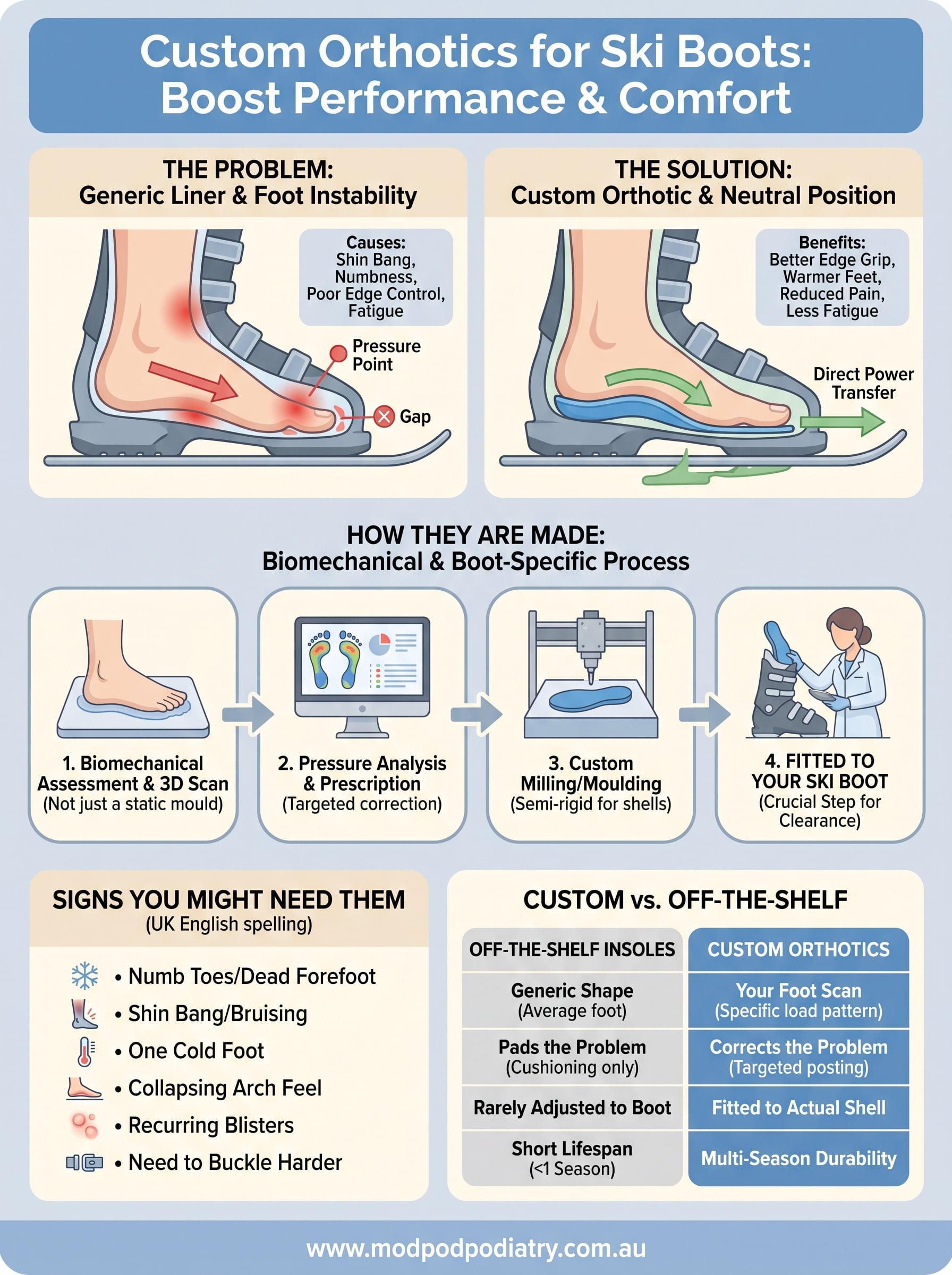
Ski boots are built rigid on purpose. That shell needs to transmit every flex of your leg straight into the ski edge, instantly, with no lag. The problem is that a rigid shell only works properly if your foot stays still inside it, and most feet don’t. Under load, your arch collapses, your heel shifts, and your forefoot spreads, all inside a boot that was moulded to a generic last, not your foot. Custom orthotics for ski boots fill that gap between your actual foot shape and the boot’s internal volume, holding everything in a neutral position so the power from your leg goes into the ski rather than getting soaked up by your foot rolling around first.
A boot that fits your shell size but not your foot shape will always cost you edge control, no matter how expensive it was.
Better edge control and power transfer
Skiers who switch to properly fitted ski boot orthotics usually notice the change within the first few runs. Turns initiate faster because there’s less delay between tipping your ankle and the ski actually responding. You’ll feel more even pressure across both feet too, which matters on long traverses and variable snow where small imbalances get magnified fast.
Fewer injuries and less pain by lunchtime
Unsupported feet don’t just ski worse, they hurt. Cold, cramped conditions inside a stiff boot are exactly where problems like shin bang, numbness, hot spots and plantar fasciitis flare-ups show up, usually by the second or third run of the day. A well-fitted orthotic reduces the excess movement causing that friction and pressure, which is why so many skiers who’ve dealt with recurring foot pain treat orthotics as essential rather than optional gear.
The benefits compound over a full ski day:
- Less foot fatigue late in the afternoon, when technique usually breaks down anyway
- Reduced pressure points that cause blisters and bruised toenails
- More consistent stance width between your left and right foot
- Warmer feet, since a snugger fit reduces the air gaps that let cold in
If you already deal with foot pain or ankle instability off the slopes, that same underlying biomechanics carries straight into your boots. Custom orthotics don’t fix a boot that’s the wrong size, but for the vast majority of skiers whose boots fit reasonably well, they solve the deeper issue: a foot that was never supported properly in the first place.
How custom orthotics for ski boots are made
Getting a proper pair starts with a biomechanical assessment, not a cast pulled off the shelf. A podiatrist watches how you stand, walk and load your foot, checking for arch collapse, heel tilt and any leftover niggles from old injuries. Most clinics now pair this with 3D foot scanning and pressure plate analysis, capturing exactly where load sits across your foot when you’re bearing weight, which matters far more for ski orthotics than a static mould ever could.
An orthotic built from how your foot actually loads will always outperform one built from how it looks standing still.
Once that data is captured, the process usually runs like this:
- Weight-bearing and non-weight-bearing scans or casts of both feet
- Pressure mapping to identify high-load zones and instability patterns
- Prescription written specifying shell rigidity, posting and correction angles
- Orthotic milled or moulded from that prescription, usually in a semi-rigid material suited to a stiff alpine shell
- Fitting appointment where the orthotic goes into your actual ski boot, not just a shoe
That last step matters more than skiers expect. Ski boot orthotics need to sit inside a much lower-volume, rigid shell than a runner or work boot, so the podiatrist often works alongside your bootfitter to grind boot liners or shells where needed for clearance. Skipping that step is a common reason orthotics that feel great in the clinic end up cramped or ineffective on snow. ModPod Podiatry’s podiatrist-made orthotics build this boot-specific fitting into the process from the start, rather than handing you a generic insole and leaving the rest to guesswork.
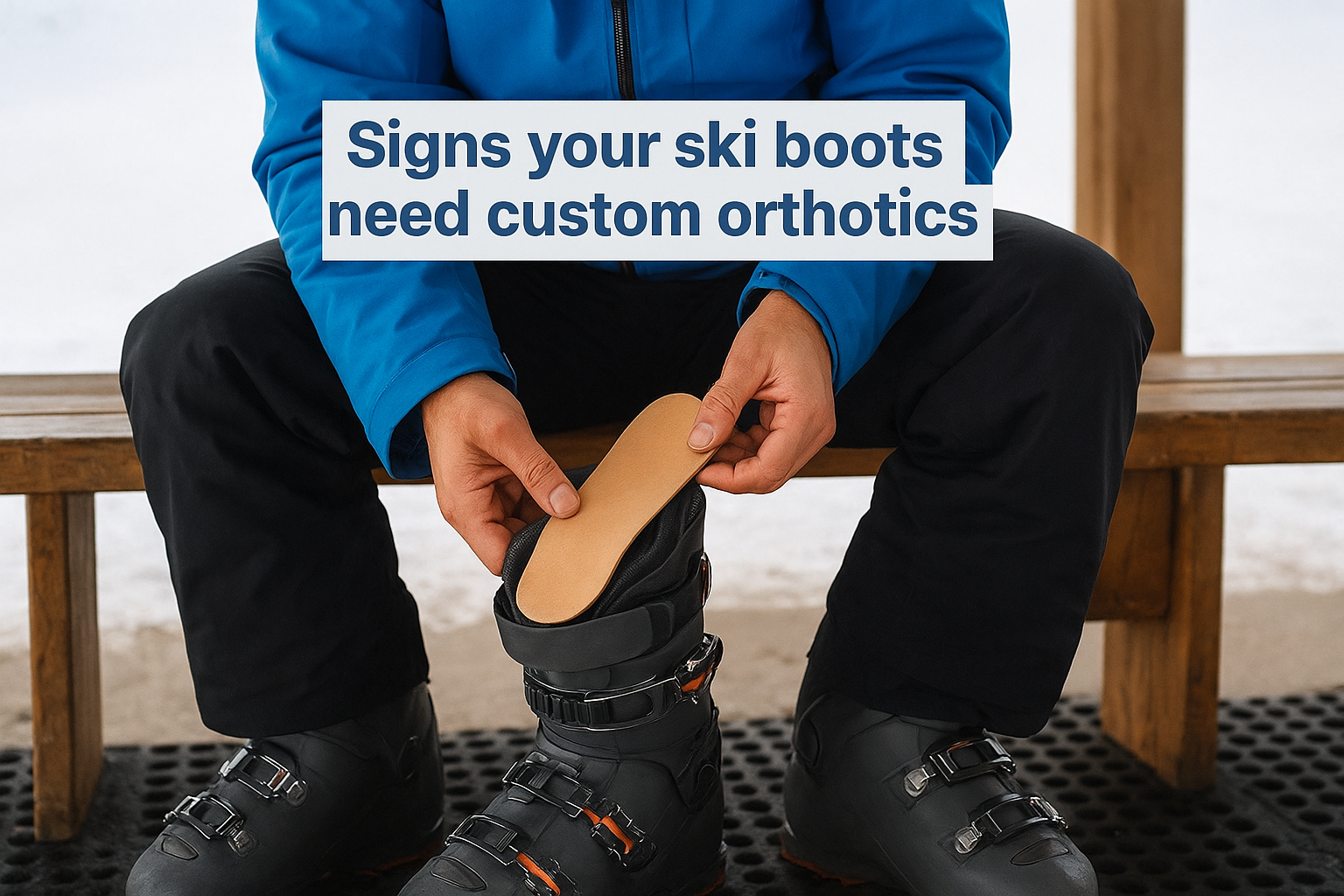
Signs your ski boots need custom orthotics
Most skiers wait far too long before checking whether their boots actually fit their feet properly. Watch for these patterns across a normal day on the mountain, because they usually point to a fit problem your stock liner can’t solve:
- Numb toes or a dead forefoot within the first hour, especially if wiggling your toes at the chairlift barely helps
- Shin bang, that deep bruised ache up the front of your leg from your shin slamming the boot tongue
- One foot going cold faster than the other, which usually means uneven pressure and poor blood flow on that side
- A collapsing arch you can feel as the day wears on, like your foot is spreading and sliding inside the shell
- Blisters or black toenails that show up in the same spot trip after trip
- Needing to buckle down harder each run just to feel any edge grip
Boots that felt fine in the shop but turn painful by lunchtime are a classic sign your feet need more support than the factory footbed gives them. Repeated calf and shin cramping or a nagging ache in the arch after skiing, even once you’re back in normal shoes, is another giveaway that your ski boot fit isn’t matching your actual foot shape.
If the same spot hurts every single ski day, that’s not bad luck, that’s your foot telling you it needs support the boot alone can’t provide.
Generally, if you’ve already dealt with plantar fasciitis, bunions or fallen arches off the slopes, those issues don’t disappear inside a stiff alpine shell. They tend to get worse, because the boot removes any natural give your foot normally relies on to compensate.
Custom orthotics versus off-the-shelf ski insoles
Walk into any ski shop and you’ll find racks of aftermarket insoles promising better support for a fraction of the cost. They’re not useless, but they’re built on a generic shape, not your foot, so they can only ever correct for an average that doesn’t actually exist. A shop insole might add arch cushioning or a bit of extra grip, but it can’t account for a collapsing arch, a rotated heel, or one foot loading differently to the other, which is exactly where most skiers run into trouble.
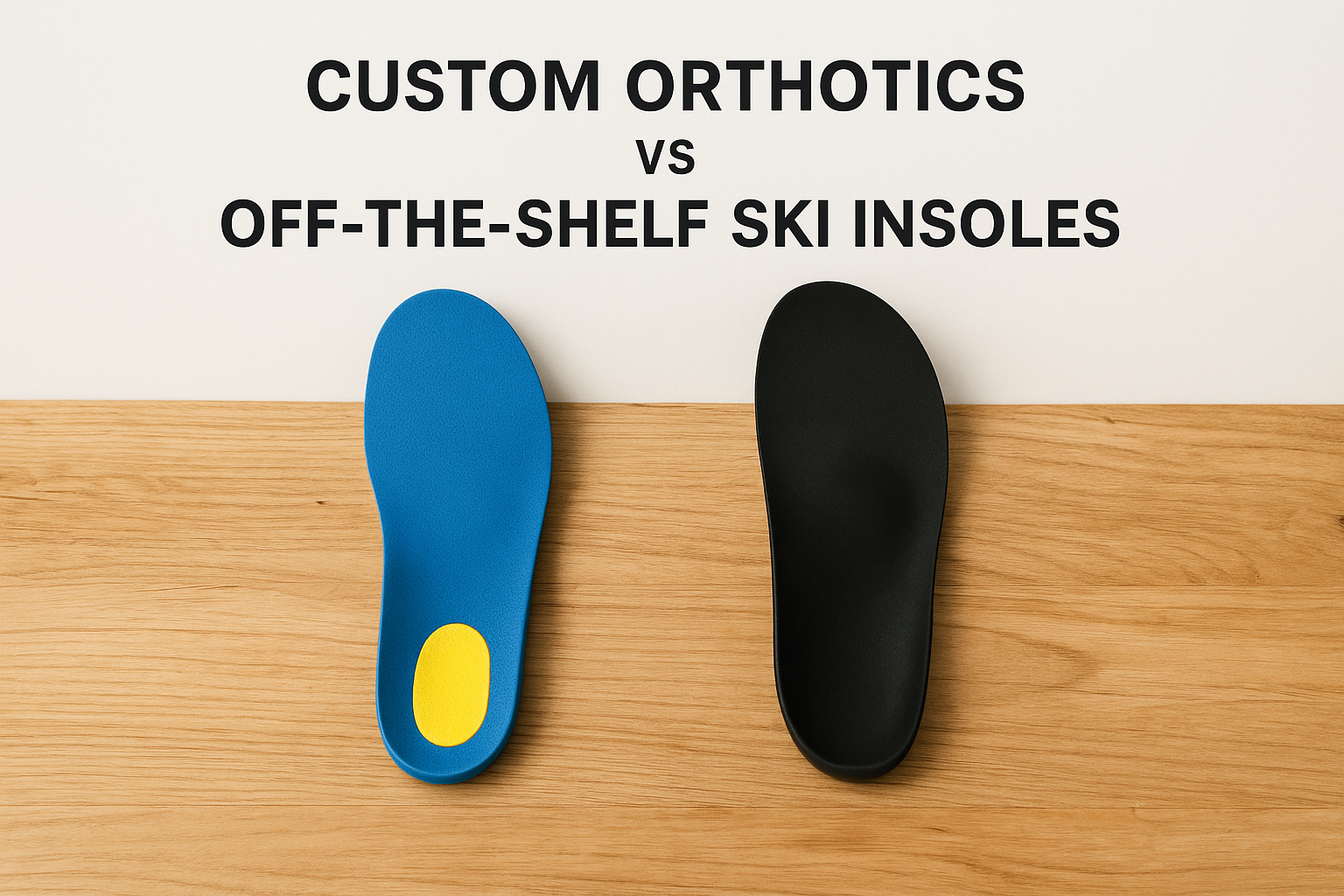
Off-the-shelf insoles pad the problem, custom orthotics correct it.
Custom orthotics start from a biomechanical assessment of your own feet, so the correction angles, posting and rigidity are specific to how you actually stand and load weight, not a size-based average. That precision is why podiatrist-made orthotics tend to outlast a season of shop insoles, both in comfort and in how long the correction actually holds up under hard skiing.
| Off-the-shelf insoles | Custom orthotics | |
|---|---|---|
| Fit basis | Generic shoe size | Your foot’s scan and load pattern |
| Correction | Cushioning only | Targeted posting and support |
| Boot fitting | Rarely adjusted | Fitted to your actual ski boot shell |
| Lifespan | One season, often less | Several seasons with proper care |
| Cost | Lower upfront | Higher upfront, better long-term value |
Spending on shoe inserts built for your feet, rather than a generic fit, pays off across every ski trip you take afterwards, not just the next run.
Finding the right support for your feet
Getting fitted for custom orthotics for ski boots isn’t complicated, but it does need proper input from someone who understands both feet and boot shells, not just one or the other. A generic insole might get you through a weekend, but if you’re skiing regularly, that gap between your foot and your boot will keep costing you edge control, comfort and warmth every single day on snow.
Start with a biomechanical assessment rather than guessing at what your feet need from a shop shelf. A podiatrist who scans your feet, checks your load patterns and works alongside your bootfitter will build something that actually holds up run after run, season after season.
If shin bang, numb toes or a collapsing arch are already part of your ski day, don’t wait for another trip to sort it out. Book a custom orthotics assessment online with ModPod Podiatry before your next time on the mountain.