

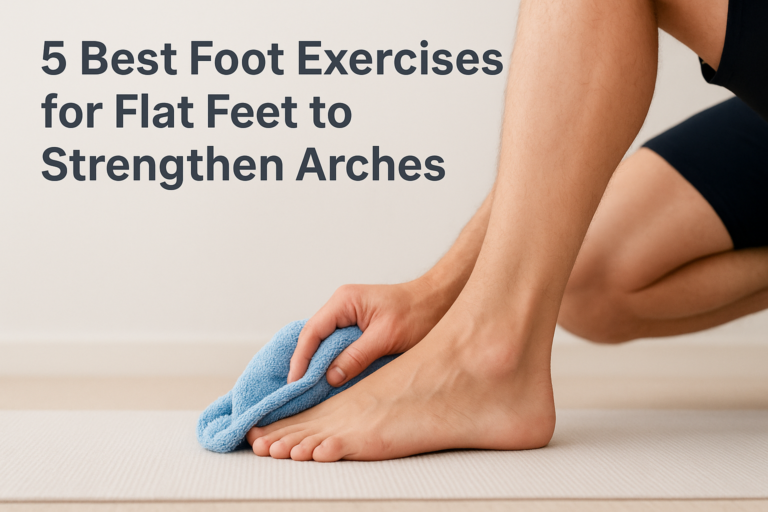
Flat feet aren’t just a cosmetic quirk. When your arches collapse under load, the rest of your lower limb picks up the slack, and that often shows up as heel pain, aching arches, or tightness that creeps up into your shins and knees. If you’ve been searching for foot exercises for flat feet, you’re probably past the point of just wanting information and ready to actually do something about it.
The good news is that a flexible flat foot (the most common type) usually responds well to targeted strengthening. You don’t need a gym membership or fancy equipment, just a few minutes a day and consistency. The right moves build up the muscles supporting your arch, improve how your foot absorbs impact, and take pressure off overworked tendons and ligaments.
Below, we’ve set out five exercises we regularly recommend to patients across our Sydney clinics, from simple arch lifts to towel scrunches and calf raises. Each one targets a different part of the chain that keeps your foot stable, so you can build a routine that actually holds up under daily activity.
1. Towel scrunches
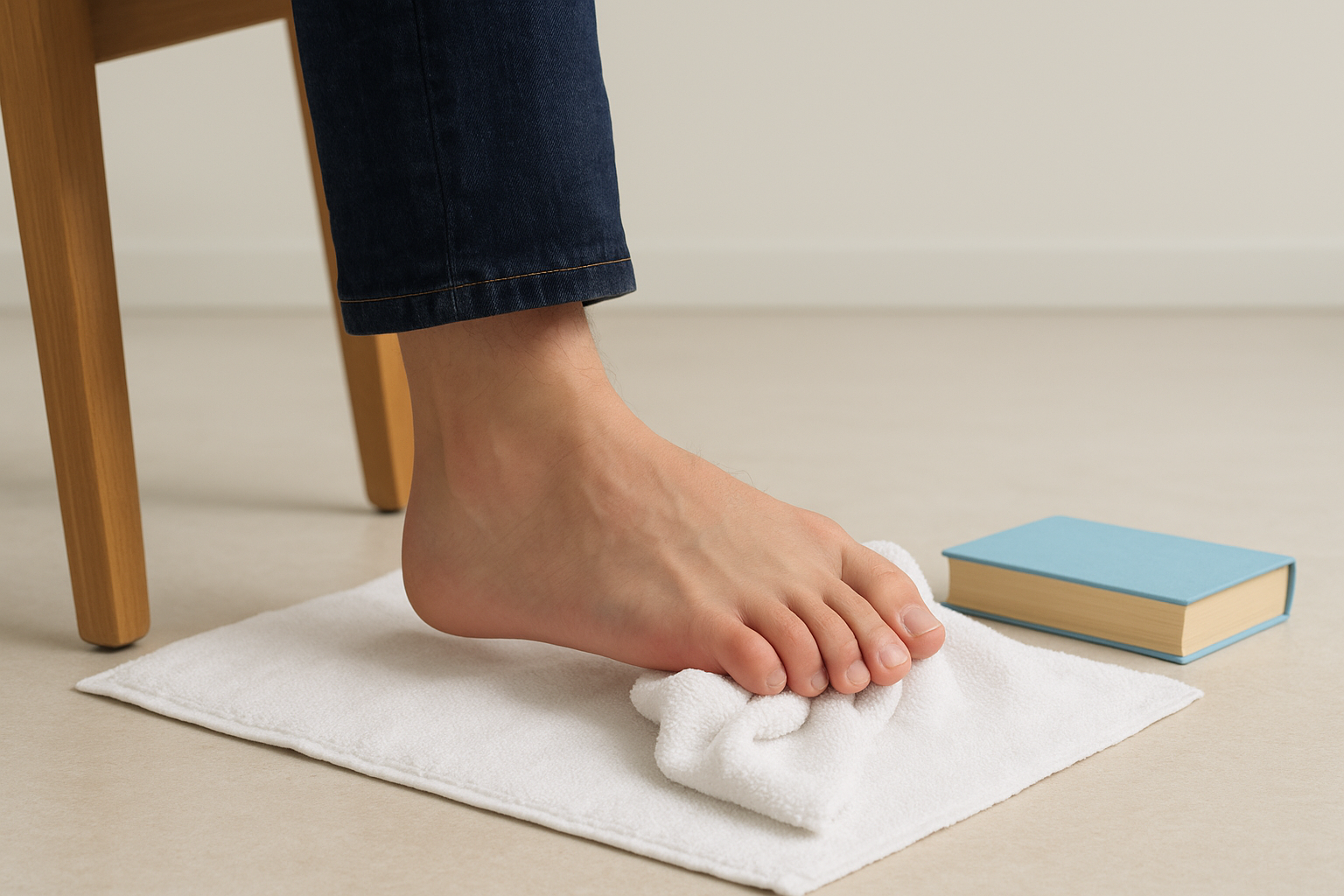
Towel scrunches are the exercise we start almost every flat feet patient on, because they isolate the small intrinsic muscles that sit under your arch without needing any equipment beyond a hand towel. If you’ve never trained these muscles before, expect your foot to cramp a little in the first week. That’s normal and it settles as the muscles wake up.
How to do it
Sit in a chair with your foot flat on the floor and a towel laid out in front of you.
- Place your bare heel on the floor with the towel under your toes and the ball of your foot
- Scrunch your toes to drag the towel towards you, gripping and pulling in short bursts
- Keep your heel planted the whole time, don’t let it lift or slide
- Release, reset the towel, and repeat
- Add a light weight (a small tin or book) on the far end of the towel once it feels easy
Why it helps your arches
This movement directly trains the intrinsic foot muscles, the small stabilisers running along the sole that support your arch from underneath. In a flat foot, these muscles are often underused because the arch relies too heavily on passive structures like ligaments to hold its shape. Strengthening them gives your foot an active support system instead of a purely passive one.
Strong intrinsic foot muscles do the job your collapsed arch can’t do on its own.
We see this exercise make a real difference for patients with plantar fasciitis and how it’s treated, and for general arch fatigue, since a stronger intrinsic system reduces the load travelling through the plantar fascia during walking and standing.
How often to practise it
Aim for two to three sets of 10 scrunches on each foot, once a day. It only takes a couple of minutes, so pair it with something routine like brushing your teeth or watching the news. Consistency over weeks matters more than intensity in any single session, so don’t push through sharp pain, just steady, repeated effort.
2. Arch lifts (doming)
Arch lifts, sometimes called "short foot" exercises or doming, teach your foot to actively shorten and lift the arch without curling your toes. It’s a subtler movement than towel scrunches, and most patients find it harder to feel at first because there’s no visible prop doing the work. Once you get the knack, it becomes the exercise you can do anywhere, standing in a queue, waiting for the kettle, without anyone noticing.
How to do it
Stand or sit with your foot flat on the floor, toes relaxed and spread out.
- Press your big toe knuckle and heel into the floor
- Draw the middle of your foot upward, shortening the distance between heel and toes, without curling your toes under
- Hold the lifted position for five seconds, feeling the arch dome slightly
- Relax fully and repeat
- Progress from sitting to standing, then to single-leg standing once it feels controlled
Why it helps your arches
Doming trains the arch’s active control system directly, rather than just the muscles under the sole. It builds the neuromuscular pattern your foot needs to hold its shape under load, which matters more for flexible flat feet than raw strength alone.
A flat foot that can dome on command is a flat foot that’s learning to support itself.
How often to practise it
Practise 10 holds per foot, two or three times daily, building duration before adding standing variations.
3. Calf raises
Your calf muscles and Achilles tendon anchor into the back of your heel, and when they’re weak or tight, your arch loses one of its key supports during push-off. Calf raises might seem like a lower-leg exercise rather than a flat feet exercise, but the two are closely linked because a stiff, underpowered calf forces your arch to absorb more strain with every step.
How to do it
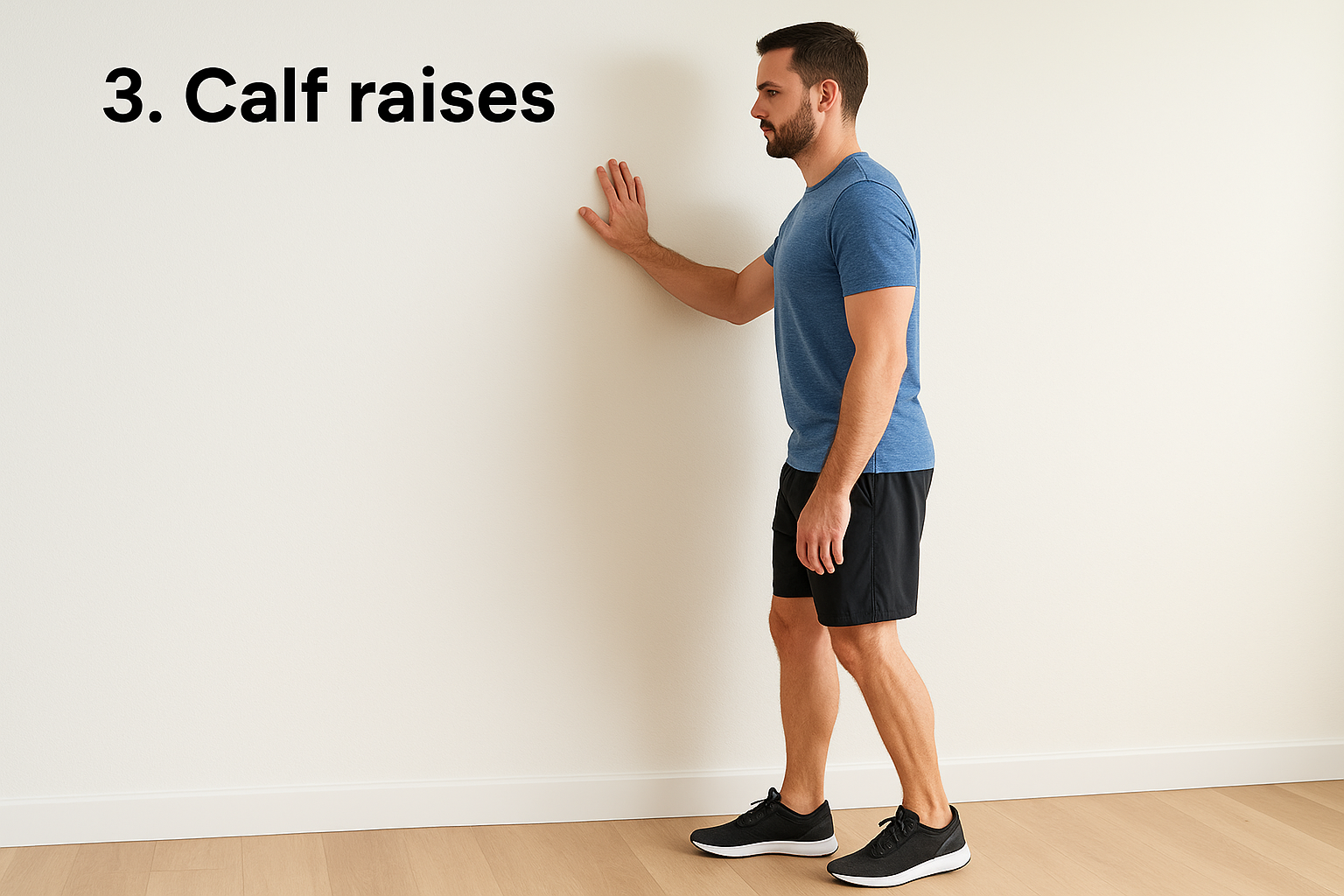
Stand near a wall or bench for balance, feet hip-width apart and flat on the floor.
- Rise slowly onto the balls of both feet, lifting your heels as high as comfortable
- Pause briefly at the top
- Lower back down with control, don’t just drop
- Once double-leg raises feel easy, progress to single-leg calf raises for extra load
Why it helps your arches
Strong calves improve how efficiently your foot pushes off the ground, which reduces the time your arch spends under strain during walking and running. This exercise also builds ankle stability, a common weak point in people with flat feet.
A strong calf takes pressure off a tired arch with every single step.
How often to practise it
Work up to three sets of 12 to 15 raises, three to four times a week, allowing a rest day between sessions so the tendon can adapt properly.
4. Heel and toe walking
Walking drills sound almost too simple to matter, but heel and toe walking forces your foot to control weight through its full range, from the arch stretched under heel-strike to the arch loaded under toe-off. Patients who struggle to feel the doming exercise often find this one easier, because the movement is bigger and the feedback from the floor is obvious.
How to do it
Find a clear stretch of floor, about ten steps long, ideally barefoot.
- Walk the length on your heels only, toes lifted off the ground
- Turn around and walk back on your toes, heels lifted
- Keep your steps short and controlled rather than rushed
- Repeat for two or three lengths each way
Why it helps your arches
This drill builds strength and control through the muscles that lift your arch during different phases of the gait cycle, rather than in one static position. It’s particularly useful for anyone whose flat feet cause a rolled-in stride, since it retrains how the foot loads through each step.
Your arch needs to work while you’re moving, not just while you’re standing still.
How often to practise it
Add this into your routine three times a week, two to three lengths each direction. Stop if you feel sharp pain rather than muscle fatigue, and build up distance gradually as your control improves.
5. Marble or towel pick-ups
Marble pick-ups round out this routine because they combine grip strength with the fine motor control your toes need for balance and push-off. It’s a favourite with kids, so if you’re doing these exercises alongside a child with flat feet, this is the one they’ll actually enjoy repeating.
How to do it
Scatter a small pile of marbles, dried beans, or scrunched-up bits of towel on the floor next to an empty bowl.
- Sit in a chair with your foot flat and the objects within easy reach of your toes
- Grip a single marble or piece of towel with your toes
- Lift it and place it in the bowl without using your hand
- Repeat until the pile is gone, then swap feet
- If marbles feel too fiddly at first, start with a folded towel and progress down to smaller objects
Why it helps your arches
This exercise trains the same toe flexor muscles as towel scrunches, but adds a lift and release component that closer matches how your toes work during real walking. It also sharpens proprioception, your foot’s sense of where it is in space, which tends to be dulled in flat feet.
A foot that can grip and lift small objects is a foot that’s regained real control.
How often to practise it
Aim for one full set of 10 to 15 pick-ups per foot, most days of the week.
Keeping your arches strong for the long term
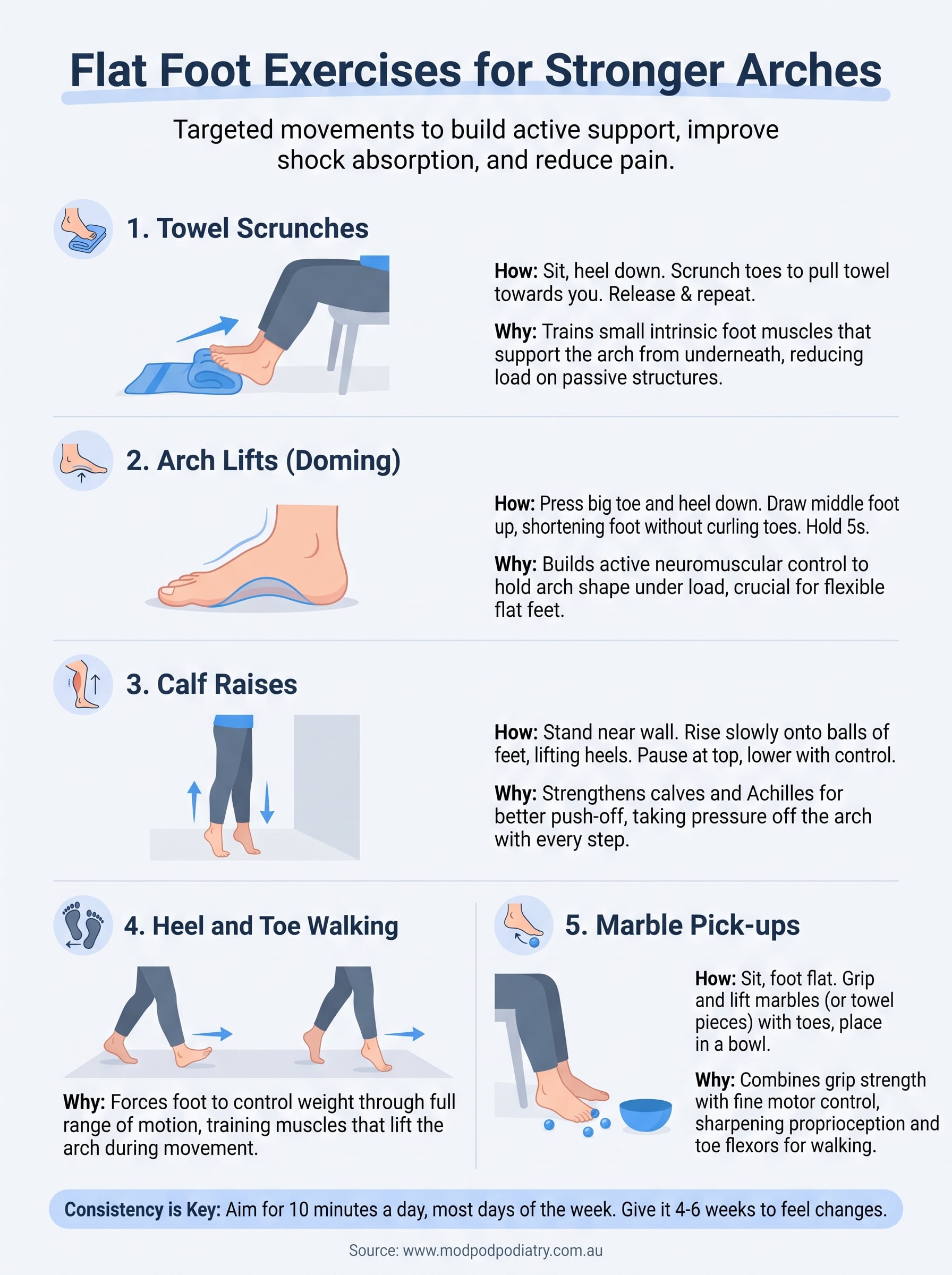
Consistency beats intensity with every exercise on this list. Ten minutes a day, most days of the week, will do more for your flat feet than an occasional big effort once a fortnight. Give these movements four to six weeks before judging whether they’re working, since muscle changes take time to show up in how your foot actually feels during a walk or run.
Working through these on your own is a solid start, but exercises alone can’t fix everything, especially if your flat feet stem from bone structure rather than muscle weakness, or if pain hasn’t shifted after a month of consistent practice. That’s when a proper biomechanical assessment makes the difference, checking your gait, your footwear, and whether custom orthotics would give your arches the support they still need. If you’re at that point, book a flat feet assessment at one of our Sydney clinics and we’ll build a plan around your feet specifically, not a generic routine.

