

That dull ache along your shin bone after a run isn’t going away on its own as fast as you’d hoped, and now you’re stuck wondering how long you actually need to wait before lacing up again. Shin splints recovery time varies more than most runners expect, and giving yourself a vague timeline like "a few weeks" often leads to reinjury because the pain eases before the underlying bone stress has actually settled.
Most cases of medial tibial stress syndrome clear up within two to six weeks with proper rest and load management, but that range depends heavily on how early you caught it, your training history, and whether you kept running through the pain. Severe or long-ignored cases can take three months or longer, especially if there’s an underlying biomechanical issue driving the problem rather than just overtraining.
In this guide, we’ll walk you through realistic recovery timeframes based on severity, the factors that speed up or slow down healing, and the warning signs that suggest you need a proper podiatry assessment rather than another week of guessing. We’ll also cover when gait analysis and orthotics become worth considering, so you can get back to running with confidence instead of nursing the same injury on repeat.
Why shin splints recovery time varies so much
Shin splints, or medial tibial stress syndrome, isn’t a single injury with a single healing curve. It’s a spectrum ranging from mild inflammation of the tendons and muscles pulling on the tibia through to genuine bone stress reactions that behave more like a hairline fracture. Two runners with the same complaint of "shin pain" can be looking at a two week break or a three month rebuild, depending entirely on what’s actually happening inside that lower leg.
How early you catch it
Catching shin splints in the first week or two, when the pain is dull and only shows up after exercise, gives you the best odds of a fast turnaround. Runners who push through pain that’s sharp, localised, or present during daily walking often have progressed toward a bone stress injury, and that shifts recovery from weeks into months. Ignoring the early warning signs is the single biggest reason a simple case turns into a stubborn one.
The longer you run through shin pain, the longer your body needs to run without it.
Training load and biomechanics
How you trained matters as much as how long you’ve had symptoms. A sudden jump in weekly mileage, a switch to hill sessions, or a change to worn-out shoes can overload the tibia faster than your bone can adapt, and that mismatch is what triggers the injury in the first place. If you don’t address the root cause of shin splints, whether that’s overpronation, tight calves, or poor running mechanics, the shin pain tends to return as soon as you resume normal training, regardless of how much rest you took.
Bone involvement versus soft tissue only
Whether the injury involves bone stress or stays limited to soft tissue changes everything about the timeline. Soft tissue cases generally respond to rest, load modification, and strengthening within a handful of weeks. Bone stress cases need a longer, more conservative approach because bone remodels far slower than muscle or tendon, and returning too early risks progressing to a genuine tibial stress fracture.
| Factor | Speeds up recovery | Slows down recovery |
|---|---|---|
| Timing of diagnosis | Caught in week 1-2 | Ignored for 4+ weeks |
| Pain pattern | Only after activity | Present at rest or walking |
| Training response | Immediate load reduction | Continued running through pain |
| Tissue involved | Muscle/tendon only | Bone stress reaction |
| Underlying cause | Addressed early (footwear, biomechanics) | Left uncorrected |
Underlying health factors play a role too. Low vitamin D, low energy availability, and a history of stress fractures all slow bone healing, which is worth mentioning if your recovery seems to be dragging without an obvious training explanation. The Australian Institute of Sport has published guidance on bone stress injuries in athletes that reinforces just how variable recovery can be once bone is involved, rather than muscle alone. Recognising which category you fall into early is what separates a quick return to running from a repeat cycle of pain.
How to speed up your shin splints recovery
Active recovery beats total rest when it comes to shin splints, because complete inactivity lets your calf and tibialis muscles weaken while doing nothing to correct the load imbalance that caused the problem. Swapping running for low-impact options such as swimming, cycling, or deep-water running keeps your cardiovascular fitness up while taking direct stress off the tibia. This is the phase where shin splints recovery time genuinely shortens if you get the balance right between rest and staying conditioned.
Load management matters more than complete rest
Building load back gradually is the single biggest lever you control. Jumping straight from zero running to your old weekly mileage is exactly how a healed shin splint becomes a repeat injury within a fortnight. A sensible reload looks like this:
- Walk pain-free for several days before any jogging
- Reintroduce running at 50% of your previous volume
- Increase weekly mileage by no more than 10%
- Add one rest or cross-training day between running sessions
- Stop immediately if sharp or localised pain returns
Recovery isn’t a countdown of days, it’s a checklist of pain-free milestones you have to earn.
Strengthening and correcting the underlying mechanics
The best exercises for shin splints, including calf raises, tibialis anterior strengthening, and hip stability work, address the muscular weaknesses that let the tibia take too much load in the first place. Combining this with simple home measures for shin splints such as ice for symptom relief and anti-inflammatories only when needed (rather than as a way to mask pain and keep training) gives your tissue the best environment to heal.
Getting a proper biomechanical assessment early, rather than waiting to see if things settle, is often what separates a four-week recovery from a repeat injury cycle. Our shin splints treatment team in Sydney can identify whether footwear, gait, or muscle imbalances are driving your shin splints, and build a graded return-to-running plan around your specific findings rather than a generic timeline pulled from average recovery statistics.
Typical recovery timelines for mild to severe cases
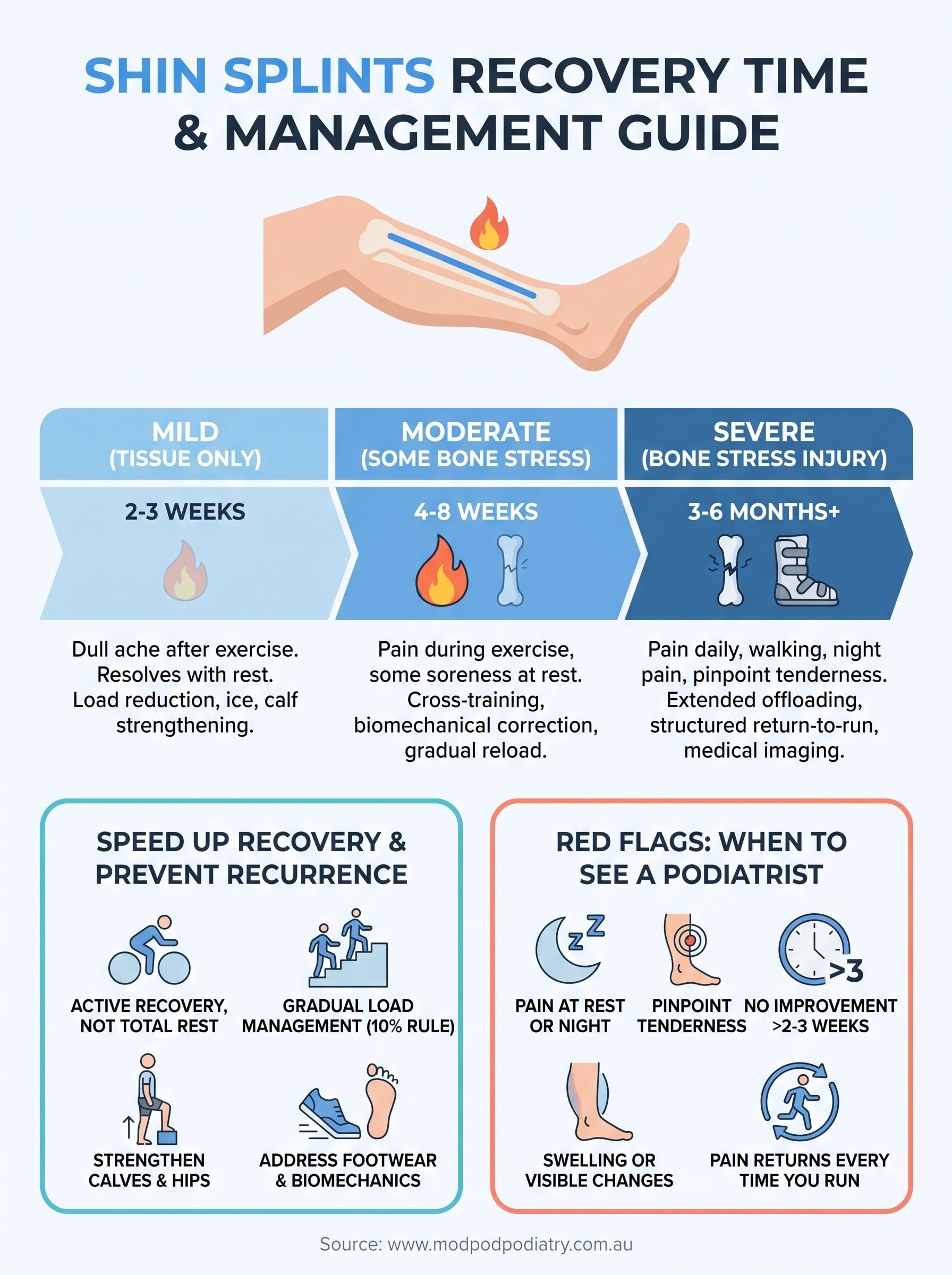
Grading your shin splints against a rough severity scale gives you a far more useful answer than "it depends". Clinicians typically split medial tibial stress syndrome into three practical bands, and where you sit determines whether you’re looking at a fortnight off or a full season on the sidelines. Working out which grade your shin splints fall into early stops you from comparing your recovery to a mate’s two-week bounce-back when your case is actually much further along the spectrum.
| Severity | Symptoms | Typical shin splints recovery time |
|---|---|---|
| Mild | Dull ache after exercise only, resolves with rest | 2-3 weeks |
| Moderate | Pain during exercise, some soreness at rest | 4-8 weeks |
| Severe/bone stress | Pain during daily walking, localised tenderness, night pain | 3-6 months |
A mild case treated properly heals faster than a severe case treated casually.
Mild presentations respond well to short-term load reduction, ice, and calf strengthening, and most runners are back to full training within three weeks provided they don’t rush the reload. Numbers shift considerably once symptoms cross into the moderate band, where pain shows up during activity itself rather than only afterwards. This group needs a proper cross-training block, often four to eight weeks, alongside correction of the underlying training error or biomechanical fault before running resumes.
Severe cases, particularly where imaging confirms a bone stress reaction along the tibia, sit in a different category altogether. These need extended offloading, sometimes a period in a moon boot, and a structured return-to-run program that can stretch past three months. Rushing this stage is how a stress reaction becomes a full stress fracture, which stretches the healing timeline out by months. If you’re unsure which category applies to you, our heel and lower limb pain guides outline the assessment process that helps pin down severity accurately rather than guessing from symptoms alone.
How to stop shin splints coming back
Getting through your shin splints recovery time once is one thing. Staying free of it for good is another problem entirely, and most runners who relapse do so because they went straight back to their old training routine the moment pain stopped. Preventing a repeat means treating the recovery period as a chance to fix whatever caused the overload in the first place, not just waiting out the clock.
Footwear and surface changes
Worn-out shoes are one of the most common culprits behind repeat cases. Work out how many kilometres your running shoes should last and replace them every 600-800km, and if you’ve recently switched shoe brands, drop back mileage for a few weeks while your legs adapt to the new loading pattern. Running exclusively on hard pavement or heavily cambered footpaths also raises tibial load, so mixing in softer trails or a treadmill session now and then spreads that stress more evenly.
Strength and mobility as ongoing habits
One-off strengthening during recovery doesn’t count for much if you drop it once symptoms settle. Build these into your weekly routine long-term:
- Calf raises (both straight and bent knee) twice weekly
- Tibialis anterior raises to balance the lower leg
- Hip and glute strengthening to correct downstream loading
- Regular calf and ankle mobility work before hard sessions
Shin splints rarely come back because of bad luck. They come back because the original cause was never fixed.
Structured training progression
Rebuilding fitness demands patience with your weekly mileage, even once you feel completely pain-free. Sticking to the 10% rule for volume increases, avoiding stacking hard sessions back-to-back, and building in a cutback week every third or fourth week keeps your tibia loading gradually rather than in sudden spikes. Sudden jumps in training stress, not gradual fitness gains, are almost always what triggers a second episode.
Custom orthotics or footwear adjustments matter here too if your gait analysis showed excessive pronation or poor shock absorption. Addressing that mechanical root cause, rather than just resting and hoping, is what actually breaks the cycle for good.
When to see a podiatrist about shin pain
Knowing when to stop self-managing and book a proper assessment saves you weeks of guessing. Most mild cases settle with rest and load changes, but certain warning signs mean you’re dealing with something that needs a clinical diagnosis rather than another round of ice and stretching. Waiting too long at this stage is exactly how a manageable case turns into a months-long bone stress injury.
Red flags that warrant a proper assessment
Get seen sooner rather than later if you notice any of the following:
- Pain that persists at rest or wakes you at night
- A specific, pinpoint spot of tenderness rather than a general ache along the shin
- Pain that hasn’t improved after two to three weeks of reduced activity
- Swelling or visible changes along the shin bone
- Shin pain that returns every time you resume running, regardless of rest taken
Shin pain that keeps coming back isn’t asking for more rest. It’s asking for a diagnosis.
What a podiatry assessment actually involves
A thorough consultation goes well beyond pressing on the sore spot. Expect an assessment of your running gait, a look at your footwear and training history, and often pressure plate testing to see how load travels through your foot and up into the tibia. This is also where imaging gets discussed if a bone stress reaction is suspected, since an x-ray or MRI can rule out a genuine stress fracture that plain rest won’t fix. Our podiatrists across Sydney use this information to build a return-to-run plan specific to your biomechanics, rather than a generic timeline that ignores why the injury happened in the first place.
Booking early also matters if you’re chasing a race date or return-to-sport deadline. Same-day and urgent podiatry appointments mean you’re not losing extra weeks waiting for a diagnosis while the underlying problem keeps grinding away at your shin.
Getting back to your sport safely
Shin splints recovery time isn’t fixed, and that’s actually good news. Whether you’re looking at two weeks or three months, the timeline is largely within your control once you stop guessing and start treating the actual cause, not just the symptom. Gradual reloading, proper strength work, and fixing whatever mechanical issue triggered the overload in the first place will get you back to running faster than pushing through pain ever will.
Don’t wait for a mild ache to turn into a months-long bone stress injury before getting it checked properly. If your shin pain has lingered past a couple of weeks, or keeps returning every time you resume training, get a proper assessment rather than another guess. Book a shin pain assessment online with one of our Sydney podiatrists and get a clear, personalised plan for getting back to your sport for good.

