
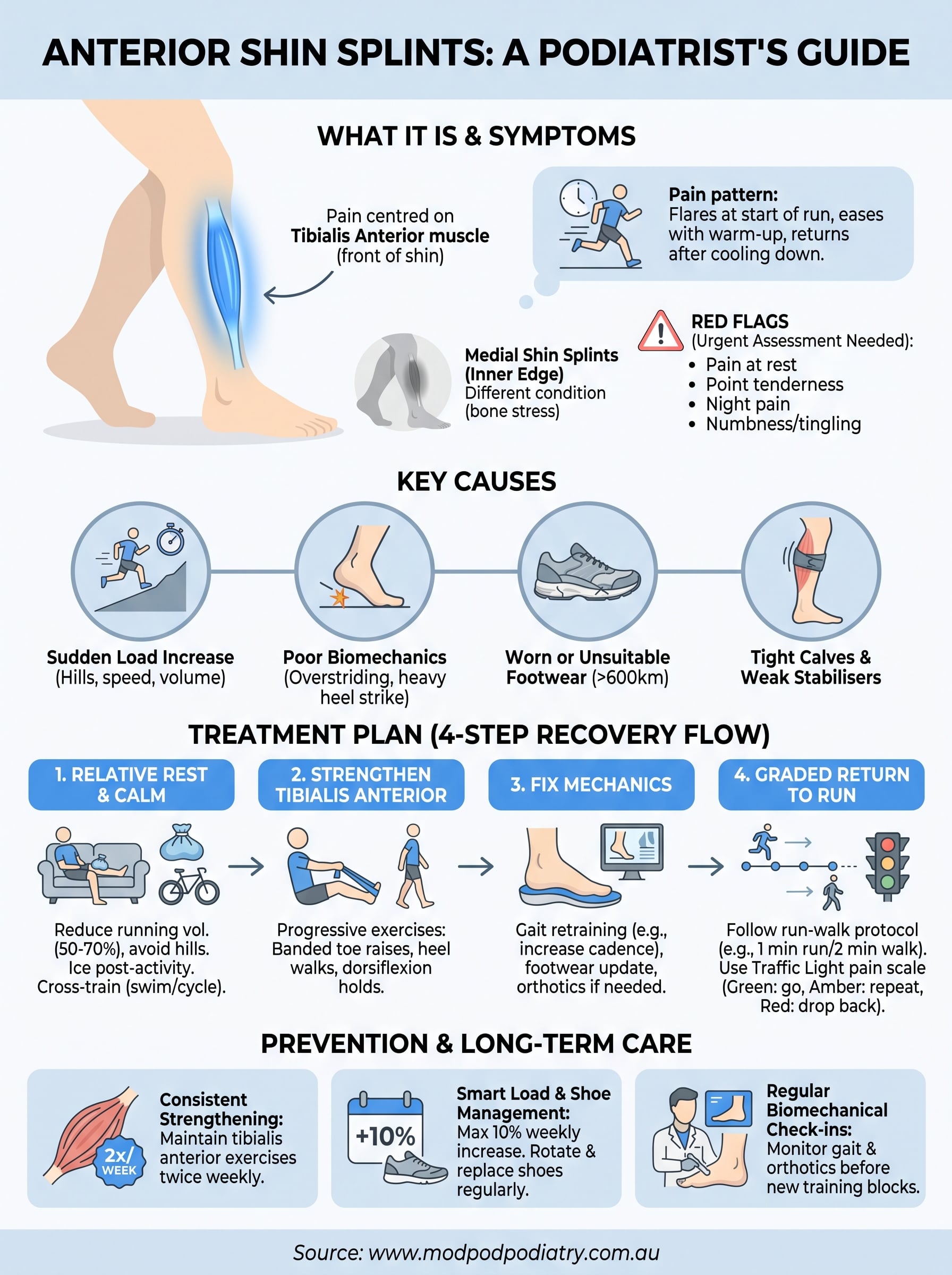
That sharp, aching pain along the front of your shin isn’t always the classic shin splint story you’ve read about online. If it flares up at the start of a run, sits at the front of your lower leg rather than the inner edge, and eases once you’re warmed up, you’re likely dealing with shin splints anterior, a problem centred on the tibialis anterior muscle rather than the more commonly discussed medial version.
This type develops when the muscle running down the front of your shin gets overloaded, usually from a sudden jump in training load, worn-out shoes, or poor lower limb biomechanics. Left untreated, it can progress into a stress reaction in the bone itself. Getting an accurate anterior tibialis shin splints treatment plan sorted early makes the difference between a two-week recovery and a two-month one.
Below, we break down exactly what causes this condition, the symptoms that set it apart from other shin pain, and the anterior shin splints treatment approaches our podiatrists use across our Sydney clinics, from load management and footwear changes to gait analysis and custom orthotics, so you can get back to running without the guesswork.
Why do anterior shin splints develop?
The tibialis anterior takes the brunt of the load
Your tibialis anterior muscle runs down the front of your shin and does two jobs every time you take a step: it lifts your foot clear of the ground during the swing phase, then it slowly lowers your foot to the floor after heel strike. That second job, called eccentric control, is the one that wrecks this muscle when things go wrong. Each time your foot hits the ground, the tibialis anterior is working hard to stop your forefoot slapping down too fast. Do that thousands of times on a run, and a muscle that hasn’t built the strength for the job starts to break down at a microscopic level, causing inflammation and pain along the shin.
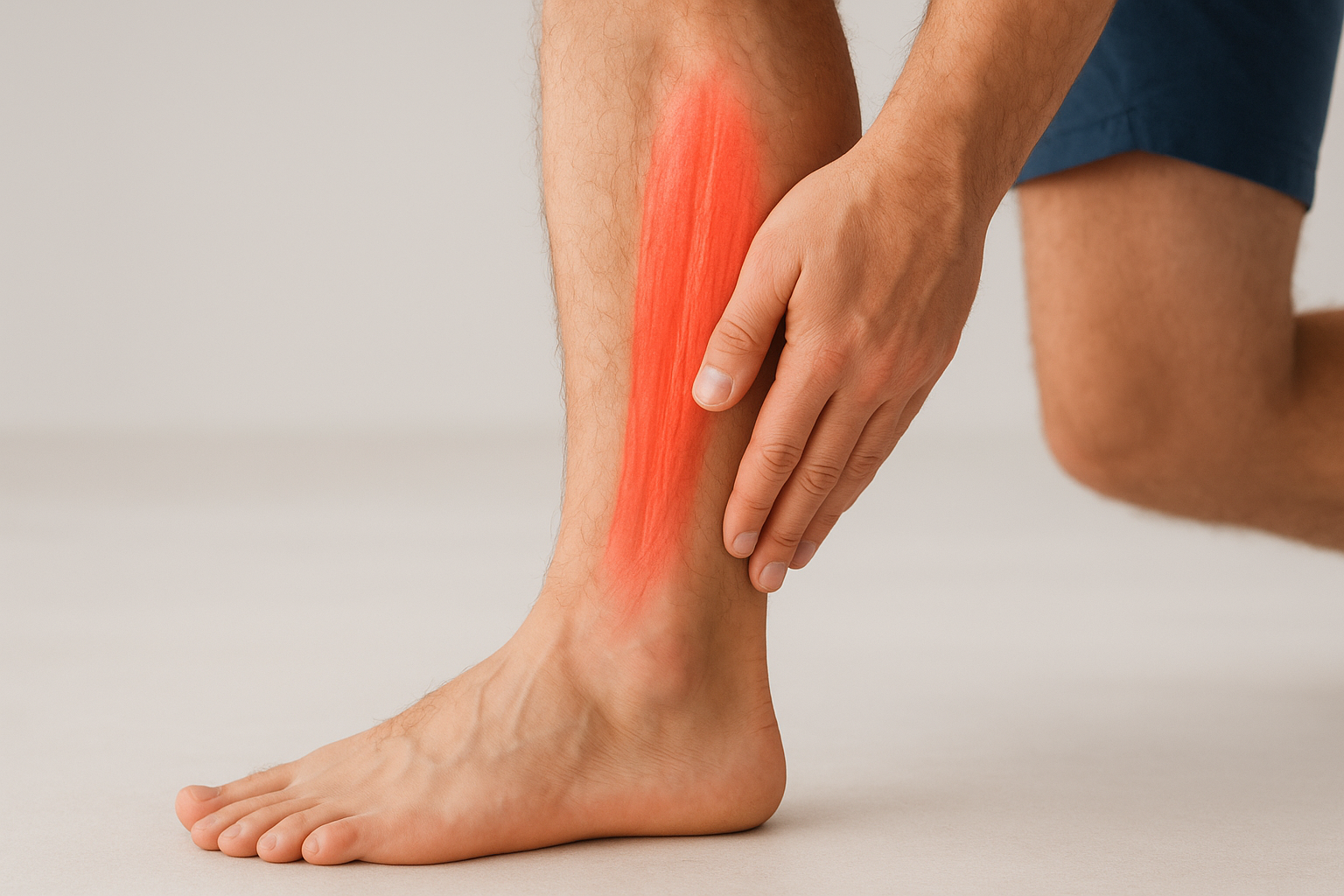
Anterior shin splints usually aren’t a shin bone problem at all, they’re a sign the tibialis anterior hasn’t built the strength to control your foot fall.
Sudden jumps in training load
Most cases we see in clinic come down to one thing, and it’s the most common cause of shin splints: doing too much, too soon. Runners who add hill sessions, speed work, or extra kilometres before their lower leg has adapted are the classic presentation. Downhill running is a particular trigger because it forces the tibialis anterior to work harder eccentrically to control the faster foot strike on a descent. Similarly, switching from a cushioned trainer to a minimalist or barefoot-style shoe without a gradual transition period puts sudden extra demand on this muscle group, since it now has to control dorsiflexion without the shoe’s built-in support.
Biomechanics and gait patterns that overload the shin
How you run matters just as much as how far you run. Overstriding, where your foot lands well in front of your body, forces the tibialis anterior to work overtime decelerating your foot before it makes contact. A heavy heel strike does the same thing. We also see this condition linked to weak hip and ankle stabilisers, which shift more of the shock-absorption workload onto the lower leg muscles rather than spreading it through the whole kinetic chain. Poor lower limb biomechanics like these rarely show up as an obvious limp or visible deformity, which is exactly why what a proper gait assessment measures picks up problems that go unnoticed by the runner themselves.
Other common contributing factors
A few other things regularly show up alongside the training and biomechanical triggers above. Worn-out running shoes lose their shock absorption long before they look obviously damaged, often somewhere between 500 and 800 kilometres depending on the shoe and your running style. Training on hard or uneven surfaces, like concrete footpaths or off-camber trails, adds extra strain with every step. Calves that tighten up from running can also force the tibialis anterior to overcompensate, since a restricted range of ankle dorsiflexion means the front of the shin has to work harder to clear the foot during swing phase.
| Contributing factor | Why it causes anterior shin splints |
|---|---|
| Rapid training load increase | Muscle hasn’t adapted to new eccentric demand |
| Downhill or hill running | Increases eccentric control needed from tibialis anterior |
| Overstriding or heavy heel strike | Forces the muscle to decelerate the foot harder |
| Worn-out or unsuitable footwear | Reduces shock absorption, shifts load to the shin |
| Tight calf muscles | Limits ankle dorsiflexion, overloading the front shin muscles |
| Weak hip and ankle stabilisers | Shifts shock absorption onto the lower leg |
Why some people are more prone than others
Anyone can develop anterior tibialis shin splints, but some runners are more susceptible than others. Beginners who ramp up mileage without a base level of conditioning, athletes returning from a break who resume their previous training volume too quickly, and people with naturally tight calves or reduced ankle mobility all sit in a higher-risk group. Structural factors play a role too, flat feet and high-arched feet both change how load travels through the lower leg, just via different mechanisms. This is where an in-clinic assessment earns its keep. Our podiatrists use pressure plate analysis and 3D scanning as part of a full biomechanical assessment to identify exactly which combination of these factors is driving your particular case, rather than guessing based on symptoms alone.
Symptoms of anterior shin splints and red flags to know
What anterior shin splints actually feel like
Most people describe a dull ache or sharp twinge along the outer front edge of the shin, roughly where the muscle belly of the tibialis anterior sits, rather than the inner border of the bone. Anterior shin splints symptoms typically show up in a predictable pattern: pain flares in the first five to ten minutes of a run, eases once the muscle warms up, then can return with a vengeance after you finish and the leg cools down. Pressing along the front of the shin usually reproduces the pain, and you might also notice tightness or a burning sensation that builds through longer sessions. Some runners also pick up mild swelling over the muscle itself, particularly after a hard hill session or a sudden jump in weekly distance.
How this differs from medial tibial stress syndrome
Getting the location right matters, because treatment for the anterior version differs from treatment for the far more common medial shin splints. Medial tibial stress syndrome, also called posterior shin splints, sits along the inner edge of the shin bone, often affects a longer stretch of the leg, and tends to worsen rather than ease as you warm up. Anterior shin splints, by contrast, concentrate over the muscle rather than the bone itself and follow that pattern of easing during activity before flaring afterwards. Confusing the two is easy without a hands-on assessment, since both cause shin pain during running and both respond poorly to rest alone if the underlying cause isn’t addressed.
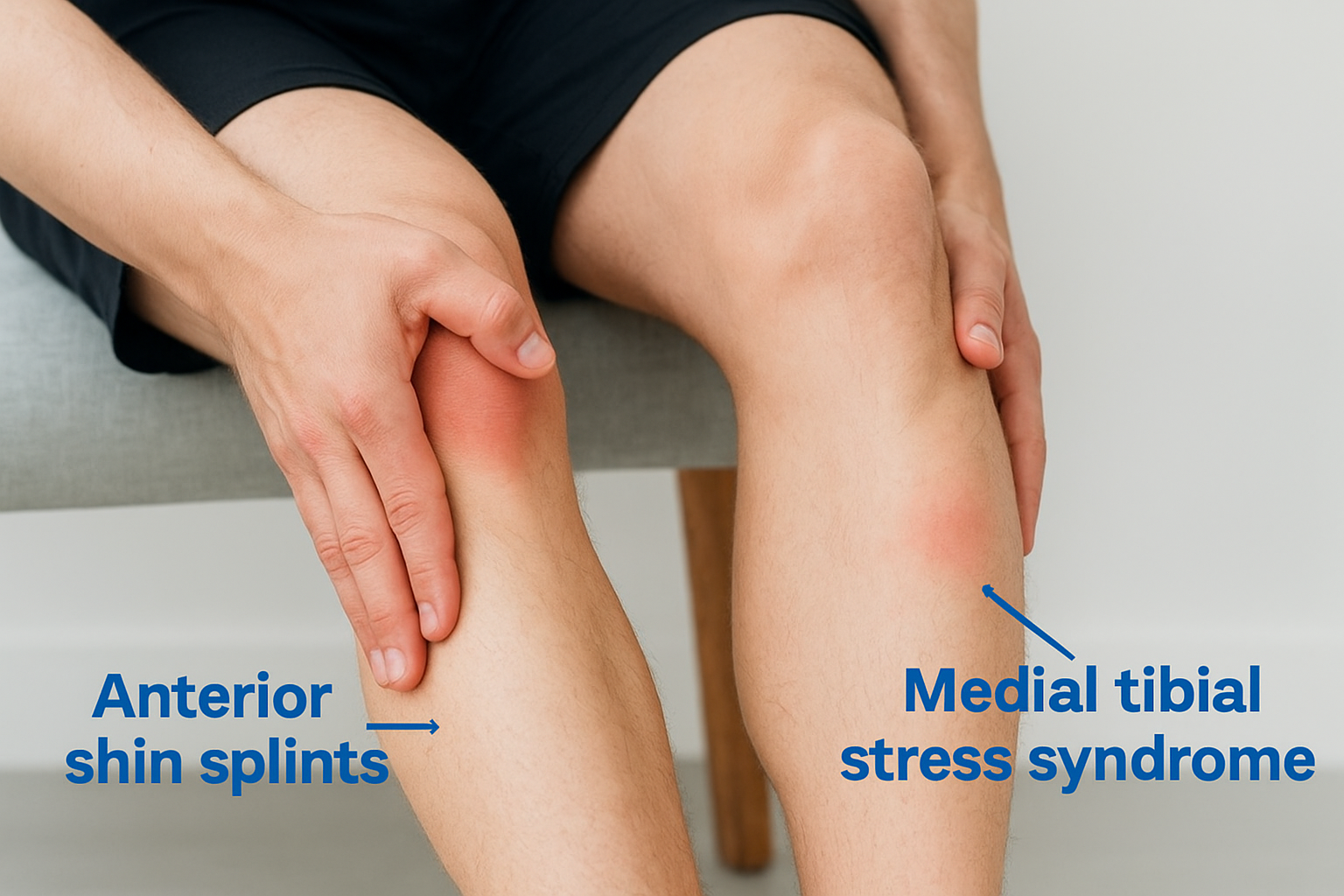
If your shin pain sits at the front rather than the inner edge and eases once you’re warmed up, that’s the clearest sign you’re dealing with the anterior version, not the standard medial shin splint.
Red flags that mean you need urgent assessment
Certain warning signs mean you shouldn’t wait for a routine appointment. These point toward a stress fracture in the shin bone or compartment syndrome rather than straightforward muscle overload, and both need prompt management to avoid a much longer layoff.
- Pain that persists at rest, rather than settling once you stop running or walking
- A specific point of intense tenderness you can pinpoint with one finger, rather than a broader ache across the muscle
- Pain that worsens rather than improves as a run progresses
- Numbness, tingling, or a tight, pressure-like sensation in the lower leg during exercise, which can suggest chronic exertional compartment syndrome
- Visible swelling or skin changes over the shin
- Night pain that wakes you or disrupts sleep, a symptom shared with other causes of lower leg pain at night
Runners who push through these red flags often turn a four-week recovery into a three-month one, because a genuine stress fracture needs a completely different loading strategy to a muscle strain. If any of these apply to you, book an assessment rather than trying to self-diagnose from a symptom list. Our podiatrists across the Sydney clinics regularly see patients who assumed they had straightforward shin splints and had actually developed a low-grade stress reaction in the tibia, picked up early through a proper clinical examination and imaging referral where needed.
Working out whether you’re dealing with muscle overload, a bone stress injury, or something else entirely isn’t something you should guess at, especially if you’re training for an event with a fixed date. A quick clinical check, including palpation, a hop test, and a look at your training log, usually gives a clear answer within the first consultation, setting you up for podiatrist-led shin splints care in Sydney rather than a generic rest-and-hope approach.
How to treat anterior shin splints
Start with relative rest, not total rest
Complete rest rarely fixes this problem, because the tibialis anterior needs some loading to recover its strength rather than losing what little conditioning it has. Relative rest means cutting your running volume by 50 to 70 percent, dropping hills and speed work entirely, and swapping some sessions for low-impact cross-training like swimming or cycling that doesn’t demand the same eccentric control from the shin. Total rest for two weeks followed by jumping straight back into your old training plan is exactly how this condition becomes a recurring problem, since the muscle never gets the graded loading it needs to rebuild capacity.
Calm the pain and inflammation down early
In the first week, ice and load management do more work than any other intervention, and they sit at the top of the home treatments that actually help shin splints. Applying ice for 15 to 20 minutes after activity helps settle the acute inflammation, and simple anti-inflammatories can take the edge off pain during the worst days, though they won’t fix the underlying overload issue on their own. Some patients respond well to a course of shockwave therapy, which we use in clinic to accelerate tissue healing in stubborn cases that haven’t settled with rest and load adjustment alone.
Ice and painkillers buy you comfort, but strengthening the tibialis anterior is what actually fixes anterior shin splints for good.
Strengthen the tibialis anterior directly
Once the acute pain has settled, the real fix starts: building eccentric strength in the muscle that’s been overloaded. This is the step most runners skip, and it’s why shin splints keep coming back season after season. A simple, progressive routine of shin splint strengthening exercises looks like this:
- Toe raises against resistance: loop a band around your forefoot (how to use resistance bands for foot exercises), anchor it, and slowly lower your foot down under control, 3 sets of 12 to 15 reps
- Seated dorsiflexion holds: pull your foot up toward your shin and hold for 5 seconds, building isometric endurance
- Heel walks: walk on your heels with toes lifted for 20 to 30 metres, repeated 3 to 4 times
- Standing tibialis raises: lean back slightly against a wall and raise your toes off the ground repeatedly, building fatigue resistance
Progress the resistance and volume week by week rather than jumping straight to advanced loading, since re-injuring an under-recovered muscle sets you back further than starting slow ever would.
Fix the mechanics driving the overload
Strengthening alone won’t hold if the biomechanical cause is still there waiting to reload the muscle the moment you return to full training. This is where footwear and gait correction earn their place in a proper treatment plan. If overstriding or a heavy heel strike is part of the picture, gait retraining cues, like aiming for a slightly higher cadence, reduce the deceleration demand on the tibialis anterior with every step. Worn shoes need replacing, and runners with flat or high-arched feet often benefit from orthotics made from a 3D scan of your foot and pressure plate analysis, which redistribute load away from the overworked front-shin muscle. Calf tightness gets addressed through a targeted stretching program for shin pain, since restoring ankle dorsiflexion range takes pressure off the tibialis anterior during the swing phase of running.
Combining these four elements, relative rest, symptom management, targeted strengthening, and mechanical correction, gets most runners back to full training within four to six weeks, which is in line with the usual shin splint recovery time. Skipping the strengthening or mechanical piece is the most common reason we see the same patient back in clinic three months later with the identical complaint.
How to return to running after anterior shin splints
Check you’re actually ready first
Before lacing up for a proper run, confirm you can manage daily activity pain-free. Return-to-run readiness means walking briskly, going up and down stairs, and doing single-leg calf raises without reproducing the shin ache. You should also be able to complete your full strengthening routine, including the resistance band toe raises and heel walks, without soreness the next day. Jumping back into running because the pain has settled at rest, without testing the muscle under load first, is one of the most common reasons this condition relapses within the first fortnight of returning.
Use a graded run-walk protocol
Going from zero running straight back to your old weekly distance is the fastest route back to the clinic. A graded return-to-run plan spreads the load increase over several weeks, giving the tibialis anterior time to adapt to repeated eccentric demand rather than being hit with it all at once. Here’s the progression we walk patients through:

| Week | Session structure | Frequency |
|---|---|---|
| 1 | 1 min run, 2 min walk, repeat for 20 minutes | 3 sessions |
| 2 | 2 min run, 1 min walk, repeat for 20 minutes | 3 sessions |
| 3 | 3 min run, 1 min walk, repeat for 25 minutes | 3–4 sessions |
| 4 | Continuous 20-minute easy run | 4 sessions |
| 5–6 | Build weekly volume by no more than 10 percent | 4–5 sessions |
Stick to flat, even surfaces during this phase and avoid hills, speed sessions, and trail running until you’ve completed at least four weeks pain-free. Adding those higher-demand sessions too early undoes the gradual loading you’ve just built.
Rushing the return-to-run progression is the single biggest reason anterior shin splints come straight back within a month of getting better.
Monitor pain using a simple traffic light system
Not every twinge means you’ve re-injured the muscle, but you need a clear rule for when to push on and when to pull back. A pain monitoring scale during return to running keeps this simple rather than something you second-guess after every session:
- Green (0–2/10 pain): continue the planned progression as normal
- Amber (3–4/10 pain): repeat the same week’s session before advancing, and add extra recovery time between runs
- Red (5/10 or higher, or pain that lingers past 24 hours): drop back two stages in the protocol and revisit your strengthening and load management before trying again
This approach keeps you moving forward without gambling on a setback that costs you another six weeks.
Keep strengthening while you rebuild running volume
Don’t drop the tibialis anterior strengthening work once running starts feeling comfortable again. The muscle is still adapting to running-specific load through this whole return phase, and stopping the eccentric exercises the moment symptoms ease is a common mistake. Keep the toe raises, heel walks, and dorsiflexion holds going two to three times a week through the full return-to-run period, tapering to a maintenance dose of once or twice weekly once you’re back to full training. If pain flares at any point during this progression, or you’re unsure whether a niggle is normal adaptation or a genuine setback, get it checked before pushing on. Our podiatrists can reassess your gait and loading tolerance mid-progression with a running assessment, adjusting the plan so you don’t lose the ground you’ve already made.
How to prevent anterior shin splints from returning
Build strength into your normal training week
Once you’re back running pain-free, don’t treat the strengthening work as a temporary fix you can drop, because it’s one of the key ways to stop shin splints coming back from running. Ongoing tibialis anterior conditioning twice a week, even just ten minutes of toe raises and heel walks, keeps the muscle capable of handling the eccentric load that running demands. Runners who stop strengthening the moment symptoms disappear are the ones who end up back in clinic with the same complaint six months later, usually right as they build toward a race and increase their weekly kilometres again.
Respect the 10 percent rule properly
Beyond week six of your return-to-run plan, keep applying the same load management principles that got you through recovery. Gradual training progression means capping weekly distance increases at around 10 percent, and treating any new addition, whether that’s hills, speed sessions, or a longer long run, as a single variable you introduce at a time. Adding hill repeats and a distance jump in the same week is a common trigger for relapse, because it stacks two new eccentric demands onto a muscle that’s only just rebuilt its baseline capacity.
Shin splints come back when training load rises faster than the tibialis anterior can adapt, not because the muscle was ever fully fixed.
Rotate footwear and check it regularly
Worn shoes are one of the easiest causes to prevent, yet one of the most commonly ignored. Track your kilometres and replace running shoes before they pass their mileage limit, roughly 600 to 700 kilometres, earlier if you’re a heavier runner or train on hard surfaces often. A simple footwear checklist helps keep this on your radar rather than relying on memory:
- Log your kilometres in a running app or diary rather than guessing shoe age
- Rotate between two pairs of running shoes to vary the load pattern slightly session to session
- Check the midsole for compression creases or uneven wear along the outer edge
- Match the shoe to your gait, since a neutral shoe on a runner who needs stability support reintroduces the same overload pattern
Keep an eye on the biomechanics that started this
If a gait assessment picked up overstriding, weak hip stabilisers, or a biomechanical driver behind your original injury, that factor doesn’t disappear once the pain does. Periodic check-ins with a podiatrist, particularly before a new training block or event, catch small mechanical drifts before they turn into a full flare-up, which is exactly what gait analysis shows a runner. Custom orthotics, if you were prescribed them, need reassessing every twelve to eighteen months as your foot posture and activity level change, and a repeat biomechanical assessment is worth booking if you notice the old symptoms creeping back even mildly.
Don’t skip the calf and hip work
Lastly, keep addressing the supporting muscle groups, not just the tibialis anterior itself. Tight calves and weak hip stabilisers were likely part of your original problem, and both drift back toward their old patterns without ongoing attention. Weekly calf stretching and simple hip strengthening, like clamshells and single-leg bridges, spread the shock-absorption workload back across the whole leg rather than dumping it all on the front of your shin every time you run.
Keeping your shins strong for the long run
Anterior shin splints feel stubborn, but they respond well once you treat the actual cause rather than just the pain. Getting the diagnosis right, loading the tibialis anterior properly, and fixing the mechanics behind the overload turns a recurring problem into a one-off setback. Consistent strengthening and a sensible approach to training load do more to keep you running than any amount of ice or rest ever will.
Zero in on the pattern early: pain at the front of the shin that eases with warm-up is your cue to act before it becomes a stress reaction in the bone. Proper gait assessment picks up the biomechanical drivers that self-treatment alone can’t fix, and it’s often the difference between one flare-up and a repeat visit every training season.
If your shins are giving you trouble, don’t wait for it to worsen. Book a shin pain assessment online with one of our podiatrists and get a plan built around your gait, your training, and your goals.