
Nail fungus photos show a nail that has turned white, yellow or brown, grown thick and started to crumble. The medical name for the infection is onychomycosis. Fungi live in and under the nail and feed on keratin, the protein that builds the nail. The infection starts as a small spot near the tip and spreads toward the base. Toenails get it more than fingernails.
This article describes what you see in fungus nail pictures at each stage, from the first white spot to a crumbling nail. You will learn why the look of your nail matters, how to take a useful photo of your own toenails, how to tell fungus from nail psoriasis and other look-alikes, and what a podiatrist does next.
ModPod Podiatry has treated feet, ankles and lower limbs across Sydney for over 20 years. Our podiatrists diagnose fungal nails by sight, so the signs below match what we check in the clinic.
Why the look of your nail matters
The look of your nail matters because it is the first clue to the cause, and the cause decides the treatment. A thick, discoloured nail can come from fungus, psoriasis, injury or bacteria. Each one needs a different plan.
A look-alike needs a different treatment
Fungus, nail psoriasis, injury and bacterial infection can all thicken or stain a nail. A product that helps one can harm another. Steroid creams used for psoriasis can make a fungal infection worse. A person who treats "fungus" at home for months, when the real cause is psoriasis, loses time and gains no change.
A clear photo gives you and your podiatrist a record to compare. It shows what the nail looked like on day one, which helps when the nail changes slowly.
Fungus spreads and gets harder to clear
Fungus is contagious. It moves from nail to nail and to the skin between your toes, where it causes athlete’s foot. It also passes between people through damp floors, towels and shared nail clippers. Early treatment deals with a small patch. A thick, ragged nail gives the fungus more room to hide and gives topical treatments more to get through.
Some people carry a higher risk of getting nail fungus:
- Older age
- Sweaty, closed shoes
- A past case of athlete’s foot
- Walking barefoot in damp public places such as pools, gyms and shower rooms
- A minor nail or skin injury
- A skin condition that affects the nails, such as psoriasis
- Diabetes, poor blood flow or a weak immune system
If you have diabetes and you see any change in a toenail, book a podiatry visit soon. A small nail problem can lead to a larger foot problem.
A nail photo cannot give a diagnosis, but it tells you when to stop guessing and get your nail checked.
What nail fungus looks like at each stage
Nail fungus moves through stages that you can see and photograph. It starts with a small white or yellow-brown spot and ends with a thick, crumbling nail that lifts from the nail bed. The table sets the stages side by side.
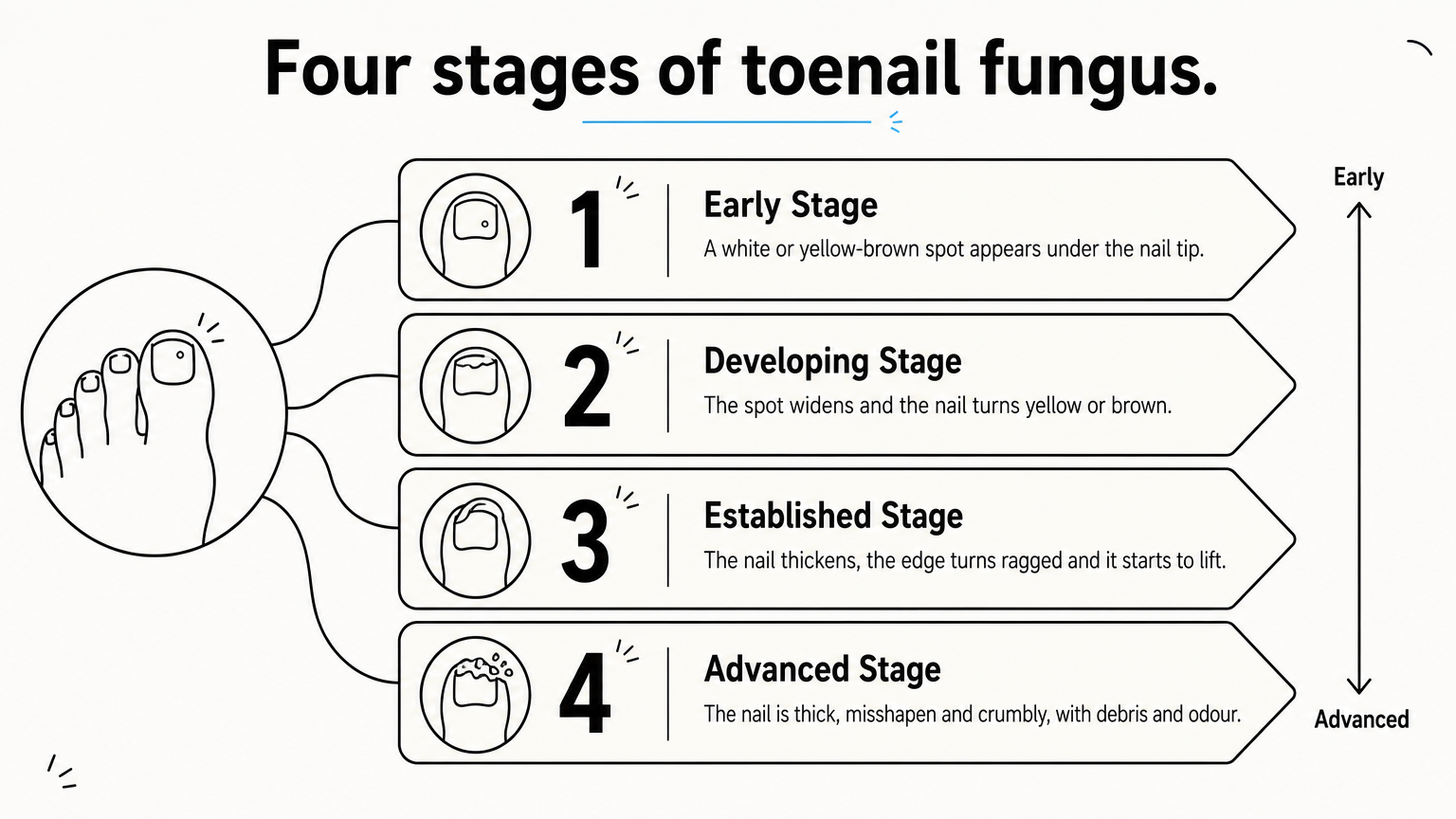
| Stage | What you see | Nails involved |
|---|---|---|
| Early | A white or yellow-brown spot under the tip or edge of the nail | One nail |
| Developing | The spot widens, the nail turns yellow or brown and the surface looks dull | One to a few nails |
| Established | The nail thickens, the edge turns ragged and the nail starts to lift | Several nails, with possible skin peeling between toes |
| Advanced | The nail is thick, misshapen and crumbly, with debris and odour, and shoes press on it | Multiple nails |
Early signs: the first spot
In an early photo, the nail still looks like a nail. You see a small white or yellow-brown mark under the free edge, often on the big toe or little toe. The nail is firm and the shape is normal. Most people ignore this stage because it causes no pain.
One spot on one nail is the classic start. The mark does not wash off or grow out in a few weeks. It spreads a little toward the cuticle with time.
Advanced signs: thick, crumbling nails
In an advanced photo, the nail has changed shape. It is thick and ragged, and the edges break away in flakes. The nail may lift from the nail bed and leave a gap filled with chalky debris. It can smell. Shoes press on the raised nail, so walking can hurt.
At this stage, nail clipping becomes hard and the nail can catch on socks. Fungus can also spread to the skin around the nail.
Colour clues in nail fungus pictures
Colour is the sign most people check first. Here is what each shade can mean:
- Yellow or yellow-brown: the common sign of fungus under the nail.
- White: chalky patches on the surface, or a white area under the tip.
- Brown: debris building under the nail as the infection deepens.
- Green or black: this can point to a bacterial infection on top of, or instead of, fungus.
Colour alone does not prove fungus, because bruises, polish stains and psoriasis can change colour too. Use colour together with thickness, shape and how many nails are involved.
Nail fungus starts as one small spot on one nail, then thickens, darkens and crumbles over many months.
How to take and read photos of your own nails
A useful nail photo is sharp, close and taken in daylight, and you repeat it every two weeks. Good photos let you see change that you would miss in a mirror. They also help your podiatrist judge how fast the nail is changing.
Steps for a clear photo
- Wash and dry your feet. Remove nail polish, because polish hides colour and thickness.
- Stand near a window in daylight. Turn off the flash, which washes out colour.
- Place your foot on a plain white towel or sheet of paper.
- Photograph the top of each toenail from directly above, then the side of the nail to show thickness.
- Take one wide shot of the whole foot, including the skin between your toes.
- Keep the same distance and angle each time, and repeat every two weeks. Save each photo with its date.

What to check in your photos
Look at each photo and ask these questions:
- What colour is the nail, and is the colour spreading?
- Is the nail thicker than the same nail on your other foot?
- Is the shape still smooth, or are there ridges, splits or ragged edges?
- Does a gap show between the nail and the nail bed?
- Is the skin between your toes red, dry or peeling?
- How many nails show changes, and are they all on one foot?
Photos cannot show smell or pain, so add a note for each. A sweet or foul odour and soreness in shoes both help a podiatrist.
Compare the nails on both feet. Fungus tends to start in one nail, while conditions such as psoriasis tend to change several nails at once. A dated photo series also shows whether a treatment works, because new healthy nail grows from the base.
Take the same photo of the same nail every two weeks, and you will see change that a mirror hides.
Nail fungus or something else?
Nail fungus starts in one toenail, can smell, and spreads slowly. Nail psoriasis tends to hit several nails, rarely smells and cannot spread to other people. Other causes, such as bruising, can look the same in a photo.
Fungus compared with nail psoriasis
Psoriasis is an immune condition. Fungus is an infection. Both can thicken the nail, change its colour and lift it from the nail bed. The table lists the signs that set them apart.
| Sign | Nail fungus | Nail psoriasis |
|---|---|---|
| Cause | Fungal infection | Overactive immune system |
| Contagious | Yes | No |
| Common site | Toenails | Fingernails and toenails, more on fingers |
| Number of nails | Starts in one, may spread | Several nails at once |
| Surface | Thick, dull, crumbly | Tiny pits or dents |
| Colour | White, yellow, brown, green, black | Yellow-pink or "oil drop" patches, red lines under the nail |
| Smell | Can be foul | Rare |
| Skin | Peeling between toes (athlete’s foot) | Red, scaly patches elsewhere on the body |
You can have both at once. A nail that psoriasis has lifted from its bed gives fungus a gap to enter. If you have psoriasis on your skin and your nails change, ask for an assessment before you use any cream on the nail.
Other causes of a changed nail
A bruise under the nail looks dark red, purple or black. It follows a knock, or repeated pressure from tight shoes in sport or on long walks. Unlike fungus, a bruise does not spread across the nail. It moves toward the tip as the nail grows.

A bacterial infection can turn the nail green or black. A yellow stain can come from nail polish, which fades once you stop wearing it.
A dark brown or black stripe that runs from the cuticle to the tip, with no injury behind it, needs a prompt check. Do not wait for it to grow out. See your doctor or a podiatrist soon so they can decide if you need further tests.
If the nail has one spot, one nail and a smell, think fungus. If it has pits, many nails and skin patches, think psoriasis.
What to do once you spot the signs
Book an assessment. A podiatrist can confirm fungus by looking at your nails, then plan treatment. You do not need a GP referral to see a podiatrist at ModPod Podiatry.
What happens at your appointment
Our podiatrists diagnose fungal nails by sight. We take no clippings and send nothing to a lab. Treatment can start the same day. We offer same-day appointments across our five Sydney clinics whenever we can.
A new patient initial consult costs $135 and covers your history, diagnosis and treatment plan. Bring your photo series if you have one. It shows how fast the nail changed.
Laser treatment for fungal toenails
We treat fungal toenails with the Lunula cold laser. The treatment is painless, each session takes about 12 minutes and you have no downtime. Most courses run four sessions, though some people need between 3 and 6. The clinic quotes a success rate of 75 to 90 percent.
Here is a worked example. The first session costs $205 because it includes nail preparation for the laser. Each follow-up session costs $160. A four-session course comes to $205 plus three sessions at $160, which is $685. We do not bulk bill, but we give you a receipt for your private health fund, and HICAPS lets you claim on the spot. We also accept Medicare EPC plans for eligible patients.
A toenail grows slowly, so a full clear nail can take 12 to 18 months. Judge progress by the clear band of new nail at the base. Keep taking your photos, because they show that band before you can feel any change.
Keep fungus from returning
Fungus can return after a clear nail grows out. These habits lower the risk:
- Keep your feet clean and dry, and dry between your toes.
- Cut your nails straight across and file down thick areas.
- Disinfect nail clippers after each use.
- Wear socks that absorb sweat, and change them during the day.
- Choose shoes that breathe, and treat or replace old shoes.
- Wear sandals in pool areas and locker rooms.
- Treat athlete’s foot as soon as you see it.
Treat the nail and the skin between your toes together, or the fungus can return from the skin.
Get your nails checked
Nail fungus photos follow a clear pattern. You see a white or yellow-brown spot, then a thick, dull nail, then a ragged, crumbling nail. Your own photos, taken in daylight every two weeks, show how fast your nails change. Psoriasis, bruising and bacteria can mimic fungus, so a podiatrist should confirm what you see.
If your toenails match the signs in this guide, you can book a fungal nail appointment at one of our Sydney clinics in the CBD, Mosman, Dee Why, Rose Bay or North Ryde. Bring your photos. We will look at your nails, tell you what they show and start treatment the same day.