
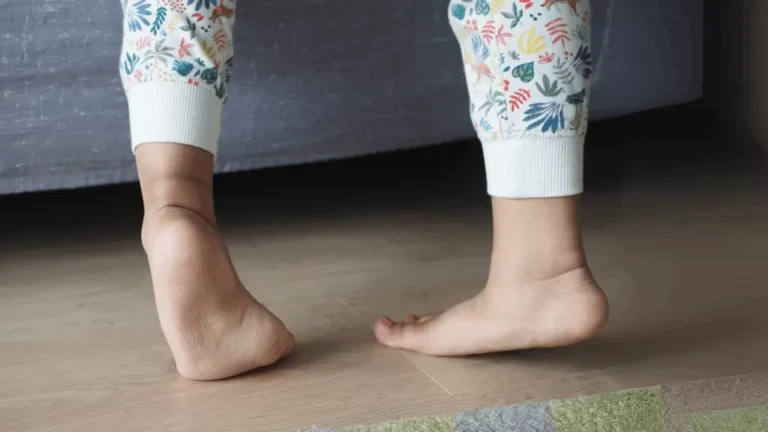
If your child’s toes point inward when they walk, you’re not alone. Pigeon toes — or in-toeing — is one of the most common reasons parents visit a podiatrist. The good news: most children grow out of it without treatment. But some cases need a closer look.
This guide explains what causes pigeon toes, when it’s part of normal development, and when you should seek professional advice.
What Causes Pigeon Toes?
In-toeing happens when any part of the leg between the hip and the foot rotates inward. It’s not a single condition — it’s a visible pattern that can come from three different places in the body. The cause depends on where the rotation starts.
Most cases show up when a child starts walking, between 12 and 18 months. Parents notice the feet turning in during running or when the child is tired. In most children, the rotation reduces as bones grow and muscles strengthen.
Understanding which level the in-toeing comes from helps guide whether treatment is needed — and what kind.
The Three Levels of In-Toeing
1. Metatarsus Adductus (the foot)
This is the most common cause in babies and infants. The front half of the foot curves inward while the heel stays straight. If you look at the sole of your baby’s foot, it may have a slight “C” shape.
Metatarsus adductus is often linked to the baby’s position in the womb. Most cases resolve on their own by age 1–2. If the foot is flexible — meaning you can gently straighten it — it almost always corrects without intervention. A stiff or rigid curve may need monitoring or, in rare cases, a referral.
2. Internal Tibial Torsion (the shin)
Here, the shinbone (tibia) is twisted inward. This is the most common cause of pigeon toes in toddlers aged 1–3. You’ll often see it on both sides, and it’s more obvious when the child runs.
Internal tibial torsion corrects on its own in the vast majority of children by age 4–5. The tibia naturally rotates outward as the child grows. Special shoes, braces, and inserts have not been shown to speed up this process — and most paediatric guidelines no longer recommend them for this cause alone.
3. Femoral Anteversion (the hip)
This is the most common cause in children aged 3–8. The thighbone (femur) has more inward rotation than usual at the hip joint. Children with femoral anteversion often sit in a “W” position and may run with both their knees and feet pointing inward.
Femoral anteversion peaks around age 5–6 and then gradually improves. Most children see significant improvement by age 8–10. It tends to run in families and is more common in girls.
Will My Child Grow Out of It?
In short: most likely, yes. Studies show that around 80–90% of children with in-toeing improve without any treatment. The bones and joints remodel as the child grows, and the rotation reduces over time.
Each of the three causes has its own timeline:
Metatarsus adductus — usually resolves by age 1–2.
Internal tibial torsion — usually resolves by age 4–5.
Femoral anteversion — usually improves by age 8–10.
That said, “wait and see” doesn’t mean “ignore it.” A children’s podiatry assessment can confirm which type your child has, track progress over time, and flag anything that isn’t following the expected path.
Red Flags to Watch For
While most pigeon toes are harmless, certain signs suggest the in-toeing needs professional attention. Book an assessment if your child has any of the following:
Frequent tripping or falling. Occasional stumbles are normal for toddlers. But if your child trips more than their peers — especially after age 3 — the in-toeing may be affecting their balance and coordination.
Pain in the feet, legs, or hips. In-toeing itself shouldn’t hurt. If your child complains of pain or avoids physical activity, something else may be going on.
Asymmetry. If one foot turns in much more than the other, or one leg looks different from the other, it’s worth investigating. Uneven rotation can point to an underlying structural issue.
Getting worse after age 3. Pigeon toes should be stable or improving by this age. If the in-toeing is becoming more obvious, have it checked.
Stiff or rigid foot. If your baby’s curved foot doesn’t straighten when you gently press it, the metatarsus adductus may need closer monitoring.
How a Podiatrist Assesses In-Toeing
A podiatrist can pinpoint exactly where the rotation is coming from and whether it falls within the normal range for your child’s age. At ModPod Podiatry, a kids’ foot assessment includes:
Digital video gait analysis. We record your child walking and running so we can review their movement in slow motion. This picks up rotation patterns that are hard to see at full speed.
Hip rotation range of motion testing. By measuring how far the hip rotates inward and outward, we can identify femoral anteversion and track it over time.
Tibial torsion measurement. We check the angle of the shinbone relative to the foot to assess internal tibial torsion.
Foot shape assessment. For younger children, we look at the shape of the forefoot to check for metatarsus adductus.
We also look at overall lower limb alignment, muscle strength, and foot posture. In some children, in-toeing and flat feet occur together, which may change the treatment approach.
Treatment Options
Treatment depends on the cause, the child’s age, and whether the in-toeing is causing any functional problems.
Monitoring
For most children, the right approach is structured monitoring. We measure the rotation at regular intervals — usually every 6–12 months — to make sure it’s improving at the expected rate. This gives parents clear data rather than guesswork.
Footwear Advice
The right shoes won’t fix in-toeing, but the wrong shoes can make it harder for your child to walk well. We recommend supportive, well-fitting shoes with a firm heel counter and a flexible forefoot. Avoid stiff shoes that restrict natural foot movement.
Orthotics
If the in-toeing involves a foot-level issue — like metatarsus adductus combined with flat feet — custom orthotics can help control foot position and improve gait patterns. Orthotics work best when the foot itself is contributing to the problem, rather than the shin or hip.
Exercises and Activity
For children with femoral anteversion, encouraging activities that use outward hip rotation — like swimming (breaststroke kick), cycling, and cross-legged sitting instead of W-sitting — can support natural correction. We may also prescribe specific stretches or strengthening exercises depending on the child’s assessment findings.
When Is Referral Needed?
Surgical intervention for in-toeing is rare and only considered in severe cases that haven’t improved by age 8–10 and are causing significant functional problems. If your child needs a referral to a paediatric orthopaedic surgeon, we’ll guide you through that process.
For children who are active in sports, in-toeing can sometimes affect performance or increase injury risk. A podiatrist experienced in sports biomechanics can assess whether the in-toeing is a factor and recommend strategies to manage it.
Book a Children’s Podiatry Appointment
If your child’s pigeon toes are worrying you, a professional assessment can give you clarity. Most in-toeing is normal — but knowing exactly what’s going on and having a plan to track it makes a real difference.
At ModPod Podiatry, our podiatrists see children with in-toeing every week across our 5 Sydney clinics — CBD, Mosman, Dee Why, Rose Bay, and North Ryde. We’ll assess your child’s gait, explain what we find in plain language, and give you a clear recommendation on whether treatment is needed or monitoring is the right path.
Book a children’s podiatry appointment at a clinic near you.