


A stress fracture can sideline you from everything, your training, your daily routine, even your walk to work. If you’re dealing with one right now, the first question on your mind is probably how long does a stress fracture take to heal and when you can safely get moving again. The honest answer is that it depends on several factors, but most stress fractures follow a reasonably predictable recovery timeline when managed correctly.
The tricky part is that stress fractures don’t always announce themselves clearly. A dull ache that worsens with activity can easily be dismissed as general soreness, which means many people keep loading the bone and delay their recovery without realising it. Where the fracture sits, how severe it is, and what you do (or don’t do) in the early weeks all play a significant role in how quickly you return to full activity.
At ModPod Podiatry, our podiatrists regularly treat stress fractures of the foot and lower limb across our five Sydney clinics. Below, we’ll walk you through realistic healing timelines, the key factors that influence recovery, and the steps you can take to give your bones the best chance of healing properly.
Why stress fracture healing times vary
No two stress fractures heal at exactly the same rate. The location of the fracture, its severity, and your individual biology all interact to produce a recovery timeline that is unique to you. Understanding these variables helps you set realistic expectations and avoid the common mistake of returning to activity too soon, which is one of the most frequent reasons stress fractures become a longer-term problem.
The location of the fracture matters
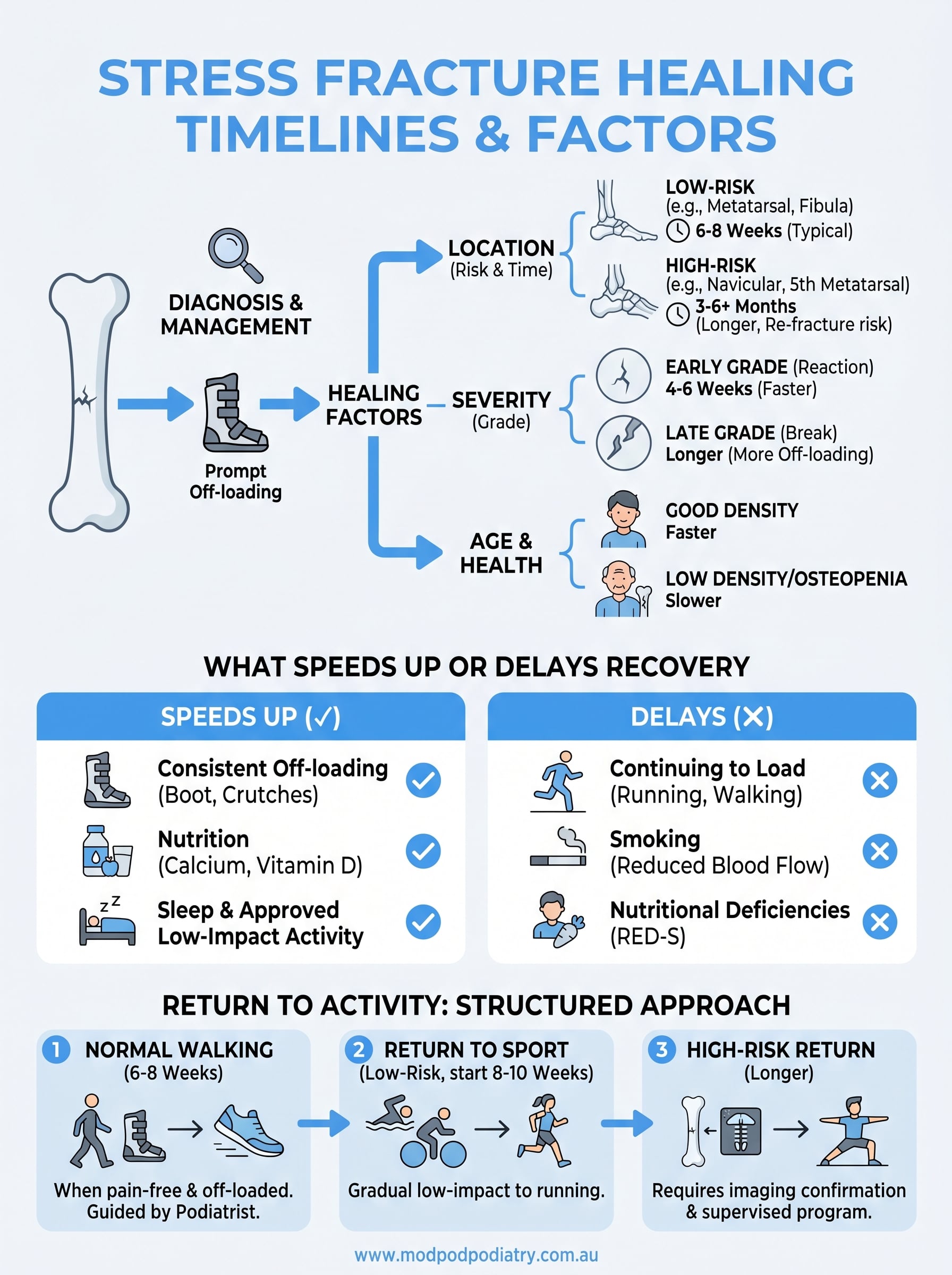
Stress fractures occur in different bones, and some locations are far more demanding to rest than others. Metatarsal stress fractures (the long bones running through the middle of the foot) are among the most common seen in runners and active people, and they generally heal within six to eight weeks with proper off-loading. However, fractures in higher-risk sites such as the navicular, the fifth metatarsal base (Jones fracture), or the anterior tibial cortex carry a significantly longer healing timeline and a greater risk of non-union because those areas receive less blood supply or remain under persistent load during everyday walking.
A navicular or Jones fracture can take three to six months to fully heal, and some cases require surgical intervention if conservative management fails.
Fracture severity and grading
Clinicians grade stress fractures based on imaging findings, typically ranging from a Grade 1 (a minor stress reaction within the bone marrow) through to a Grade 4 (a complete cortical break visible on imaging). Lower-grade stress reactions in the early stages often resolve in four to six weeks if activity is modified promptly. A Grade 3 or 4 fracture, where there is visible disruption to the bone on MRI or CT, will generally require a longer period of immobilisation and may need a walking boot or non-weight-bearing management for several weeks.

Catching a stress fracture at an early grade makes a meaningful difference to your total recovery time. Many people first notice pain weeks before they seek assessment, which gives the injury time to progress from a manageable stress reaction to a more significant fracture. Getting imaging done early gives your treating podiatrist or medical team accurate information to guide your management from the start.
Your age and bone health
Your bone density and overall bone health have a direct bearing on how long does a stress fracture take to heal. Younger athletes with good bone density tend to recover faster than older individuals, particularly post-menopausal women who may have reduced bone mineral density. Conditions such as osteopenia or osteoporosis slow the remodelling process that allows bone to repair itself, and a podiatrist managing a stress fracture in a patient with low bone density will often coordinate with a GP or endocrinologist to address underlying nutritional or hormonal factors alongside the foot injury.
How you manage load after injury
The decisions you make in the first two weeks after diagnosis significantly shape your recovery. Continuing to walk or train on a stress fracture delays bone healing and risks converting a Grade 2 injury into a Grade 3 or 4. Appropriate off-loading, whether through a moon boot, crutches, or structured activity modification, reduces the mechanical stress on the fracture site and allows the initial bone repair process to begin without interruption. Your podiatrist will determine the right level of restriction based on the fracture location, grade, and your daily demands.
Typical stress fracture healing timelines
Understanding how long does a stress fracture take to heal across different sites gives you a realistic baseline to work from. These timeframes assume you follow your treating podiatrist’s advice and keep the fracture properly off-loaded. Pushing back into activity before the bone has consolidated is the most common way people end up with a much longer recovery than necessary.
Foot and metatarsal stress fractures
Metatarsal stress fractures are the most common type seen in runners, dancers, and people who have recently increased their activity levels. With appropriate rest and off-loading, most metatarsal fractures heal within six to eight weeks. Lower-grade injuries caught early can sometimes resolve closer to the four-to-six-week mark, particularly in younger patients with good bone density.
Your podiatrist will typically reassess you at the four-week mark to check your pain response and, where indicated, arrange follow-up imaging to confirm bone healing before clearing you for a gradual return to load.
Tibia and fibula stress fractures
Tibial stress fractures are common in distance runners and military personnel. Posteromedial tibial fractures, the type affecting the inner, rear surface of the shin, generally heal within six to ten weeks. The anterior tibial cortex is a different story. Fractures on the tension side of the tibia face a higher non-union risk, and healing timelines can extend to four to six months in more severe cases. Fibula stress fractures tend to heal at a similar rate to metatarsal fractures, usually within six to eight weeks, because the fibula bears less load during walking.
If your shin pain is located on the front of the tibia rather than the inner surface, seek imaging promptly as this location carries a significantly higher complication risk.
Navicular and fifth metatarsal stress fractures
These two locations are classified as high-risk stress fractures due to limited blood supply and persistent mechanical load during daily movement. Navicular fractures typically require eight to twelve weeks of strict non-weight-bearing in a cast or boot, with some cases taking up to six months. Fifth metatarsal base fractures (Jones fractures) carry a well-documented re-fracture risk if returned to sport prematurely, and athletes often require twelve to sixteen weeks of protected recovery, or surgical fixation if healing stalls.
What speeds up or delays recovery
Several factors within your control directly influence how long does a stress fracture take to heal, and making the right decisions early in recovery can shave weeks off your total downtime. The two most important are consistent load management and meeting your nutritional needs, both of which support the biological process of bone remodelling that allows the fracture to consolidate.
Factors that support faster healing
Prompt diagnosis and immediate off-loading give your bone the best possible environment to repair. When you reduce mechanical stress on the fracture site in the first two weeks, the initial cellular repair process can begin without ongoing disruption. Following your podiatrist’s off-loading instructions consistently, whether that means wearing a moon boot, reducing walking distance, or temporarily using crutches, makes a genuine difference to your recovery trajectory.
Calcium and vitamin D intake play a direct role in how efficiently your body lays down new bone. If your diet is low in dairy, leafy greens, or oily fish, or if you spend limited time outdoors, your bone repair process may be slower than it needs to be. Your GP can check your vitamin D levels with a simple blood test, and supplementation is often recommended alongside dietary changes during recovery.
Getting adequate sleep also supports bone healing, as the majority of bone remodelling occurs during deep sleep cycles when growth hormone activity is at its peak.
Physical activity that does not load the fracture site, such as swimming or upper body conditioning, helps you maintain fitness without interfering with healing. Staying active in ways your podiatrist approves also supports circulation to the injury site, which aids the delivery of nutrients needed for repair.
Factors that delay healing
Continuing to load the fracture is the single biggest driver of delayed recovery. Even light jogging on a metatarsal fracture that feels manageable can prevent the bone from consolidating and push a Grade 2 injury toward Grade 3. Smoking is another significant factor. Research consistently links tobacco use to impaired bone healing due to reduced blood flow and lower osteoblast activity, meaning the cells responsible for building new bone are less effective.
Nutritional deficiencies, particularly low bone density linked to under-fuelling in athletes, are also common contributors. This is particularly relevant in female distance runners, where relative energy deficiency in sport (RED-S) can suppress bone repair even when off-loading is done correctly.
Safe return to walking, work and sport
Returning to normal activity after a stress fracture requires a structured, gradual approach. Rushing back to walking, work, or sport before the bone has fully consolidated is the most common reason people end up reinjuring themselves and extending an already frustrating recovery. Understanding when you are ready to progress and how to do so safely is just as important as the rest and off-loading you do in the early weeks.
Returning to daily walking and work
Most people with a foot or lower limb stress fracture can return to normal walking within six to eight weeks, provided they have been properly off-loaded and their pain has fully resolved. Before you stop wearing a boot or transition back to regular footwear, your podiatrist will assess your symptoms and may arrange follow-up imaging to confirm the fracture has consolidated. If you have a desk-based job that involves minimal walking, you may be cleared to return to work sooner, sometimes within two to four weeks while still wearing a moon boot.
If your role involves prolonged standing, walking on hard surfaces, or carrying loads, your return timeline will be longer and needs to be guided by your treating podiatrist. Going back to a physically demanding job too early places the same type of repetitive stress on the healing bone that caused the fracture initially.
If pain returns when you increase your walking distance, reduce the load immediately and contact your podiatrist before progressing further.
Returning to sport and training
How long does a stress fracture take to heal before you can safely train again? For low-risk fractures such as metatarsal or fibula injuries, most athletes can begin a structured return-to-sport programme at eight to ten weeks. This typically starts with low-impact activity such as swimming or cycling, then progresses to walking, jogging, and sport-specific drills over four to six additional weeks.

High-risk fractures, including navicular and Jones fractures, require a more conservative return. Your podiatrist should not clear you for running until imaging confirms consolidation and you have completed a supervised loading programme without pain. Jumping straight back into training without completing these steps significantly increases the risk of re-fracture, which resets your entire recovery timeline.
When to see a podiatrist and what to expect
Many people wait too long before seeking professional assessment for foot or lower limb pain. If you have localised bone tenderness, pain that worsens with activity and eases with rest, or swelling over a specific point on your foot or shin, these are signs you need an assessment rather than a wait-and-see approach. The earlier you get a diagnosis, the more control you have over how long does a stress fracture take to heal from that point forward.
Signs you should not ignore
Bone pain that follows a recent increase in training load or physical activity is one of the clearest warning signs of a stress fracture. You should book an appointment promptly if you notice pain that starts during exercise and does not settle within a day or two of rest, or if pressing on a specific point along the foot or shin reproduces sharp, localised discomfort. Waiting for the pain to resolve on its own while continuing to train significantly increases the risk of a low-grade stress reaction progressing to a more serious fracture.
If you experience sudden, severe pain during exercise that stops you in your tracks, seek assessment the same day rather than resting and hoping it settles.
What happens at your first appointment
At your initial podiatry consultation, your podiatrist will take a detailed history of your symptoms, training load, and any recent changes in activity. They will perform a physical assessment including palpation of the affected area and, where relevant, a biomechanical assessment to identify any contributing gait or foot mechanics issues. If a stress fracture is suspected, your podiatrist will refer you for appropriate imaging, typically an MRI for early-stage injuries or an X-ray for more advanced fractures, to confirm the diagnosis and grade the injury accurately.
Ongoing management and follow-up
Once you have a confirmed diagnosis, your podiatrist will build a structured management plan tailored to the fracture location, grade, and your daily activity demands. This includes off-loading advice, footwear recommendations, and a staged return-to-activity plan. Follow-up appointments allow your podiatrist to monitor your progress, adjust your management as the bone heals, and clear you for each stage of activity based on your symptoms and imaging findings rather than guesswork.
Next steps
How long does a stress fracture take to heal depends on where the fracture sits, how early you catch it, and how consistently you manage your load during recovery. Most foot stress fractures resolve within six to ten weeks when managed properly, but high-risk sites like the navicular and fifth metatarsal can take considerably longer. The decisions you make in the first two weeks after symptoms appear have a direct impact on your total recovery time.
If you have foot or lower limb pain that worsens with activity and eases with rest, do not wait to see if it settles on its own. Getting an accurate diagnosis early gives you the best chance of a straightforward recovery and reduces the risk of a low-grade stress reaction becoming a more serious fracture. The team at ModPod Podiatry can assess your symptoms, arrange appropriate imaging, and build a structured plan to get you back on your feet. Book an appointment online at one of our five Sydney clinics.