


A stress fracture doesn’t happen because of one bad step or a single awkward landing. It develops gradually, tiny cracks forming in bone when stress fracture foot causes like repetitive loading, sudden training changes, or inadequate recovery push your skeleton past its ability to repair itself. By the time you notice the ache, the damage has often been building for weeks.
Understanding what actually triggers these injuries matters, because most stress fractures are preventable. They follow patterns. Certain activities, foot structures, training habits, and even nutritional gaps create the conditions for bone to fail under loads it would normally handle. Recognising these risk factors early can be the difference between a minor adjustment to your routine and months spent off your feet.
At ModPod Podiatry, our podiatrists regularly assess and treat stress fractures across our five Sydney clinics. We see them in runners ramping up mileage, weekend athletes changing surfaces, and everyday patients whose foot mechanics place extra strain on specific bones. This article breaks down the causes, risk factors, and warning signs of a stress fracture in the foot, so you can act before a small problem becomes a serious one.
What a foot stress fracture is and how it starts
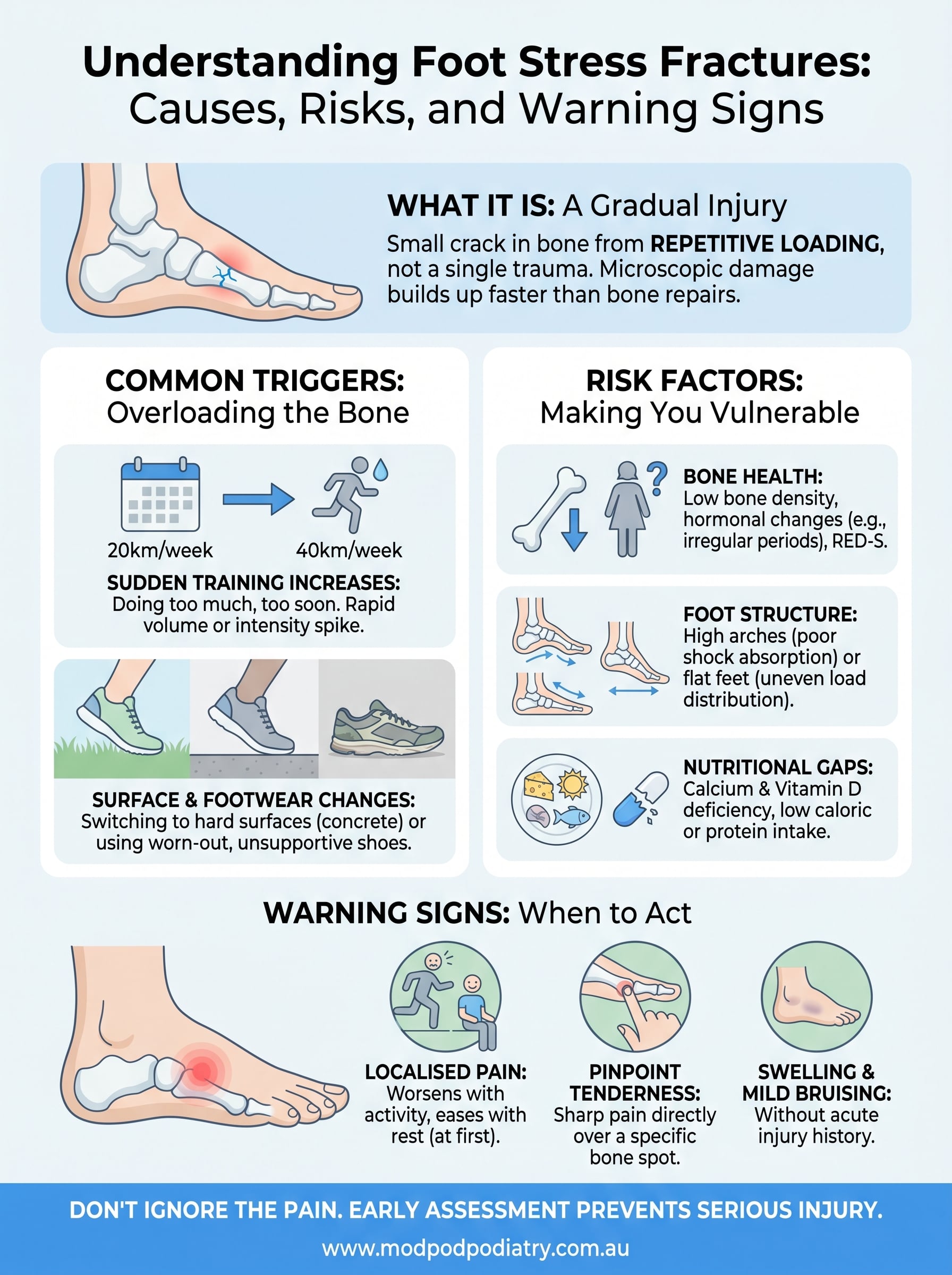
A stress fracture is a small crack in the bone that develops from repetitive mechanical loading rather than a single traumatic event. Unlike a complete fracture where the bone snaps under sudden force, a stress fracture builds over time as microscopic damage accumulates faster than the bone can repair itself. In the foot, the metatarsals (the long bones running toward your toes) are the most commonly affected, but stress fractures can also develop in the navicular, calcaneus (heel bone), and sesamoids.
How bone normally handles load
Your bones are not static structures. They respond to physical stress through a continuous process called bone remodelling, where old bone tissue breaks down (resorption) and new tissue forms in its place. When you run, jump, or walk, your foot absorbs forces several times your body weight with every stride, and remodelling allows the skeleton to adapt and strengthen over time. This process works well when your body gets adequate recovery, nutrition, and gradual progression in activity.
The problem arises when the breakdown phase outpaces the rebuilding phase, leaving the bone structurally weakened before new tissue can fill the gap.
When the repair cycle fails
Repetitive loading without sufficient rest means bone resorption occurs faster than new bone forms. Small stress reactions in the bone begin to develop, and if the activity continues without modification, those reactions progress into visible cracks. At this stage, you have a stress fracture. The foot is particularly vulnerable because it handles concentrated, repetitive impact across a relatively small surface area with every step. Certain bones carry more of this load depending on your foot shape, arch height, and gait pattern, which is why some people fracture the second metatarsal while others develop problems in the heel or navicular.
Why the foot is especially at risk
Stress fracture foot causes often trace back to the structural demands placed on specific bones during movement. The second and third metatarsals bear a disproportionate share of force during the push-off phase of walking and running, making them the most frequently fractured bones in the foot. Your arch mechanics play a significant role as well: a high, rigid arch absorbs shock poorly and transfers more stress into the metatarsals, while a low, flat arch shifts load toward the medial forefoot and navicular. This means your individual foot structure partly determines which bones are most at risk, regardless of your activity level.
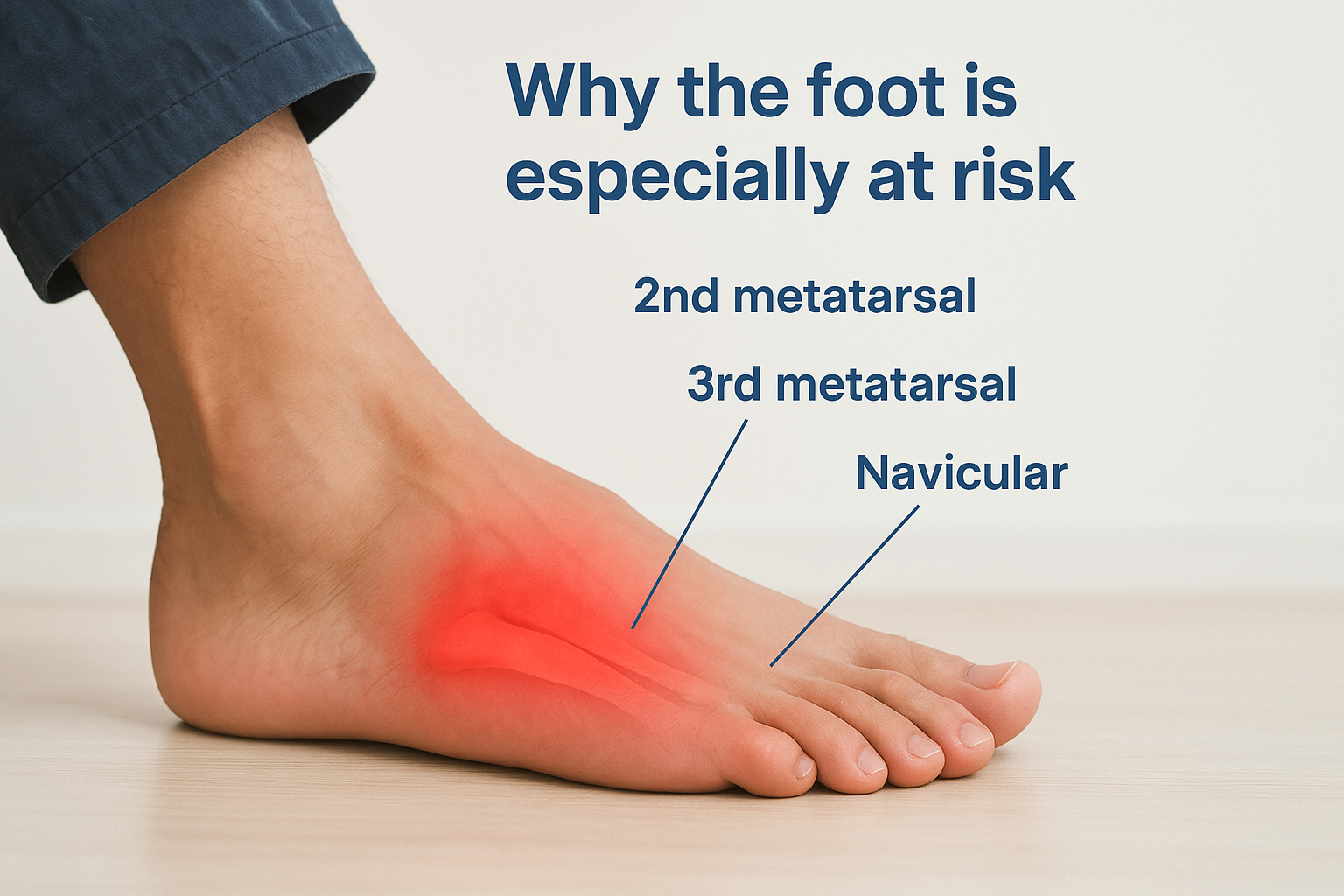
Each of these structural factors interacts with how you train, what surfaces you use, and what shoes you wear, which is why two people following the same programme can have very different injury outcomes.
Common triggers that overload the foot
Stress fracture foot causes almost always trace back to a point where the load on the bone exceeds its current capacity to cope. The triggers are usually predictable once you understand them, and most involve changes to your activity patterns rather than any single catastrophic event. Identifying the specific trigger in your situation is the first step toward both treatment and prevention.
Sudden increases in training volume or intensity
The most common trigger is doing too much, too soon. When you increase your weekly running distance, add extra sessions, or shift from low-impact to high-impact activity within a short window, your bones don’t have time to adapt. The remodelling process that strengthens bone under load operates on a timeline of weeks to months, not days. Jumping from 20km to 40km per week, or returning to full training after an extended break, creates exactly the kind of rapid loading spike that initiates a stress fracture in vulnerable bones like the second metatarsal or navicular.
Research consistently identifies a training load increase greater than 10% per week as a meaningful threshold for overuse bone injury.
Surface and footwear changes
Switching from soft grass or trail surfaces to concrete or bitumen substantially changes the forces your foot absorbs with every stride. Hard surfaces return more energy to the foot and reduce the time available to disperse that impact across surrounding tissue. Similarly, worn-out shoes that have lost their cushioning and structural support transfer more load directly into bone with each step. Returning to sport after time off in new, minimalist, or poorly fitted footwear adds further risk. These factors compound quickly: a runner who simultaneously changes surface, increases distance, and trains in worn shoes is stacking multiple stress fracture triggers at once.
Risk factors that make you more vulnerable
Not everyone who increases their training load ends up with a stress fracture. Individual biology, foot structure, and lifestyle habits all influence how much stress your bones can tolerate before damage accumulates. Knowing your personal risk profile lets you make smarter decisions about training and recovery before stress fracture foot causes become a real problem for you.
Bone density and hormonal health
Low bone density is one of the strongest predictors of stress fracture risk. When bone mineral content is reduced, the skeleton tolerates less repetitive load before cracks develop. This affects postmenopausal women in particular, as declining oestrogen accelerates bone loss. Female athletes who experience irregular or absent periods (a condition linked to low energy availability) are also at significantly elevated risk, partly because oestrogen plays a direct role in bone maintenance.
Clinicians refer to the combination of low energy availability, menstrual disruption, and poor bone density as Relative Energy Deficiency in Sport (RED-S), and it sharply increases fracture risk across all bones in the foot.
Foot structure and biomechanics
Your arch height and gait pattern influence how load distributes across your foot bones with every step. A high, rigid arch absorbs shock poorly and concentrates force through the metatarsals, while a flat foot shifts stress toward the navicular and medial forefoot. Leg length discrepancy can also create uneven loading, putting one foot under consistently higher strain than the other. These structural factors interact with footwear and surface choice, meaning even moderate activity can produce bone stress in the wrong anatomy.
Nutritional gaps
Calcium and vitamin D deficiency directly impairs bone remodelling, reducing the speed and quality of repair between loading sessions. Low caloric intake overall, whether from dieting or inadvertent under-fuelling during heavy training blocks, limits the raw materials your body needs to rebuild bone tissue. Inadequate protein intake contributes as well, since bone matrix relies on collagen for structural integrity. Addressing these nutritional gaps is often the most straightforward step to reducing your stress fracture risk.
Warning signs and when to get checked
Stress fractures don’t announce themselves the way acute injuries do. Because stress fracture foot causes develop gradually, the pain tends to follow a slow, creeping pattern that’s easy to dismiss early on. Recognising the specific warning signs allows you to seek assessment before a partial crack becomes a complete break.
Pain patterns that point to a fracture
The most characteristic early warning sign is localised pain that worsens with activity and eases with rest. You might notice a dull ache in the front or top of your foot during a run that settles within an hour of stopping. As the fracture progresses, that window of relief shortens, and eventually the pain persists even when you’re not on your feet. Pinpoint tenderness directly over a specific bone is another telling sign. If pressing on one small spot on your metatarsal or navicular produces sharp, focused discomfort, that’s different from general foot soreness and warrants investigation.

Swelling and mild bruising over the affected area without any history of a twisted ankle or direct impact are common findings in confirmed stress fractures.
When to stop waiting and book an assessment
You should get checked if pain during activity has been present for more than one to two weeks without a clear explanation, or if rest hasn’t resolved your symptoms within a few days. Night pain, meaning aching that interrupts your sleep or persists when you’re lying down, is a signal that bone stress is significant enough to require imaging and professional evaluation. Don’t wait for the pain to become unbearable. Continuing to load a stress fracture delays healing, risks full displacement of the fracture, and can substantially extend your recovery time. Book an appointment with a podiatrist so the problem gets properly assessed before it escalates.
How podiatrists diagnose it and rule out lookalikes
When you arrive at a podiatry clinic with suspected foot bone damage, your podiatrist won’t rely on a single test to confirm what’s happening. Accurate diagnosis requires combining a detailed history, hands-on physical assessment, and appropriate imaging, because several common foot conditions produce pain patterns that closely resemble a stress fracture. Getting the diagnosis right matters, since the treatment path for each condition differs significantly.
Clinical assessment comes first
Your podiatrist will begin by asking about your training history, any recent changes in activity, and the exact location and behaviour of your pain. This conversation alone often points strongly toward stress fracture foot causes, particularly if you’ve recently increased load, changed surfaces, or returned to sport after a break. Physical examination then focuses on localised bone tenderness using a precise palpation technique, where pressure applied directly over the suspected bone reproduces your pain in a specific, concentrated way that differs from broader soft tissue soreness.
A positive "hop test", where landing on the affected foot sharply recreates your pain, is a reliable clinical indicator that bone stress is the underlying problem.
Imaging to confirm the fracture
Your podiatrist will refer you for imaging to confirm the diagnosis and assess severity. Plain X-rays are often the first step, but they frequently miss early stress fractures because the bone changes take several weeks to become visible on standard films. MRI is the preferred imaging method when clinical suspicion is high but X-rays appear normal, as it detects bone marrow oedema and early stress reactions before a visible crack develops.
Conditions that can look similar
Several other diagnoses can produce comparable symptoms. Morton’s neuroma, metatarsalgia, tendinopathy, and plantar plate injuries all cause forefoot pain that worsens with activity, and distinguishing between them requires careful clinical reasoning. Your podiatrist uses the specific location, quality, and pattern of your pain alongside imaging findings to rule each of these out before settling on a diagnosis and treatment plan.
What to do next
Stress fractures follow predictable patterns, and so does recovery from them. The sooner you connect the dots between stress fracture foot causes and your specific situation, the faster you can get the right treatment and return to activity without risking a complete break. Waiting rarely helps and often extends your recovery timeline by weeks or months.
Your foot structure, training habits, and bone health all interact to determine your personal risk level. A podiatry assessment gives you a clear picture of exactly which factors are at play for you, and what practical changes will reduce the chance of reinjury once you’re back on your feet. Our podiatrists use hands-on assessment and targeted imaging referrals to confirm what’s happening and rule out other diagnoses.
If any of the warning signs described in this article sound familiar, don’t keep training through the pain. Book an appointment at ModPod Podiatry across our five Sydney clinic locations and get a clear diagnosis before things get worse.