

You’ve probably heard that how you walk or run matters just as much as how often you do it. But what does that actually mean in practice? That’s where understanding how does gait analysis work becomes genuinely useful, not just as a concept, but as a clinical tool that breaks your movement into measurable phases and identifies what’s going wrong.
Gait analysis looks at the way your body moves through each step, from heel strike to toe-off, and everything happening at the ankle, knee and hip in between. It picks up asymmetries, timing issues and compensations that you can’t spot in a mirror, and that often explain pain you’ve been putting up with for months. At ModPod Podiatry, we use pressure plate technology and video assessment across our Sydney clinics to measure these patterns with precision rather than guesswork.
This article walks you through the specific steps we assess during a gait analysis, what each phase reveals about your biomechanics, and how that information translates into practical decisions about footwear, orthotics and treatment. Whether you’re a runner chasing a PB or someone whose feet just hurt at the end of the day, understanding this process helps you make sense of the recommendations your podiatrist gives you.
What gait analysis is and what it can show
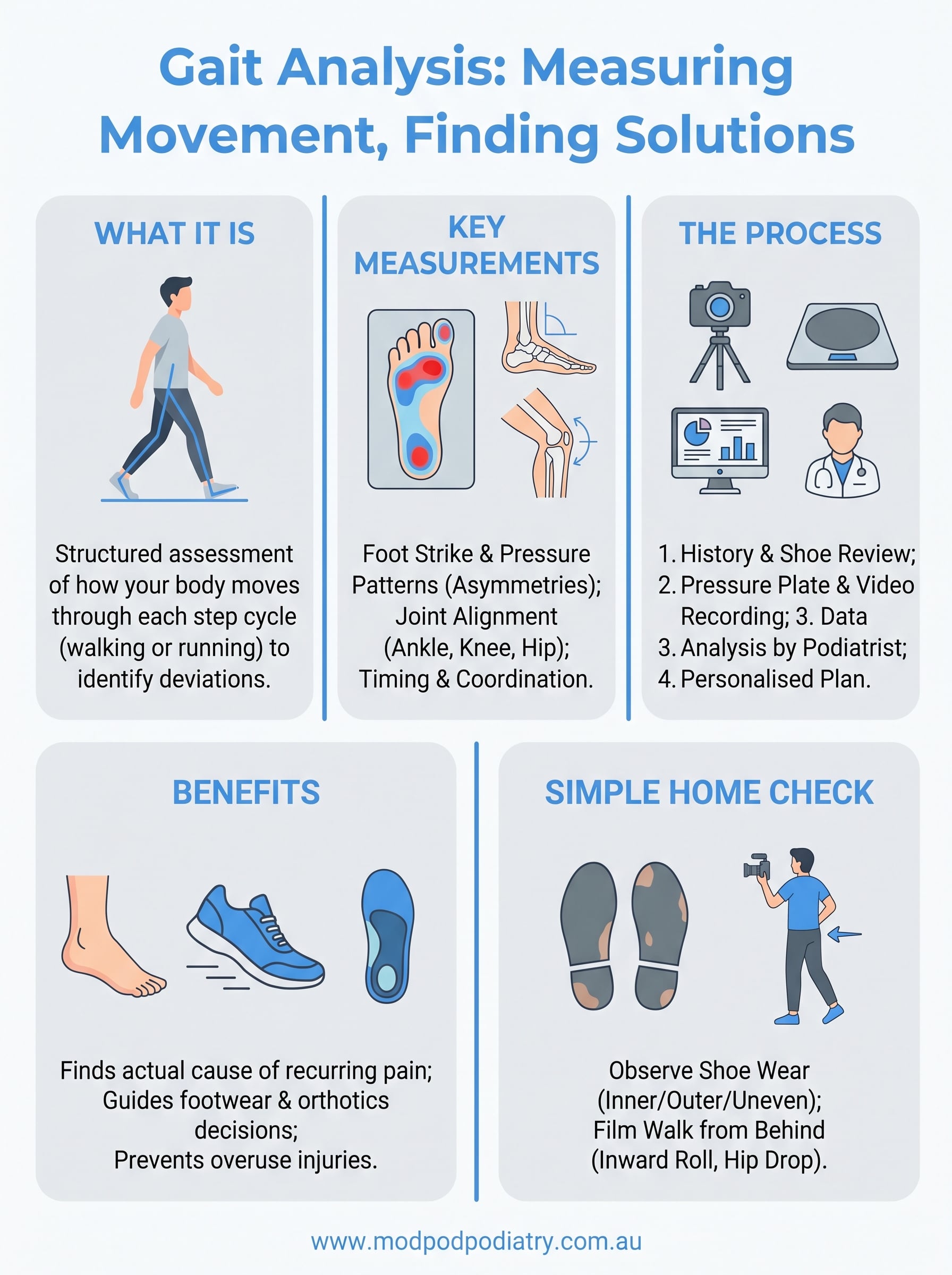
Gait analysis is a structured clinical assessment of how your body moves through each complete step cycle. It examines the timing, alignment and coordination of your lower limbs during walking or running, and identifies where your movement deviates from what it should be. The result is a detailed picture of your biomechanics that no quick visual check can replicate.
The difference between normal gait and dysfunctional gait
Normal gait follows a predictable and repeatable pattern across two main phases: the stance phase (when your foot is in contact with the ground) and the swing phase (when your foot moves forward through the air). Your stance phase alone involves heel contact, mid-stance loading and toe-off, each of which places specific demands on your muscles, joints and connective tissue.
When something disrupts that sequence, your body compensates. You might shift weight onto one side, overload a tendon, or alter your knee tracking to reduce discomfort somewhere else. These compensations often happen without you noticing, which is why pain at the knee can trace back to how your foot strikes the ground, and why heel pain can worsen because of hip weakness rather than the heel itself.
Gait problems rarely stay confined to one area. A fault at the foot typically creates a chain of adaptations that travel upward through the leg, knee and hip.
What problems gait analysis can reveal
Understanding how does gait analysis work starts with recognising what it can actually detect. A thorough assessment identifies issues like overpronation, supination and poor shock absorption, all of which affect load distribution across your joints with every single step you take.
Beyond structural findings, gait analysis can also reveal muscle timing faults and joint stiffness that contribute directly to overuse injuries like plantar fasciitis, shin splints and patellofemoral pain. For runners particularly, small deviations in cadence or foot strike pattern accumulate over thousands of repetitions and become the direct cause of injury rather than just a contributing factor.
What we measure during a gait analysis
A gait analysis doesn’t just observe your movement generally. It breaks your walking or running cycle into specific, measurable components and records data at each point. This gives your podiatrist objective information rather than impressions, which means the findings hold up across appointments and let us track whether treatment is actually working.
Foot strike, pressure and timing
Your foot contact pattern tells us where you load the ground and in what sequence. Pressure plate technology maps exactly which areas of your foot bear the most force, how quickly you transition from heel to forefoot, and whether your loading is symmetrical between left and right. Asymmetries in pressure or timing are often the first sign that a compensation is occurring somewhere higher in the chain.
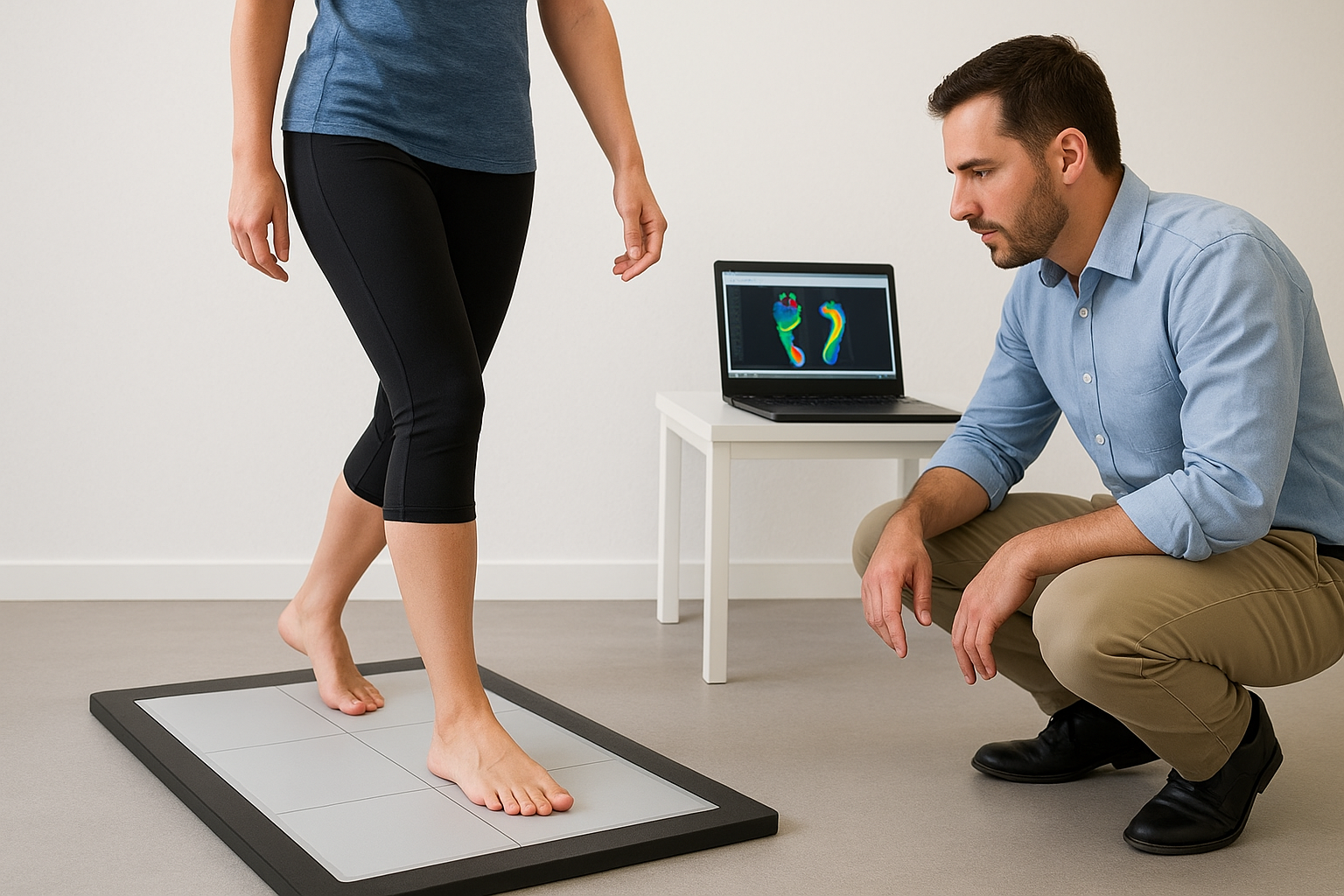
If one foot consistently loads more than the other, the overloaded side will usually be where your injury occurs, even if the underlying cause sits higher up the leg.
Joint alignment and movement range
Understanding how does gait analysis work at this level means looking at ankle, knee and hip alignment as each phase of your stride unfolds. We assess how much your ankle pronates, whether your knee tracks over your second toe, and how your hip drops or rotates during single-leg loading. Each of these angles influences the stress placed on tendons, joints and muscles with every step you take. Key measurements include:
- Ankle pronation angle and speed of pronation
- Knee valgus (inward collapse) under load
- Hip drop during the stance phase
How a gait analysis appointment works
Knowing what to expect makes the appointment more productive for you. A gait analysis session at ModPod Podiatry typically runs 45 to 60 minutes, and the process starts well before you step onto the pressure plate. Your podiatrist works through a structured sequence so that every finding connects back to your specific history and goals.
What happens before you walk
Your podiatrist begins by reviewing your symptom history, activity levels and footwear habits. This background shapes how we interpret what we see during the movement assessment. Bring the shoes you wear most often to your appointment, whether that’s running shoes, work shoes or everyday casuals, because worn sole and upper patterns carry useful diagnostic information about your existing loading habits before we record a single step.
The movement assessment itself
You walk or run across a pressure-sensitive plate while a camera captures your movement from multiple angles. Several passes are needed to collect a consistent and representative pattern, since a single step can vary from your normal movement if you’re aware you’re being watched.
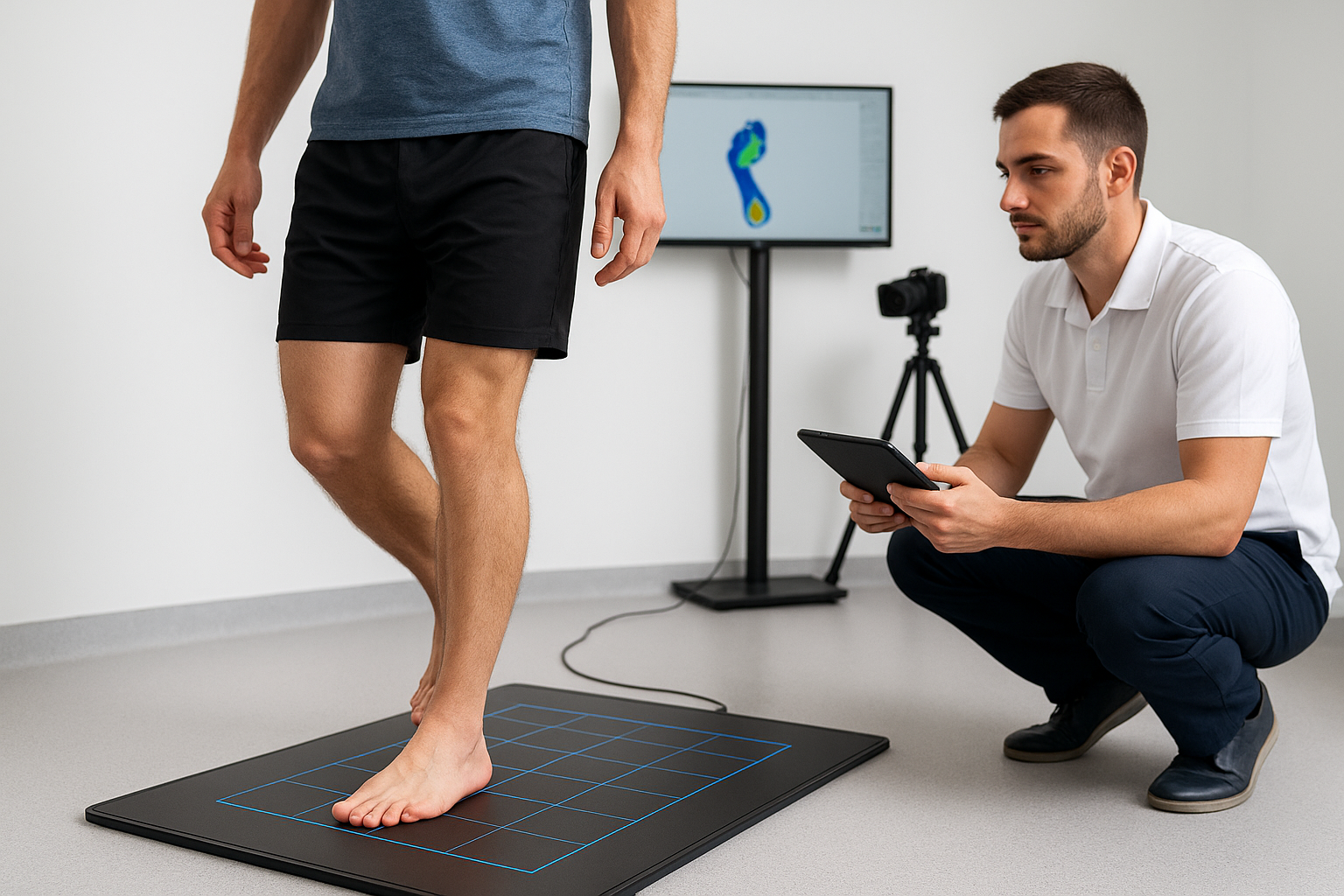
The combination of pressure data and video gives a more complete picture than either tool can provide alone.
Once we’ve collected the footage and measurements, your podiatrist reviews both data sets together and explains the findings in plain language. You leave the appointment understanding exactly what your movement pattern shows and what your options for footwear, orthotics or direct treatment look like from there.
When gait analysis helps and when it won’t
Gait analysis delivers the most value when your symptoms connect directly to how you move. If you have a recurring overuse injury or unexplained joint pain that keeps returning despite rest and basic treatment, understanding how does gait analysis work in your specific case gives your podiatrist the data to find the actual cause rather than just managing the symptom.
When it’s the right tool
The clearest cases for gait analysis involve pain that appears or worsens during movement, such as plantar fasciitis, shin splints, Achilles tendinopathy, or knee pain while running. It also helps when you’re selecting custom orthotics, since pressure plate data gives your podiatrist precise measurements rather than a general estimate of what your foot actually requires.
Gait analysis adds the most value when you keep getting injured in the same spot and haven’t found a clear reason why.
When it won’t be enough on its own
Gait analysis doesn’t replace imaging for suspected stress fractures or ligament tears. If your pain started from a specific incident rather than building gradually, your podiatrist will likely order an X-ray or ultrasound alongside the movement assessment. Gait analysis works best as one part of a complete clinical picture, not a standalone fix for every lower limb problem. Conditions that fall outside its scope include:
- Acute trauma or sudden-onset pain following an impact
- Suspected fractures or significant soft tissue tears
- Inflammatory conditions during an active flare-up
How to check your gait at home safely
A clinical gait analysis gives you precise data, but you can do a basic self-check at home that tells you whether it’s worth booking an assessment. These observations won’t replace a pressure plate or video analysis, but they give you useful starting information before your appointment.
Look at your shoe wear patterns
Turn your most-used shoes upside down and compare the sole wear on each side. Excessive wear on the inner heel suggests overpronation, while heavy wear along the outer edge points toward supination. If the wear pattern differs noticeably between left and right, that asymmetry often indicates an underlying movement issue worth investigating further.
Common wear patterns and what they tend to suggest:
- Inner heel and forefoot wear: likely overpronation
- Outer edge wear: likely supination or underpronation
- Asymmetrical wear between shoes: possible gait compensation on one side
Uneven sole wear between your left and right shoe is one of the clearest early signs that your gait is placing unequal load through your lower limbs.
Film yourself walking from behind
Set your phone against a wall or ask someone to hold it at knee height, then walk away from the camera at your normal pace. Watch the footage and note whether your ankles roll inward, your hips drop on one side, or your feet point outward rather than straight ahead.
These are the same reference points your podiatrist checks when understanding how does gait analysis work in a clinical setting, and spotting them at home gives you useful context before your appointment.
What to do next
If your shoes show uneven wear, your ankles roll inward, or you keep getting the same injury in the same spot, a clinical gait analysis gives you answers that rest and guesswork won’t. Understanding how does gait analysis work in practice means recognising it as a structured diagnostic process, not a one-size-fits-all running store check. Every finding connects to a specific part of your movement, and every recommendation follows from objective data rather than general advice.
ModPod Podiatry runs gait assessments across five Sydney locations using pressure plate technology and video analysis, so you leave with a clear explanation of what your movement pattern shows and what to do about it. Whether you need footwear guidance, custom orthotics, or a targeted treatment plan, the process starts with booking an appointment so your podiatrist can assess your movement directly. Book online today and get a precise answer to what’s driving your pain.