

You’ve probably tried a pharmacy freeze spray or a salicylic acid pad on that stubborn wart under your foot, and it’s still there. So now you’re searching plantar wart treatment reviews to work out what actually gets rid of them, rather than wasting another six weeks on something that doesn’t. Fair enough. Plantar warts are notoriously slow to respond, and the internet is full of conflicting claims from forums, product ads and clinics all pushing their own method.
This article compares the real-world results of the main options you’ll come across: over-the-counter salicylic acid, in-clinic cryotherapy, laser treatment, and Swift microwave therapy, based on how podiatrists actually see these treatments perform on Sydney patients. We look at success rates, how many sessions each typically takes, discomfort levels, and cost, so you’re not guessing.
By the end, you’ll know which treatments have solid evidence behind them, which ones are more hype than substance, and how to decide what’s worth trying first for your specific wart, whether it’s a single stubborn lesion or a cluster that keeps spreading.
Why the right treatment choice matters
What’s actually happening under your skin
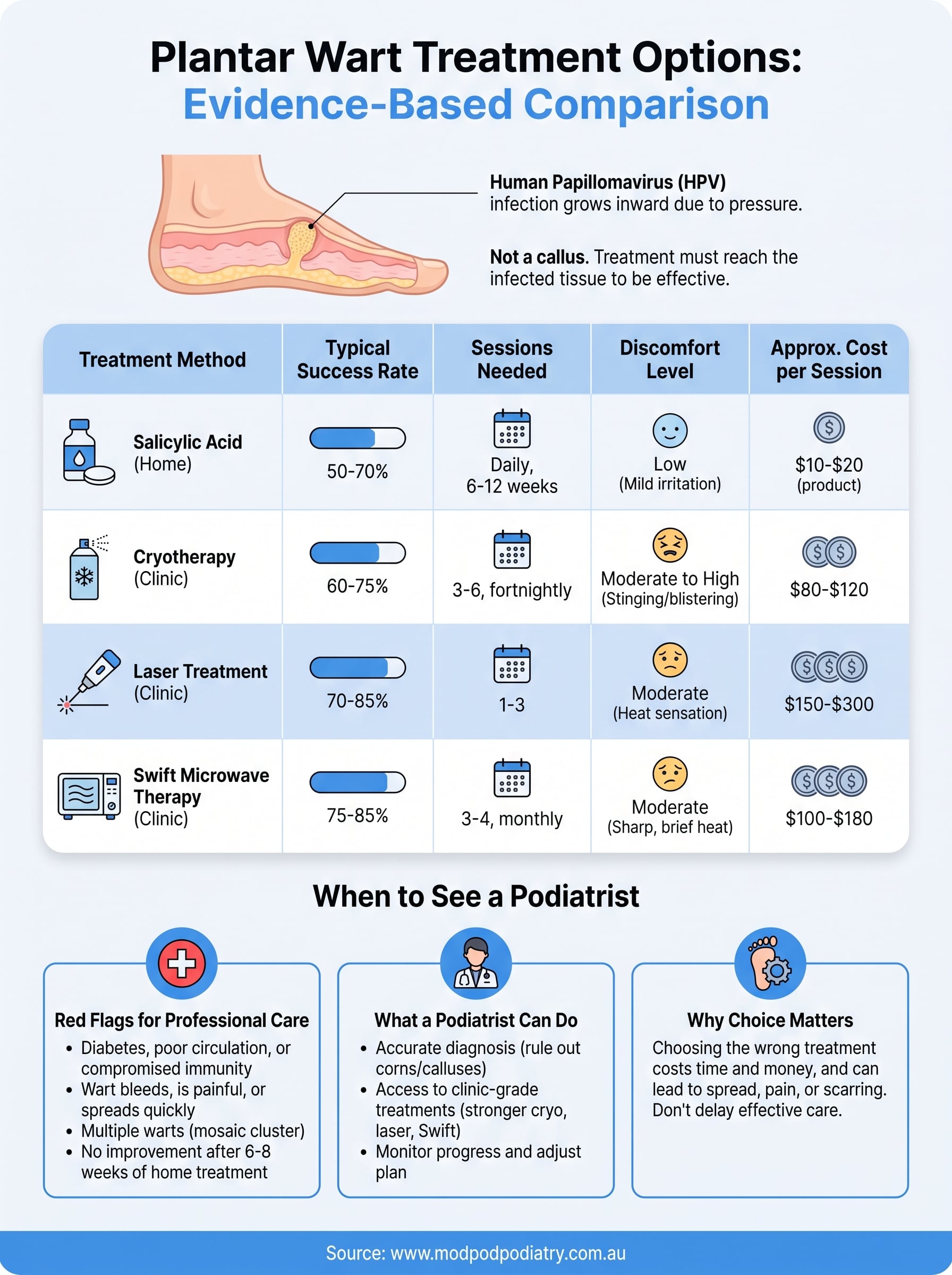
A plantar wart isn’t a callus or a corn, even though it can look like one. It’s caused by the human papillomavirus (HPV) entering through tiny breaks in the skin on the sole of your foot, and it grows downward rather than outward because of the pressure from standing and walking. That’s why generic wart removal options sold at the chemist often barely touch the surface while the virus keeps replicating underneath. Understanding this is the whole reason plantar wart treatment reviews matter: you’re not just picking a product off a shelf, you’re choosing a method that either reaches the infected tissue or doesn’t.
Wasted time and money add up
Guessing your way through treatments gets expensive fast, in both dollars and frustration. Salicylic acid pads cost little upfront, but if you’re buying a new box every few weeks for six months with no result, that adds up. Worse, an untreated or poorly treated wart can spread, either into a cluster (called a mosaic wart) or onto other toes, which then means treating multiple lesions instead of one.
The longer a plantar wart sits untreated, the deeper it burrows and the harder it becomes to shift.
Getting the choice wrong also has physical costs. Warts on weight-bearing parts of the foot cause pain that changes how you walk, which can lead to knee, hip or back discomfort over time. Aggressive home treatments used incorrectly, like over-freezing skin with an over-the-counter cryotherapy pen, can cause blistering, scarring or infection. On the other end, being too conservative with a fast-spreading wart lets it multiply before you’ve properly started.
Here’s what’s typically at stake when the wrong treatment drags on:
- Months of ongoing discomfort or altered gait
- Spread to nearby toes or the opposite foot
- Unnecessary spending on products that don’t work
- Increased risk of scarring from repeated harsh self-treatment
- Higher chance of recurrence if the virus isn’t fully cleared
That’s why it pays to understand what actually works before you commit weeks to any single approach.
How to treat a plantar wart step by step
Starting at home
Most people begin with at-home wart treatment before booking a clinic visit, and that’s a reasonable first move for a small, single wart caught early. The key is consistency, not intensity. A single freeze or one strong acid application won’t touch a virus that’s had weeks to embed itself.
- Soak the foot in warm water for five to ten minutes to soften the thickened skin.
- Gently file away dead surface skin with an emery board, never a shared blade.
- Apply a salicylic acid solution (17% to 40%) directly to the wart, avoiding healthy skin.
- Cover with a plaster or occlusive dressing overnight.
- Repeat daily for six to twelve weeks, checking for irritation.
Consistency beats intensity: daily small doses of treatment outperform one aggressive attempt.
Knowing when to stop and reassess
Progress should look like the wart shrinking, flattening, or the black dots (tiny clotted capillaries) fading over a few weeks. If nothing’s changed after six weeks, or the wart’s grown, spread, or become painful, that’s your signal to stop the DIY approach. Continuing a plantar wart home remedy past this point usually just delays proper treatment, and it risks damaging the surrounding healthy skin. Pain when walking, bleeding, or a wart that’s doubled in size are all clear reasons to book an assessment rather than buy another box of pads.
Comparing plantar wart treatments: what the evidence shows
Lining up the numbers
Once you move past home remedies, the four treatments podiatrists compare most often are salicylic acid, cryotherapy, laser and Swift microwave therapy. Each works differently, and the research backs some more strongly than others. Cochrane reviews on wart treatments consistently rate salicylic acid and cryotherapy as the best-studied options, with laser and Swift showing promising but smaller-scale results (Cochrane covers the underlying evidence). The table below reflects what Sydney podiatry clinics typically see across a course of treatment, not a single visit.
| Treatment | Typical success rate | Sessions needed | Discomfort | Approx. cost per session |
|---|---|---|---|---|
| Salicylic acid | 50-70% | Daily, 6-12 weeks | Low | $10-$20 (product) |
| Cryotherapy | 60-75% | 3-6, fortnightly | Moderate to high | $80-$120 |
| Laser | 70-85% | 1-3 | Moderate | $150-$300 |
| Swift microwave | 75-85% | 3-4, monthly | Moderate | $100-$180 |
What the pattern tells you
Notice that success rates climb as the treatment gets more targeted at the deeper tissue, but so does the cost and, often, the discomfort. Swift and laser tend to post the strongest results in clinical settings because they reach virus-infected tissue that surface treatments can’t touch.
No single treatment wins every case; the right one depends on your wart’s size, depth and how long it’s been there.
Rather than chasing the "best" treatment in isolation, match the option to your specific situation, and expect a podiatrist to combine methods if one alone stalls.
When to see a podiatrist instead of DIY treatment
Red flags that mean it’s time to book
Some situations call for professional podiatry care straight away, rather than another round of pharmacy pads. If you have diabetes, poor circulation, or a compromised immune system, self-treating any skin lesion on the foot carries real risk, since healing is slower and infections spread faster. Bleeding, rapid growth, or a wart that’s turned painful enough to change how you walk are also signs the virus has gone deeper than surface treatments can reach.
- Diabetes, neuropathy or reduced circulation
- A wart that bleeds, weeps or looks infected
- Multiple warts appearing in a cluster (mosaic warts)
- No improvement after six to eight weeks of consistent home treatment
- Pain that’s altering your gait or posture
If a wart is bleeding, spreading or painful underfoot, that’s your cue to see a podiatrist, not to keep treating it yourself.
What a podiatrist can do that home treatment can’t
Unlike shelf products, a podiatrist can confirm it’s actually a wart and not a corn, verruca-like callus or something more serious, using dermoscopy where needed. They also have access to stronger, clinic-grade treatments such as cryotherapy at colder temperatures than any over-the-counter pen, plus laser and Swift microwave therapy, none of which are available for home use. Ongoing monitoring matters too, because a podiatrist tracks whether the wart is actually regressing between sessions and adjusts the approach if progress stalls, something a self-treatment routine can’t do for you.
Finding the treatment that works for you
No single product or procedure wins every case, and that’s the real takeaway from comparing plantar wart treatment reviews across salicylic acid, cryotherapy, laser and Swift. A small, recent wart often responds to consistent home care. A deep, painful or spreading one usually needs clinic-grade treatment to actually clear the virus rather than just the surface skin. The mistake most people make is sticking with one method for months after it’s stopped working.
If you’ve given home treatment a fair trial and nothing’s changed, or you’re dealing with pain, bleeding or a cluster of warts, it’s time for a proper assessment rather than another guess. A podiatrist can confirm what you’re actually treating and match the method to your specific wart, saving you months of trial and error. Book an appointment online with ModPod Podiatry and get a treatment plan that’s built around evidence, not guesswork.

