
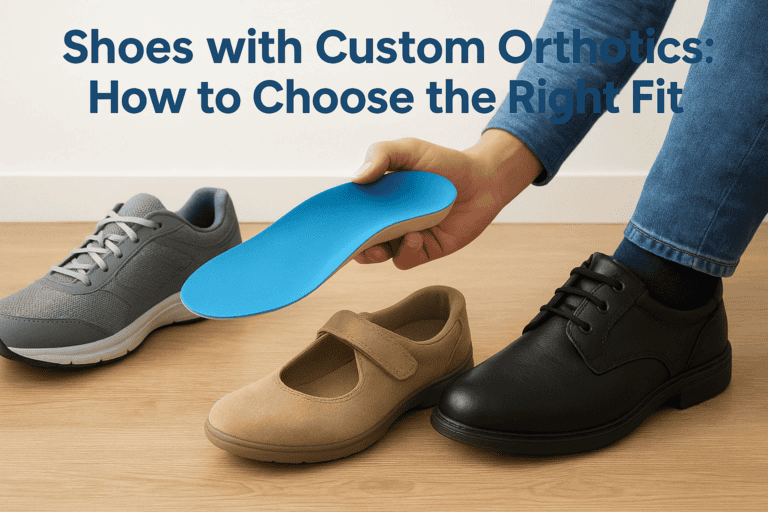
You’ve spent good money on shoes with custom orthotics, only to find them slipping out of your everyday sneakers or squashed inside shoes that were never built for them. It’s a common frustration, and it undoes a lot of the good work your orthotics are meant to do. If the shoe doesn’t fit the device, the device can’t do its job properly.
Finding shoes that fit custom orthotics comes down to a few practical features: removable insoles, a deep enough toe box, and a firm heel counter that keeps everything stable. Get these right and your orthotics sit exactly where they should, supporting your foot the way they were prescribed to. Get them wrong, and you risk blisters, poor alignment, or a device that simply doesn’t work.
In this guide, we’ll walk you through what makes a shoe genuinely orthotic-friendly, which custom shoes for orthotics and brands tend to work best across different activities, and how to check the fit yourself before you buy. Our podiatrists see this issue daily across our Sydney clinics, so we’re sharing what actually works for real feet, not just marketing claims.
Why the right shoes matter for custom orthotics
A custom orthotic only works as well as the shoe it sits in. Podiatrists design each device to hold your foot in a specific position, correcting the way your arch collapses, your heel strikes, or your weight shifts through each step. Put that same device into a shoe with a soft, collapsing heel or a shallow, curved footbed, and you’ve undone the correction before you’ve even left the house. The orthotic moves, your foot compensates, and the whole prescription becomes guesswork.
How an ill-fitting shoe undermines your orthotic
Most problems start with basic shoe construction. Removable insoles matter because the orthotic needs to replace, not sit on top of, the factory footbed, otherwise you lose depth and your foot gets pushed hard against the upper. A shallow toe box crushes your toes against the orthotic’s edge, causing blisters, black toenails, and corns, problems caused by ill-fitting shoes that have nothing to do with your original foot complaint. Meanwhile, a flexible, poorly structured heel counter lets your heel roll sideways, cancelling out the stability your orthotic is meant to provide.
A shoe with the wrong shape can undo months of orthotic correction in a single walk.
The knock-on effects further up the body
Once the fit is wrong at the foot, the problem rarely stays there. Poor orthotic positioning changes how force travels up through your ankles, knees, and hips with every stride. We regularly see patients at our Sydney clinics who’ve developed knee or lower back pain, not because their orthotic was wrong, but because the shoe around it forced their foot into an unnatural position. Athletes notice it fastest, since running or jumping in a shoe that doesn’t accommodate the device amplifies any instability tenfold.
Why this matters for your treatment plan
Getting the shoe-orthotic pairing right is part of the treatment, not an afterthought. When we prescribe custom orthotics for your feet, we talk through footwear because the two work as a system. A well-matched pair extends the life of your orthotic too. Shoes that fit properly reduce the friction and pressure points that wear down the device’s edges and top cover, so you’re not paying for replacements more often than necessary. Skipping this step is a false economy: you’ve invested in a precision device, and the shoe is what lets it actually do its job every single day you wear it.
How to choose shoes that fit custom orthotics
Walking into a shop and grabbing whatever looks comfortable won’t cut it once you’re wearing a prescribed device. You need a shoe built with enough internal volume and structure to hold both your foot and the orthotic without compromising either. Removable footbeds are non-negotiable, since they let you swap the factory insole for your device without cramming your foot against the upper.
Check these features before you buy
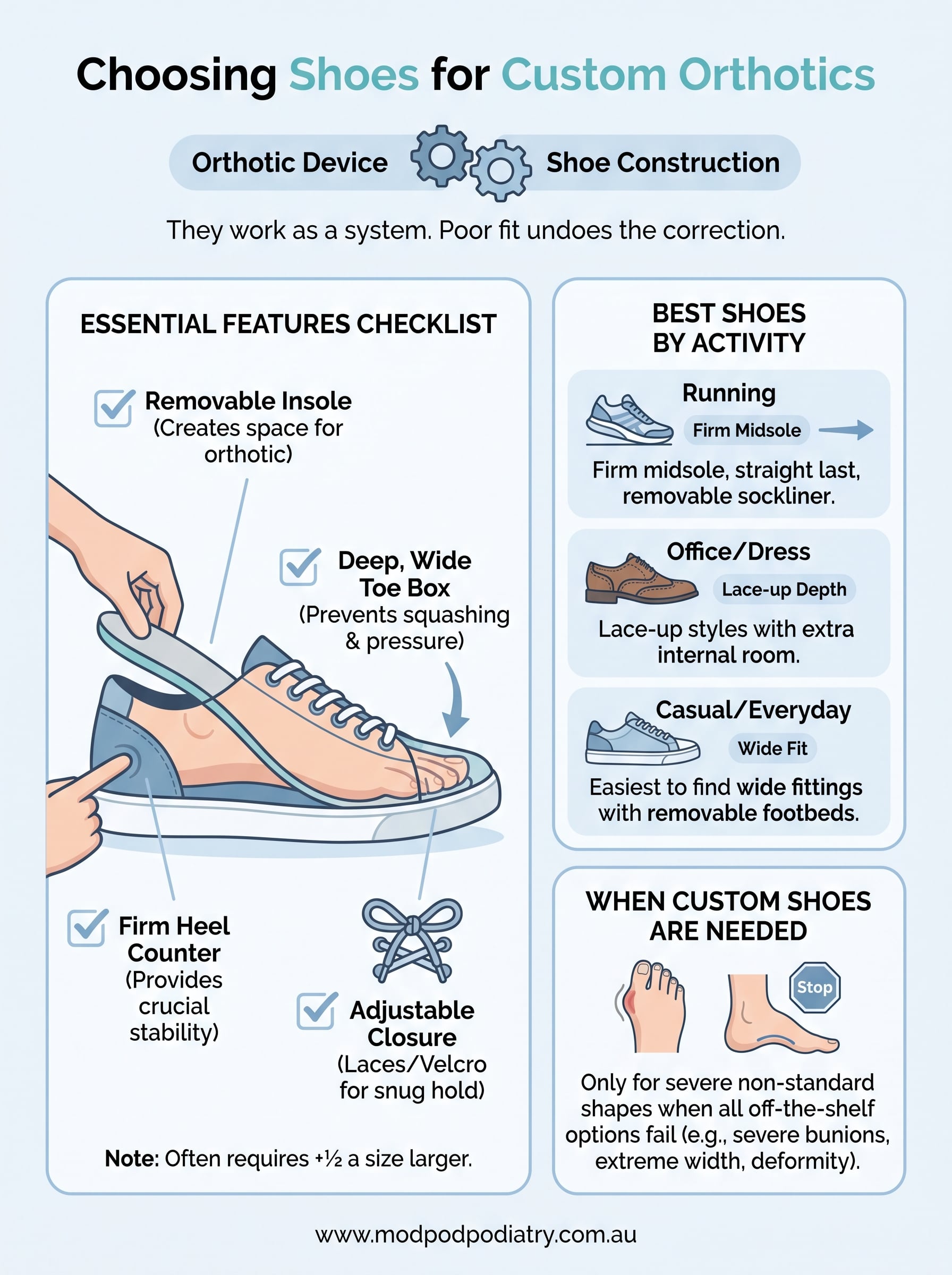
Use this checklist every time you’re shopping, whether you’re after everyday sneakers or dress shoes:
- Removable, flat insole that lifts out completely, leaving a smooth base
- Firm heel counter that resists squeezing from side to side
- Deep, wide toe box with roughly a thumb’s width of space beyond your longest toe
- Half a size larger than your usual fit, to allow for the orthotic’s extra volume
- Lace-up or velcro closure rather than slip-on styles, so you can adjust for a snugger hold
If you can’t remove the insole, walk away, no matter how good the shoe looks.
Try the orthotic in the shoe, not just on your foot
Always fit the orthotic and shoe together before deciding, ideally with the socks you’d normally wear. Slide the device in, stand up, and check that your heel sits centred in the heel cup rather than sliding forward or gripping the sides. Insist on walking a few laps of the shop rather than standing still, because pressure points only show up once you’re moving, and the same rules for getting the perfect shoe fit apply whether you’re buying trainers or work shoes.
Ask about lasts and width fittings
Brands vary enormously in how they shape their lasts, so a size 9 in one label can feel completely different from a size 9 in another. Look for guidance on orthotic friendly shoes from brands offering multiple width fittings, since a wider last gives your orthotic room without forcing your foot to compress sideways.
Best shoes for different activities and lifestyles
Different activities put different demands on your orthotic, so the shoe you pick needs to match the job it’s doing. Running shoes built for orthotics tend to have a removable sockliner, a straighter last, and a firmer midsole than typical trainers, since a soft, curved running shoe collapses the arch support you’re relying on. Brooks, Asics, and New Balance all make orthotic-friendly ranges with generous depth, and we point runners toward our podiatrists’ running shoe picks for orthotics regularly after a biomechanical assessment.
Office and workwear present a trickier challenge, because dress shoes are rarely built with depth in mind. Look for lace-up brogues or oxfords with a removable insole rather than slip-ons, and expect to go up half a size to fit the orthotic without pinching your toes. Ecco and Clarks both produce structured leather options with enough internal room, which makes them a reliable starting point if your workplace has a strict dress code.
Casual and everyday shoes give you the most flexibility, since brands like New Balance, Asics, and some Merrell styles are designed around a removable footbed as standard. These work well for walking the dog, running errands, or standing all day at work, and they’re usually the easiest category to find in wide fittings.
The right shoe for orthotics changes with the activity, not just the foot.
| Activity | Key features to look for | Common brands |
|---|---|---|
| Running | Removable sockliner, firm midsole, straight last | Brooks, Asics, New Balance |
| Office/dress | Lace-up, removable insole, extra depth | Ecco, Clarks |
| Everyday/casual | Removable footbed, wide fit options | New Balance, Merrell |
Specific sports, like netball or tennis, need extra lateral support on top of these basics, so get podiatrist footwear advice on which model suits your sport before buying.
When you might need custom-made shoes for orthotics
Sometimes even the best off-the-shelf shoe with the deepest toe box and a removable footbed still won’t cut it. Certain foot shapes and conditions need a level of accommodation that standard retail shoes simply can’t offer, no matter how many brands or width fittings you try. This is where custom-made shoes for orthotics come into the conversation, and it’s a decision we make with patients only after standard options have genuinely failed.
Signs that standard shoes aren’t enough
A few clear signs point towards custom footwear rather than another round of shop-bought trial and error:
- Severe bunions or hammertoes that no toe box can accommodate without pain
- Significant leg length discrepancy needing a built-up sole on one side
- Diabetic feet with reduced sensation, where pressure points can’t be risked
- Charcot foot deformity or other structural changes from arthritis
- Extremely narrow or wide feet outside standard width ranges, even at the widest fitting available
When your foot shape falls outside every standard range, a made-to-measure shoe stops being a luxury and becomes the only safe option.
What the process involves
Ordering custom-made shoes usually starts with the same 3D scanning technology we use for orthotic design, capturing your exact foot shape rather than relying on a standard last. From there, a shoemaker builds the upper and sole around your foot and your device together, so there’s no compromise on either side. Expect a longer lead time and a higher price than off-the-shelf options, since you’re paying for a shoe built once, for one person.
Generally, this route suits a small percentage of patients, and we’ll only recommend it once we’ve properly ruled out every standard alternative. Most people get excellent results from well-chosen retail shoes paired correctly with their orthotic, so custom footwear stays a last resort rather than a default recommendation.
Getting the fit right for your feet
Getting shoes with custom orthotics right isn’t about luck or trial and error at the shop. It’s about knowing what to check: a removable insole, a deep toe box, a firm heel counter, and the right brand for your activity. Most people find a great match on the shop floor once they know what to look for, and only a small number genuinely need custom-made footwear to go with their device.
If your current shoes aren’t playing nicely with your orthotics, or you’re not sure your device is even fitted correctly anymore, don’t guess. Our podiatrists check both the orthotic and the footwear together at every review appointment across our Sydney clinics, so nothing gets left to chance. Book an orthotic and footwear check at one of our Sydney clinics and we’ll make sure your shoes are actually doing the job your orthotics were prescribed for.