

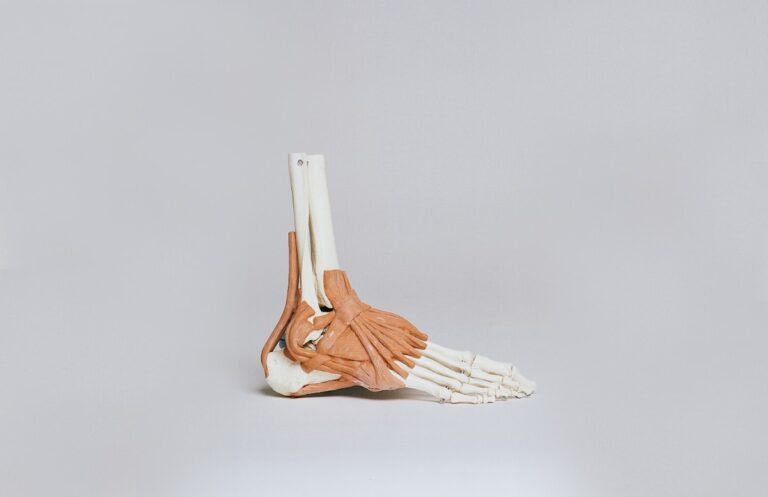
A sprained ankle — also called a rolled ankle or twisted ankle — is one of the most common injuries we treat across our Sydney clinics. It occurs when the ligaments on the outer side of the ankle are forced beyond their normal range, causing stretching or tearing. The injury ranges from a mild stretch requiring a few weeks of rest to a complete ligament rupture needing structured rehabilitation. Getting the right sprained ankle treatment in Sydney early is the key to a full recovery and preventing re-injury.
What Is a Sprained Ankle?
Ligaments are the strong, fibrous bands that hold the bones of the ankle joint together. When the foot rolls inward suddenly — during a change of direction, an awkward landing, or a misstep on uneven ground — the lateral ligaments are stretched or torn. This is what produces the immediate pain, swelling, and instability you feel after rolling an ankle.
The three main ligaments affected in a lateral ankle sprain are the anterior talofibular ligament (ATFL), the calcaneofibular ligament (CFL), and the posterior talofibular ligament (PTFL). Most sprains involve the ATFL, which is the weakest of the three.
Ankle Sprain Grades
Podiatrists classify ankle sprains into three grades based on the degree of ligament damage:
- Grade 1: Mild ligament stretching with no tearing. Localised tenderness, minimal swelling, and you can usually weight-bear with some discomfort. Recovery typically takes 1–3 weeks.
- Grade 2: Partial ligament tear. Moderate swelling, bruising, and pain with weight-bearing. The ankle may feel unstable. Recovery: 3–6 weeks with appropriate rehabilitation.
- Grade 3: Complete ligament rupture. Substantial swelling, bruising, and significant joint instability. You may have heard a pop at the time of injury. Recovery: 6–12 weeks or longer, often requiring imaging and structured rehabilitation.
Our sprained ankle treatment approach begins with an accurate assessment of sprain grade — because the correct grade determines the treatment pathway.
Symptoms of a Sprained Ankle
Common signs include:
- Pain on the outer side of the ankle, worsening with weight-bearing
- Swelling, which can develop quickly after the injury
- Bruising that may extend toward the foot and lower leg
- Restricted range of motion in the ankle joint
- Feeling of instability or the ankle “giving way”
- A popping sound or sensation at the moment of injury (Grade 2–3)
If you cannot put any weight on the foot, there is obvious deformity, or you felt a crack rather than a pop, seek emergency assessment to rule out fracture.
Initial Management: RICE — and Its Limitations
In the first 48–72 hours, RICE (Rest, Ice, Compression, Elevation) reduces acute pain and swelling. Apply ice for 15–20 minutes every two hours wrapped in a cloth, use a firm compression bandage, and keep the ankle elevated above heart height when resting.
RICE controls symptoms but does not rehabilitate the damaged ligament. For Grade 2 and Grade 3 sprains, RICE alone leaves the lateral ligaments healing in a lax position, reducing proprioception (the joint’s ability to sense its position in space) and substantially increasing the risk of a repeat sprain. This is why professional assessment and rehabilitation matter.
What Not to Do
- Avoid heat in the first 48 hours — it increases blood flow and worsens swelling.
- Do not walk through pain — this places ongoing stress on a damaged ligament and delays healing.
- Do not ignore the injury — untreated sprains are the leading cause of chronic ankle instability in active adults.
Sprained Ankle Treatment at ModPod Podiatry
Our podiatrists have over 20 years of experience treating ankle sprains across our Sydney locations. A consultation typically includes:
- Clinical assessment: We assess ligament integrity, joint stability, swelling, and your ability to weight-bear — and refer for X-ray or ultrasound if a fracture or complete rupture is suspected.
- Strapping and bracing: Clinical ankle strapping or a rigid brace provides mechanical support while the ligament heals and allows gradual return to activity.
- Rehabilitation programme: Graduated exercises rebuild ankle strength, restore range of motion, and retrain proprioception to reduce re-sprain risk.
- Gait assessment: We examine how you load the foot and ankle through the walking and running cycle to identify biomechanical factors that may have contributed to the injury.
For patients with recurrent sprains or chronic ankle instability, custom orthotics can correct pronation patterns and offload the lateral ligaments during activity. Where ligament tissue has not healed adequately, shockwave therapy stimulates tissue repair and reduces chronic lateral ankle pain.
Recovery Timeline and Return to Sport
Recovery depends on sprain grade and how promptly treatment begins:
- Grade 1: Return to activity within 1–3 weeks with conservative management.
- Grade 2: Return to sport in 3–6 weeks with bracing, rehabilitation exercises, and gradual load progression.
- Grade 3: Full recovery takes 6–12 weeks or more. Surgical referral is occasionally required for complete ruptures that do not stabilise with conservative care.
Returning to sport before full proprioceptive recovery is the main reason athletes re-sprain the same ankle. Our rehabilitation programme includes specific sport-relevant milestones before clearance for return to full training. For more on the first-aid steps and what to do immediately after a sprain, read our guide to how to heal a sprained ankle fast.
Ankle Sprains in Australia
Sports Medicine Australia identifies ankle sprains as the most common acute musculoskeletal injury in Australian sport, representing 10–30% of all sports injuries. With millions of Australians participating in netball, football, basketball, and running through the cooler winter season, ankle sprains are a year-round presentation at our clinics.
If you are managing an ankle injury under a GP-referred Medicare Chronic Disease Management (CDM) plan, podiatry is a covered allied health service. Rebates are available for up to five sessions per calendar year. Medibank, BUPA, HCF, and NIB Extras members can also claim podiatry consultations — check your policy for the applicable rebate amount.
Frequently Asked Questions
Q: How long does a sprained ankle take to heal?
A: Grade 1 sprains typically resolve within 1–3 weeks. Grade 2 sprains take 3–6 weeks. Grade 3 injuries involving complete ligament rupture can take 6–12 weeks or longer, depending on the rehabilitation approach.
Q: Should I see a podiatrist or a physiotherapist for a sprained ankle?
A: A podiatrist specialises in the foot and ankle and can provide a complete assessment, imaging referral, strapping, orthotics, and rehabilitation for ankle sprains. Either profession can manage most ankle sprains effectively. What matters most is getting the grade assessed early and starting the right treatment.
Q: Can you walk on a rolled ankle?
A: Walking is generally appropriate for Grade 1 sprains if you can do so without significant pain. For Grade 2 and 3 sprains, avoid walking through pain — use crutches if needed in the acute phase.
Q: Do I need an X-ray for a sprained ankle?
A: Not always. The Ottawa Ankle Rules — a clinical decision tool — guide when imaging is necessary. If you cannot weight-bear, have bony tenderness at the base of the fifth metatarsal, or the fibula tip, imaging is appropriate. Your podiatrist will advise during assessment.
Q: What causes chronic ankle instability?
A: Chronic instability develops when sprained ligaments heal in a lax position and proprioception is not fully rehabilitated. It results in a feeling of the ankle “giving way” and increased re-sprain risk. Custom orthotics and a targeted exercise programme are the standard treatment.
If you have sprained your ankle and are not improving as expected, book online with ModPod Podiatry. We assess and treat ankle sprains at our Sydney clinics in the CBD, Mosman, Dee Why, Rose Bay, and North Ryde.

