


If you want to try toenail fungus and apple cider vinegar together, mix one part vinegar with three parts warm water. Soak your feet for 10 to 40 minutes, dry them until no moisture remains, and repeat each day. Treat this as a low-cost first step, not a cure. Vinegar may slow fungus on the surface, but it does not reliably clear an infection that sits under a thick nail.
You probably have a bottle in the pantry, and plenty of websites call vinegar a cure. The truth is less tidy. A toenail is hard and grows slowly, so anything you soak or paint on has to reach fungus that hides under and inside the nail. That is why many people soak for weeks and see no change.
This guide comes from the podiatrists at ModPod Podiatry in Sydney, who treat fungal nails in four clinics. You will learn what vinegar can and cannot do, how to check that fungus is the problem, how to mix and run the soak, how to protect your feet between soaks, and when to stop and get treatment.
Will vinegar kill toenail fungus?
No good evidence shows that a vinegar soak kills the fungus inside a toenail. Vinegar can slow fungus in a lab dish and on skin, but a toenail is a harder target. Used well, a soak softens the nail and keeps the skin clean while you do the work that matters.
What a vinegar soak can and cannot do
Vinegar is a weak acid. In lab studies, apple cider vinegar slows the growth of fungus. On your skin, it lowers the pH, which makes the surface less friendly to germs. Those effects are real, but they stay at the surface.
The infection sits under and inside the nail plate, and that plate is thick and hard. A soak cannot push enough acid through it to clear the fungus. This is why many podiatrists tell patients that a vinegar cure for toenail fungus does not hold up in practice. Harvard Health Publishing lists a vinegar soak as a cheap first step that softens the nail so another antifungal can get in. That is a fair job for it.
A vinegar soak softens the nail and cleans the skin, but it is a helper, not a cure.
How vinegar compares with other options
The table sets vinegar beside the main options, using the figures that Harvard Health Publishing reports for each.
| Option | How it works | Reported result |
|---|---|---|
| Vinegar soak alone | Softens the nail, lowers skin pH | No reliable cure rate |
| Over-the-counter products (tea tree oil, antifungal creams) | Applied to the nail after a soak | About 60% see improvement after a few months |
| Prescription lacquers | Brushed on once a day for months | 35% to 60% cure |
| Prescription pills | Taken daily for three months | About 80% cure, with more side effects |
| Laser | Breaks down nail tissue and fungus | 60% to 75% reported |
Results vary with the product, the severity and the age of the infection. An improved nail can still hold fungus, and reinfection is common. Plan for prevention as well as treatment.
Apple cider vinegar or white vinegar
Either one works the same way, because both are dilute acetic acid. Harvard Health Publishing names both, and nothing in the research shows that apple cider vinegar acts better on nails. White vinegar costs less. Pick the one you will use.
Do not use vinegar at full strength. It can burn and irritate skin. Always dilute it, as the mixing step below shows.
Step 1. Check that fungus is the problem
Look at the nail before you soak, because other conditions copy the look of fungus. Injury, psoriasis and long-term polish stains can all thicken or discolour a nail. A soak will not fix any of them.
Signs that point to fungus
Fungus, called onychomycosis, tends to start at the tip or edge of the nail and spread toward the base. Look for these changes:
- Yellow, white or brown colour
- A thick nail that is hard to trim
- A crumbly, dull or brittle surface
- A nail that lifts from the nail bed
- A musty smell from debris under the nail
- Athlete’s foot on the skin nearby
Athlete’s foot matters because the same fungus can move from the skin to the nail. If you have both, treat both.
Who should skip the soak
See a podiatrist before you start if you have any of these:
- Diabetes, poor circulation or numb feet
- A weak immune system
- Cracked or broken skin around the nail
- Pain, redness, swelling or pus at the nail edge
Pain with redness at the side of the nail often points to an ingrown nail or a bacterial infection. Vinegar fixes neither. If you have diabetes or numb feet, you may not feel a burn or a scald, so ask a professional first.
Get a quick answer if you are unsure
At ModPod Podiatry, a podiatrist diagnoses fungal nails by looking at them. You do not need clippings or lab tests. You also do not need a GP referral, and treatment can start the same day. If you doubt what you see, one visit saves you weeks of soaking the wrong problem.
Confirm that fungus is the cause before you commit weeks to a soak.
Step 2. Mix and run your vinegar soak
A toenail fungus vinegar soak uses one part vinegar and three parts warm water, for at least 10 minutes. You can build up to 40 minutes. This is the ratio and timing that Harvard Health Publishing gives, and it is gentle on skin.
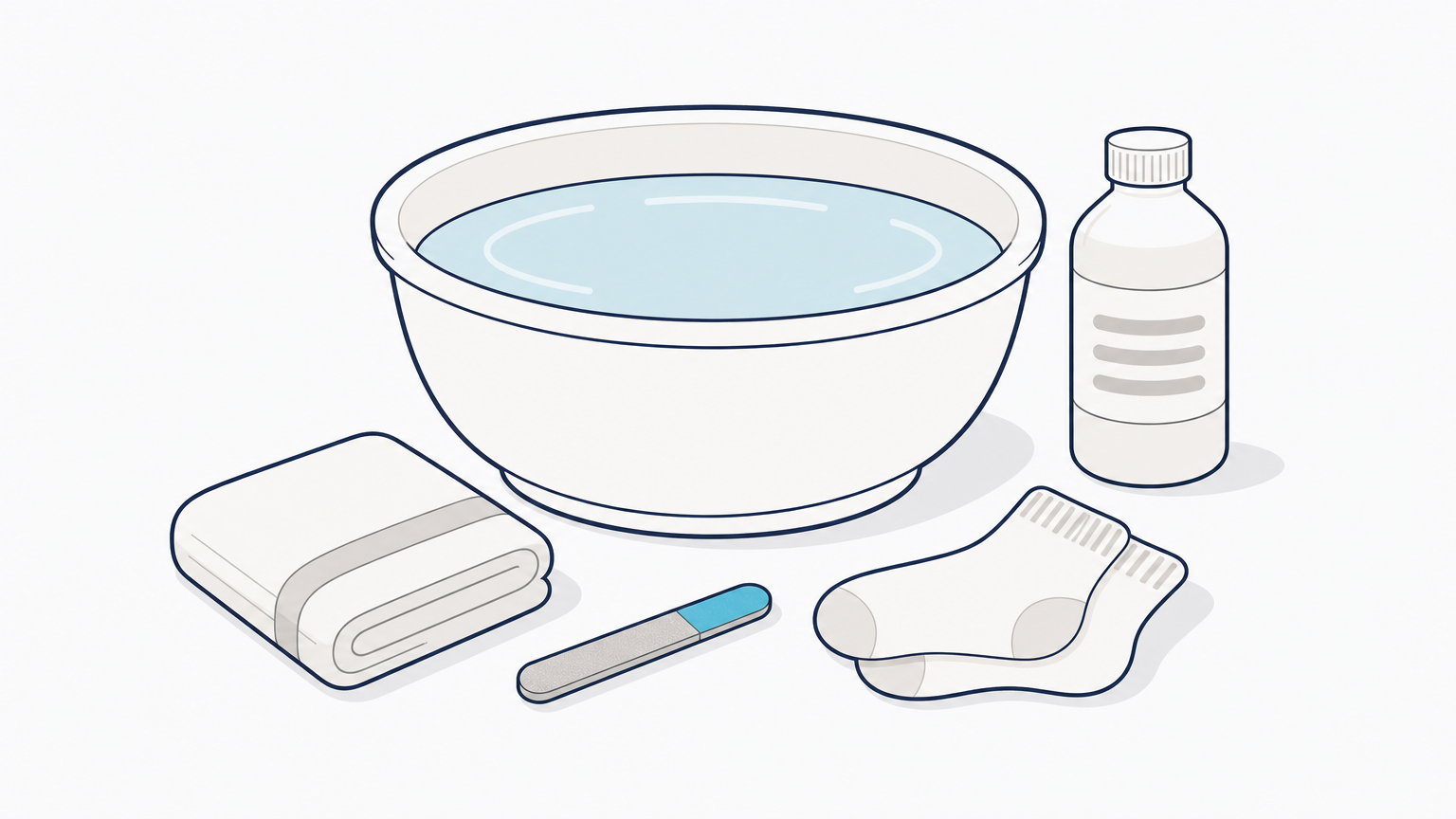
What you need
- A basin deep enough to cover your toes
- White vinegar or apple cider vinegar
- Warm water
- A clean towel that only you use
- A disposable emery board
- Clean cotton socks
Mix the soak
Use a 1 to 3 ratio of vinegar to warm water. Some clinics suggest equal parts, but the weaker mix is easier on your skin. Start with the weaker one. The table gives three batch sizes. Pick the one that matches your basin.
| Basin volume | Vinegar | Warm water |
|---|---|---|
| 1 litre | 1 cup (250 ml) | 3 cups (750 ml) |
| 2 litres | 500 ml | 1.5 litres |
| 3 litres | 750 ml | 2.25 litres |
For a typical basin that holds 3 litres, pour in 750 ml of vinegar and 2.25 litres of warm water. Test the water with your wrist. It should feel comfortable, not hot. Hot water can scald, and it dries out your skin.
Soak, dry and repeat
- Wash your feet with soap and rinse them.
- Place both feet in the basin so the water covers every nail.
- Soak for 10 minutes on day one. Add a few minutes each day until you reach 20 to 40 minutes.
- Lift your feet out and pat them dry with the clean towel. Dry between every toe.
- Gently file the surface of thick nails with the emery board. Bin the board after use.
- Repeat once a day. Skip a day if your skin stings or peels.
Wash the towel at a hot setting after each use. Fungus survives on damp fabric, and a shared towel can pass it to another person.
Use one part vinegar to three parts warm water, soak for 10 to 40 minutes, and dry your feet until no moisture remains.
Step 3. Treat the nail and protect your feet
Apply an antifungal to the nail right after the soak, while the nail is soft. Harvard Health Publishing says soaking first helps the product reach the nail. Then change the habits that let fungus thrive, or it will come back.
Apply a treatment while the nail is soft
After you dry your feet, put the product on every affected nail and on the skin around it. Two choices are common:
- 100% tea tree oil. Harvard Health Publishing says this has the best evidence among home options.
- An over-the-counter antifungal. Creams made for athlete’s foot are one example. Ask your pharmacist which product suits nails.
Treatment takes months. A toenail needs 9 to 12 months to grow out fully, so a result by next week is not realistic.
Stop the fungus returning
Fungus thrives in warm, damp places. Cut off its supply with these steps:

- Dry shoes. Rotate two pairs so each pair dries for a full day.
- Clean socks. Change them each day. Choose cotton or moisture-wicking fabric.
- Separate tools. Use one set of clippers for infected nails and one for healthy nails.
- Protected feet. Wear thongs or water shoes in gym showers and around pools.
- Careful salons. Salon basins and tools can carry fungus. Skip pedicures until your nails clear.
- Fresh shoes. Harvard Health Publishing suggests new shoes after treatment, since old ones may hold fungus.
Once your nails look clear, a diluted vinegar soak once or twice a week may help keep fungus away. That is the best use of vinegar in this whole routine.
Fungus returns through damp shoes and shared floors, so treat your shoes as well as your nails.
Step 4. Track progress and know when to stop
Judge the soak by new, clear nail growing at the base, not by the old nail. Give it about three months. The old, damaged nail stays discoloured until it grows out, so it is a poor guide.
Signs the soak is working or not
Take a photo of each nail every two weeks, in the same light. Compare the base of the nail near the skin.
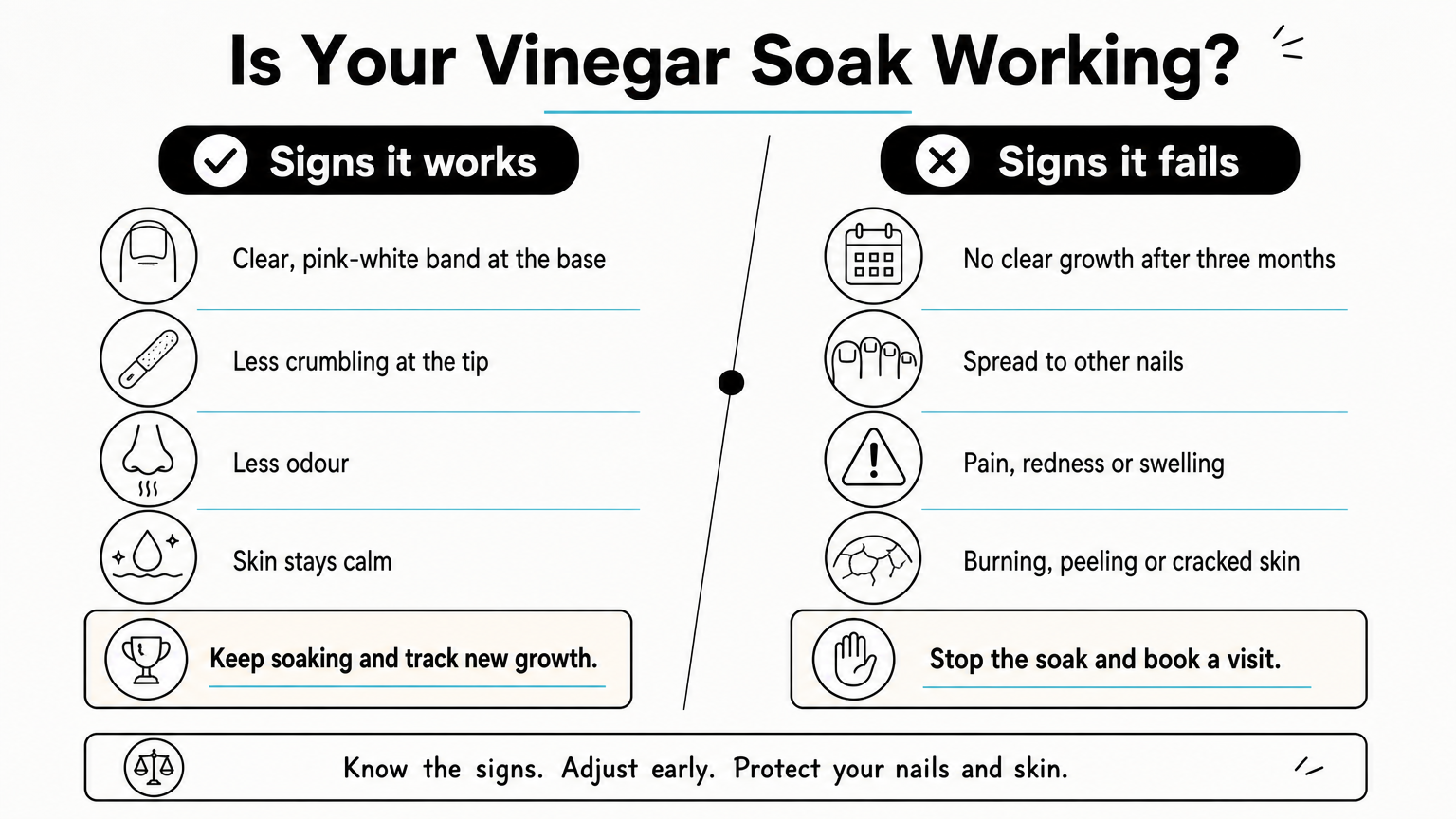
| Working | Not working |
|---|---|
| A band of clear, pink-white nail at the base | No clear growth after three months |
| Less crumbling at the tip | Spread to other nails |
| Less odour | Pain, redness or swelling |
| Skin stays calm | Burning, peeling or cracked skin |
If you see any sign in the right-hand column, stop the soak and book a visit. Do not wait for the full three months if you have pain or spreading redness.
When to book a podiatrist
Book if the soak has not worked after three months, if the infection is spreading, or if you have diabetes or poor circulation. A podiatrist can confirm the cause, trim and thin the nail, and offer treatment that reaches the fungus.
What treatment at ModPod Podiatry looks like
ModPod Podiatry offers fungal nail laser treatment with the Lunula cold laser. It suits people whose infection has not cleared with pharmacy creams or home remedies. Treatment is painless, with no heat, no needles and no downtime. The laser is FDA cleared for onychomycosis, and ModPod reports a 75% to 90% success rate.
A course is 4 to 8 weekly sessions of about 12 minutes. The first session costs $205 and includes nail preparation. Each follow-up costs $160, and the price is the same for one nail or all ten. If your plan has four sessions in total, the cost is $205 plus three follow-ups. , or $685. Eight sessions come to $1,325. Medicare does not cover laser treatment, but ModPod uses HICAPS, so you can claim a health fund rebate on the spot if your cover includes podiatry.
If you see no clear new nail at the base after three months, a podiatrist can offer more than a soak.
Your next step with vinegar and toenail fungus
A vinegar soak is cheap and safe for most healthy feet when you dilute it. Use one part vinegar to three parts warm water, soak for 10 to 40 minutes, dry well, and follow with an antifungal. Keep your shoes and socks dry. Track new growth at the base of the nail, and set a limit of about three months.
If the nail has not improved by then, or if you have diabetes, pain or spreading redness, do not keep soaking. Book a fungal nail visit online with ModPod Podiatry. We have clinics in Sydney CBD, Mosman, Dee Why and Rose Bay, and we aim to see you the same day where we can.

