
Foot pain has a habit of taking over your day. Whether it’s a sharp stab in your heel with your first steps out of bed or a dull ache that builds after standing at work, you want relief now, not next week. Before you book an appointment, there’s a good chance the right exercises for foot pain relief can ease things considerably, especially if plantar fasciitis, tight calves, or general overuse are behind your symptoms.
This article gives you five practical, at-home stretches and exercises that target the most common causes of foot pain we see across our Sydney clinics. Each one is simple to do, needs no special equipment, and is backed by what actually works in clinical practice, not generic advice pulled from anywhere online. We’ll walk you through how to perform each movement correctly, how often to do it, and what kind of pain it’s best suited for.
We’ve also included guidance on when these exercises are enough on their own, and when persistent or worsening pain means it’s time to get a proper assessment from a podiatrist rather than pushing through it.”
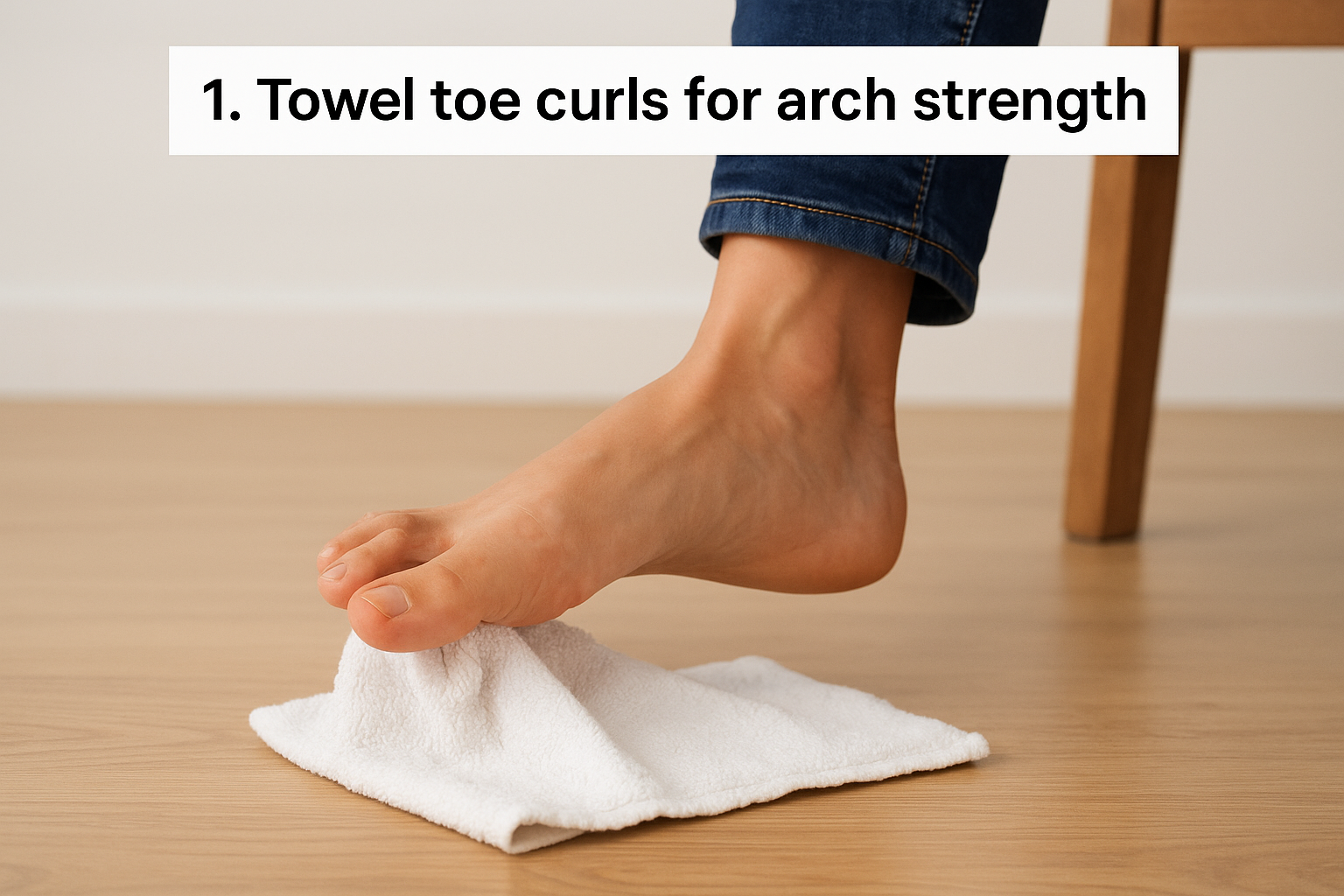
1. Towel toe curls for arch strength
Towel toe curls are one of the simplest ways to build strength in the small muscles that support your arch. Weakness here is a common contributor to plantar fasciitis and general arch fatigue, so strengthening these muscles gives your foot better support through the day, whether you’re walking the dog or standing at a market stall for hours.
How to do it
Sit in a chair with your bare foot flat on the floor and a small towel laid out in front of you.
- Place your heel on the ground and rest the ball of your foot on the near edge of the towel.
- Using only your toes, scrunch the towel towards you, gripping and pulling it in small bunches.
- Keep going until you’ve dragged the whole towel under your foot.
- Push it back out with your toes and repeat.
Add a small weight, like a tin of beans, to the far end of the towel once this starts feeling easy. It increases the resistance without changing the movement.
What it helps with
This exercise strengthens the intrinsic foot muscles, the small stabilisers that run along the sole and support your arch from underneath. Strong intrinsic muscles reduce strain on the plantar fascia itself, which is why we often recommend this move for patients dealing with plantar fasciitis, flat feet, or arches that tire quickly during long days on your feet.
Stronger arch muscles mean less load passes through to the plantar fascia with every step.
It’s also useful if you’ve noticed your feet ache more after standing than after walking, since that pattern often points to weak stabilising muscles rather than a structural problem.
How often to practise
Aim for two to three sets of towel curls, once a day, five days a week. Each set should take roughly two to three minutes, so it fits easily before your morning shower or while watching the news. Expect it to take three to four weeks of consistent practice before you notice a real difference in arch fatigue, since intrinsic muscle strength builds gradually rather than overnight.
2. Golf ball roll for the arch and heel
Rolling a golf ball under your foot is one of the easiest ways to release tightness through the plantar fascia without needing a massage table or a therapist’s hands. It works the sole from heel to toe, hitting the exact tissue that flares up when you’ve been on your feet too long.
How to do it
Sit in a chair with a golf ball placed under the arch of your bare foot.
- Press down gently and roll the ball from your heel to the base of your toes.
- Pause on any tender spot and hold light pressure for 20 to 30 seconds.
- Switch feet once you’ve covered the whole sole.
A frozen water bottle works just as well if you don’t have a golf ball handy, and it adds a cooling effect for extra relief.
What it helps with
This roll releases tension and breaks up tightness in the fascia and surrounding soft tissue, easing the stabbing heel pain that’s classic with plantar fasciitis, particularly first thing in the morning.
A few minutes of rolling can loosen tissue that’s been tightening overnight.
It’s also handy after long shifts on your feet, when the arch feels swollen or achy rather than sharply painful.
How often to practise
Roll each foot for two to three minutes, once or twice daily, ideally first thing in the morning and again in the evening.
3. Calf raises for heel and Achilles pain
Calf raises might look like a gym exercise, but they’re one of the most effective ways to build strength through the Achilles tendon and calf, both of which take direct load every time your heel lifts off the ground. Tight, weak calves are a common driver of heel pain, so this exercise tackles the problem at its source rather than just easing the symptom.
How to do it
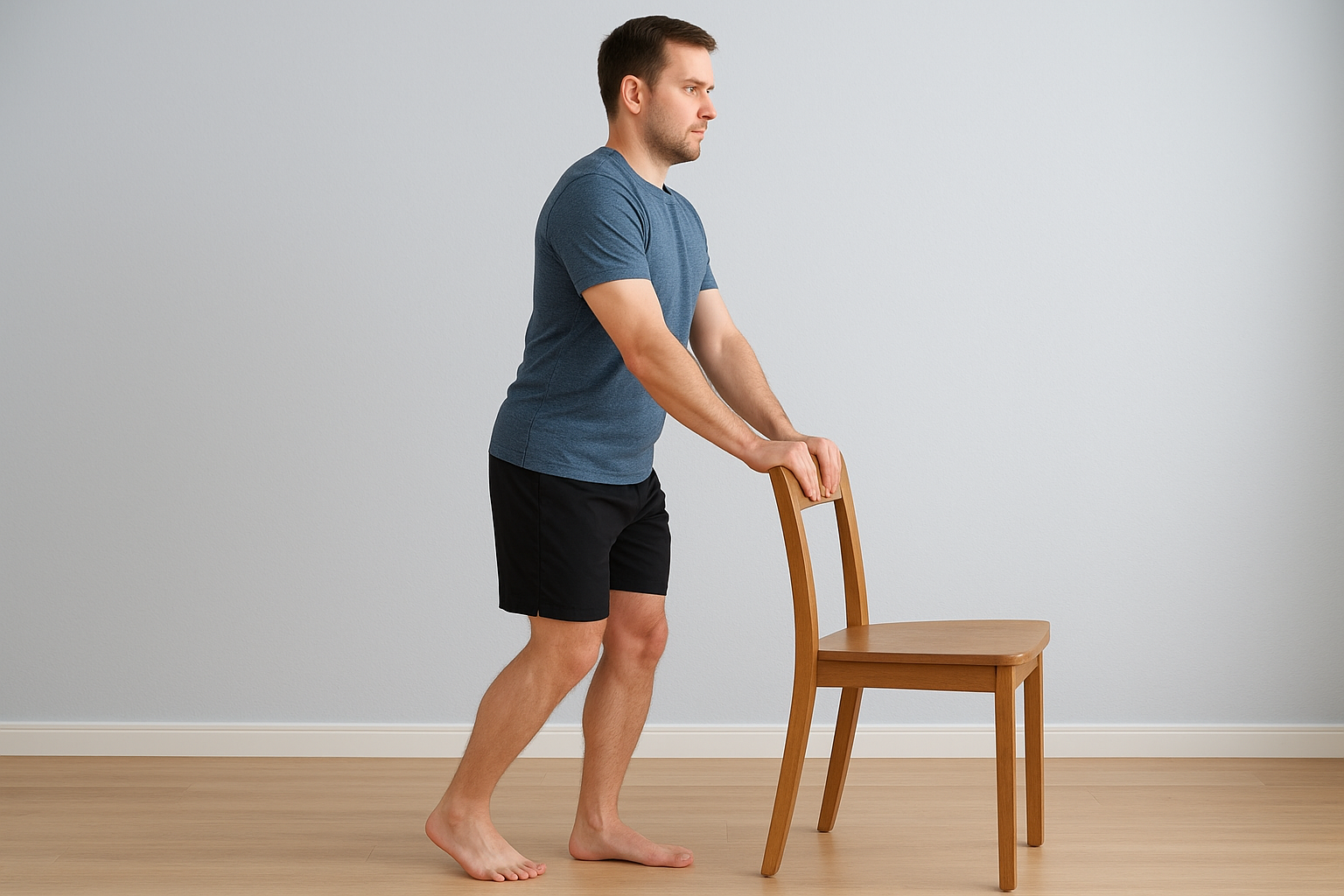
Stand behind a chair or against a wall for balance.
- Rise slowly onto the balls of both feet, lifting your heels as high as comfortable.
- Hold for two to three seconds at the top.
- Lower back down slowly, taking three to four seconds on the way.
- Once double-leg raises feel easy, progress to single-leg raises on the sore foot.
Control the movement on the way down. That slow lowering phase is doing most of the strengthening work.
What it helps with
Calf raises build strength in the calf and Achilles, reducing the strain that travels down into your heel with every step. We recommend them for Achilles tendinopathy, insertional heel pain, and general tightness that flares after running or long walks.
Strengthening the calf takes pressure off the Achilles and the heel below it.
How often to practise
Do three sets of 10 to 15 raises, four to five days a week, resting for a minute between sets.
4. Toe spreads and big toe stretches
Most people never move their toes independently once they leave childhood, and that lack of movement stiffens the joints and weakens the small muscles that keep your big toe tracking correctly. This exercise brings mobility back to a part of the foot that’s easy to ignore until it starts causing problems like bunions or restricted push-off when you walk.
How to do it
Sit with your bare foot resting on the opposite knee or flat on the floor.
- Spread all five toes apart as wide as you can and hold for five seconds.
- Relax, then use your fingers to gently pull your big toe upward and hold for 15 to 20 seconds.
- Pull the big toe downward and hold again for 15 to 20 seconds.
- Repeat the whole sequence three times per foot.
What it helps with
Toe spreads improve flexibility in the big toe joint, which matters if you’re managing bunions, hallux limitus, or stiffness that makes it hard to push off properly when walking or running. It also helps counter the squeezing effect of narrow shoes, which pushes toes together all day and shortens the muscles between them.
Loosening the big toe joint restores the push-off power your foot needs with every step.
How often to practise
Repeat this sequence once or twice daily, ideally in the evening after a day in shoes, when your toes have had the most time cramped together.
5. Wall stretch for the calf and Achilles tendon
A tight calf pulls on the Achilles, and the Achilles pulls straight into your heel, so stretching this chain often eases foot pain that seems to have nothing to do with your calf at all. This stretch is one we give almost every patient with heel pain, because it directly targets the tightness feeding the problem.
How to do it
Stand facing a wall with your hands flat against it at shoulder height.
- Step one foot back, keeping that back leg straight and the heel flat on the floor.
- Bend your front knee and lean forward gently until you feel a stretch through the back calf.
- Hold for 30 seconds, then slightly bend the back knee too, shifting the stretch lower toward the Achilles, and hold for another 30 seconds.
- Switch legs and repeat.
What it helps with
This stretch lengthens the calf muscles and Achilles tendon, easing the tension that contributes to plantar fasciitis, Achilles tightness, and that stiff, first-thing-in-the-morning ache through the heel. It pairs well with the calf raises above, since one builds strength and the other restores length.
A looser calf means less pull on the heel with every single step you take.
How often to practise
Stretch each leg twice through the sequence, once in the morning and once before bed, most days of the week.
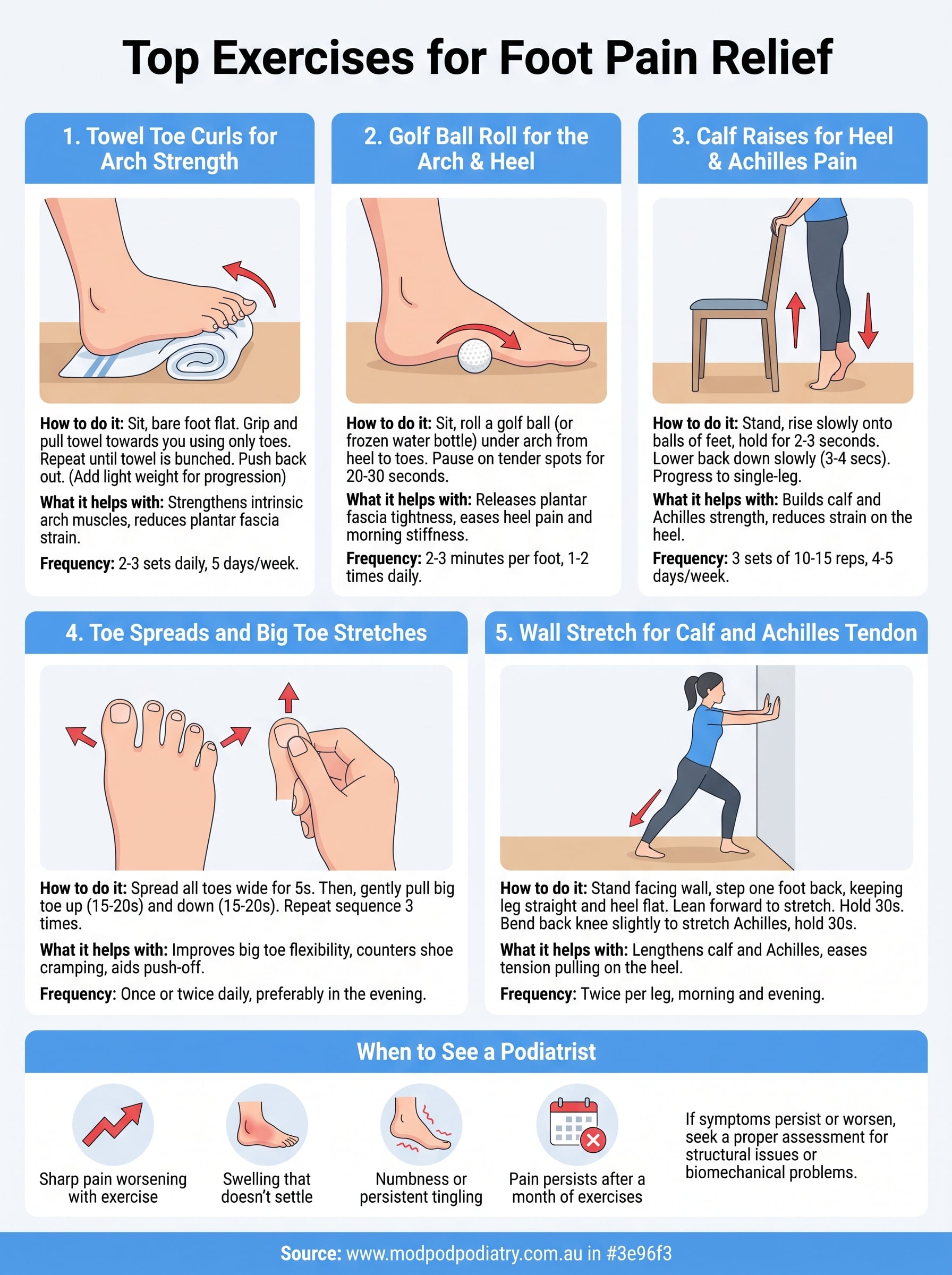
When it’s time to see a podiatrist
These five exercises handle a lot of foot pain on their own, especially when tight calves or weak arches are the main culprit. Give them three to four weeks of consistent practice before judging whether they’re working, since tissue and muscle changes take time to show up.
Watch for warning signs that mean it’s time to stop self-treating. Sharp pain that worsens with exercise, swelling that doesn’t settle, numbness, or pain that’s still there after a month of daily stretching all point to something exercises alone won’t fix. Structural issues like bunions, a dropped arch, or an underlying biomechanical problem usually need a proper assessment rather than more stretching.
If that sounds like you, don’t wait it out. Our podiatrists across Sydney can pinpoint exactly what’s driving your pain and build a treatment plan around it, whether that’s manual therapy, custom orthotics, or something else entirely. Book an appointment online and get a straight answer this week.