

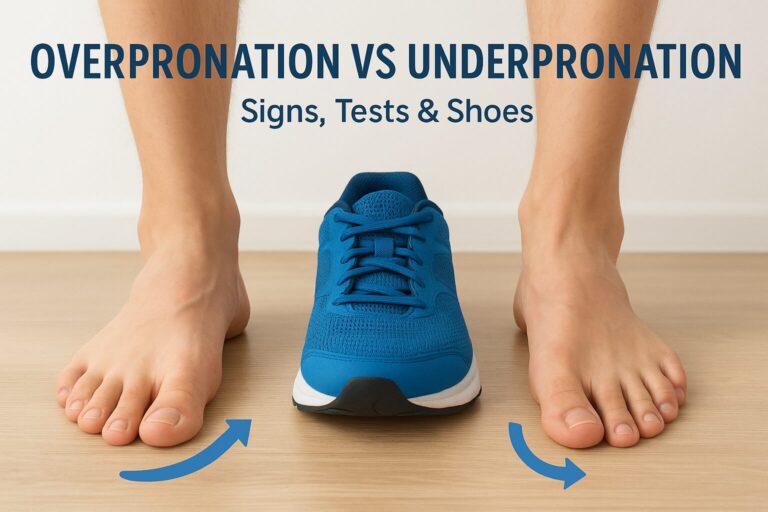
Every time your foot hits the ground, it rolls slightly inward or outward to absorb shock. That movement is called pronation, and it’s completely normal. The problem starts when your feet roll too much in either direction, and that’s where the overpronation vs underpronation debate matters. Both patterns change how force travels through your feet, ankles, knees and hips, and both can lead to repetitive strain injuries if left unchecked.
The tricky part is that most people have no idea which pattern applies to them. You might be buying the wrong shoes, stretching the wrong muscles or ignoring early warning signs that something’s off. A quick look at your worn-out shoe soles or a simple wet foot test can point you in the right direction, but understanding what the results actually mean is where real progress happens.
At ModPod Podiatry, our podiatrists assess pronation patterns daily using pressure plate gait analysis across our Sydney clinics. This article breaks down the key differences between overpronation and underpronation, how to identify your foot type at home, and which shoe features to look for based on your specific biomechanics.
Why pronation matters for pain and injury
Pronation is your foot’s natural way of distributing impact forces each time you take a step. When you walk or run, your heel strikes the ground first, and then your foot rolls inward slightly before pushing off through your big toe. Neutral pronation keeps that movement within a healthy range, allowing your muscles, tendons and joints to share the load evenly. When that range shifts too far in either direction, certain structures in your lower limb end up absorbing far more stress than they were designed to handle.
How abnormal pronation creates injury patterns
The connection between your foot mechanics and the pain you feel in your knee, shin or hip is more direct than most people realise. Overpronation vs underpronation both disrupt the alignment of your entire lower limb chain. When your foot rolls excessively inward, your shin bone rotates inward with it, pulling your knee out of its neutral tracking position. When your foot rolls outward, shock that should spread across your arch instead concentrates along the outer edge of your foot and travels upward through a rigid leg.
Over time, these small mechanical shifts accumulate. A single run won’t cause a stress fracture, but thousands of steps with poor mechanics will. Your body compensates by recruiting different muscles to stabilise each stride, and those compensating muscles and tendons eventually become overloaded and inflamed.
Poor pronation mechanics don’t just cause foot pain. They change the way force moves through every joint from your ankle to your lower back.
Common injuries linked to pronation problems
Ignoring your pronation pattern leads to a predictable set of injuries that keep recurring until the underlying mechanics are addressed. Both overpronation and underpronation are linked to specific conditions depending on which direction your foot deviates:
- Plantar fasciitis: heel and arch pain from strain on the plantar fascia
- Shin splints: tibial stress from repeated impact loading
- Patellofemoral pain: knee pain caused by poor kneecap tracking
- Iliotibial band syndrome: outer knee or hip pain, common in runners
- Stress fractures: bone stress injuries from concentrated force
Your footwear choices and training load directly influence how quickly these injuries develop. Knowing your pronation pattern gives you a clear starting point for fixing the root cause rather than just treating the symptoms.
Overpronation explained: causes and common symptoms
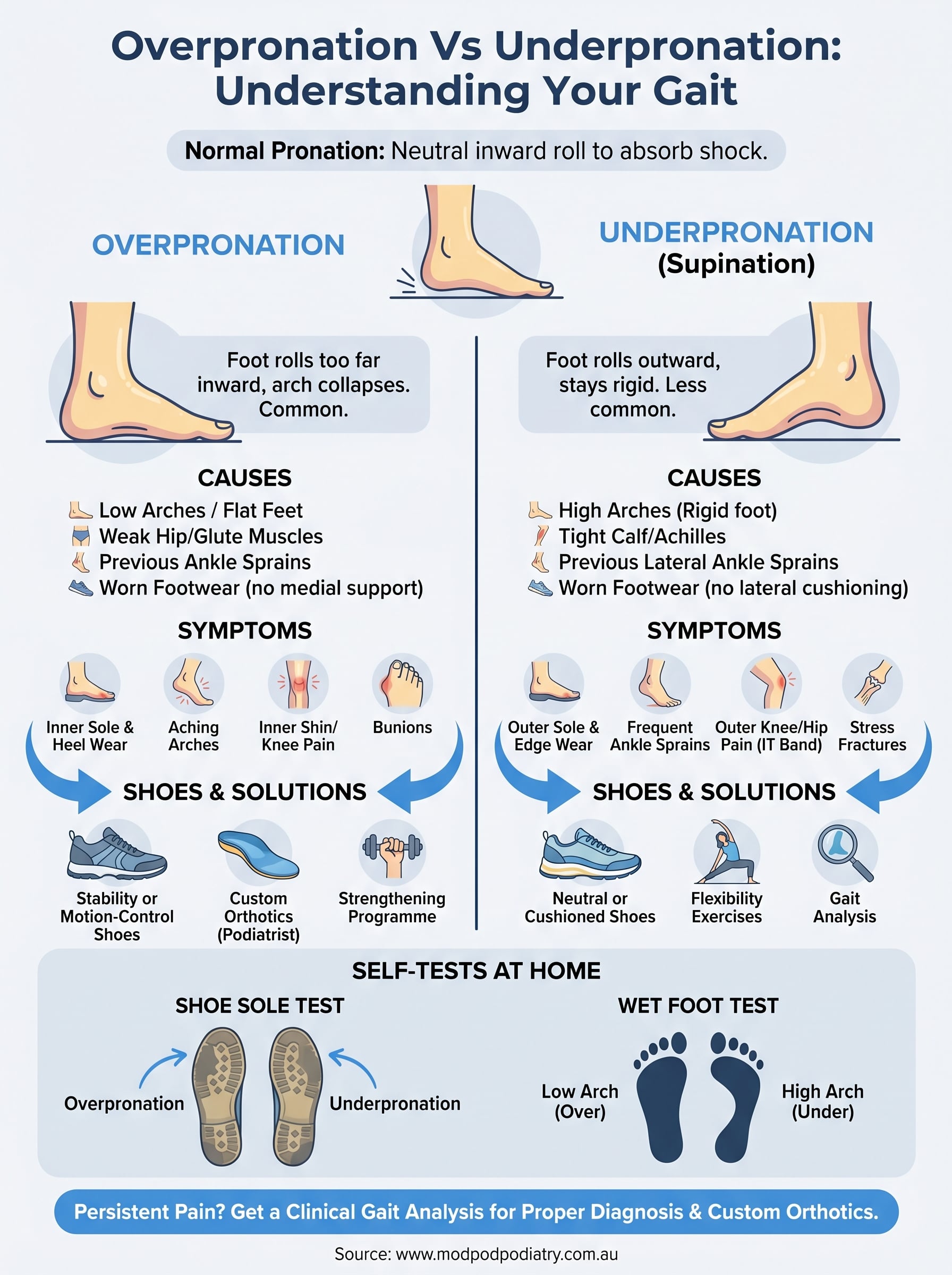
Overpronation happens when your foot rolls too far inward as it moves through each stride. Instead of that inward roll stopping within a normal range, your arch continues to collapse toward the ground, pulling your ankle and lower leg out of alignment with every step you take. When comparing overpronation vs underpronation, overpronation is by far the more common pattern in the general population.
What causes overpronation
Several factors push your foot into excessive inward rolling. The most common is low arches or flat feet, where the arch has less structural support to resist the forces of each footfall. Weak hip and glute muscles are another major contributor because they fail to control the inward rotation of your thigh, which then pulls your foot into a collapsed position. Previous ankle sprains, carrying extra body weight, and wearing worn-down footwear with no medial support can all make overpronation worse over time.
Symptoms to watch for
Your body usually gives you clear signals before a full injury develops. The inside edge of your heel and the ball of your foot tend to wear down faster than the outer edge on your shoes. You might notice aching arches after standing for long periods, soreness along the inner shin, or knee pain that sits just below and to the inside of your kneecap.
If your big toe pushes outward when you stand barefoot, that is often a reliable visual cue of overpronation worth investigating with a podiatrist.
Underpronation explained: causes and common symptoms
Underpronation, also called supination, is the opposite of overpronation. Your foot rolls outward instead of inward, keeping your weight along the outer edge of your foot rather than spreading across the arch. When comparing overpronation vs underpronation, underpronation is far less common but tends to generate more concentrated impact forces because a rigid foot is poorly equipped to absorb shock from each footfall.
What causes underpronation
High arches are the most common structural cause. A rigid, high-arched foot has limited flexibility to flatten during impact, so it stays on its outer edge throughout your gait cycle. Tight calf muscles and Achilles tendons also restrict how far your ankle can flex forward, which reduces the natural inward roll that should happen mid-stride.
Several other factors can contribute to underpronation:
- Genetics: an inherited high arch structure with limited flexibility
- Previous lateral ankle sprains: repeated outer ankle injuries that reinforce outward rolling
- Worn footwear: shoes lacking lateral cushioning that break down unevenly over time
Symptoms to watch for
Supination puts repetitive stress on the outer structures of your foot and lower leg. The outer edges of your shoe soles will wear down faster than the inner edges. Frequent ankle sprains are common because your foot already lands in a slightly inverted position, and stress fractures along the outer metatarsals often follow from that concentrated load. You might also notice tightness running up your calves and IT band after longer activity sessions.
A repeatedly sprained ankle on the same side is often a sign that underpronation is pulling your foot outward with every landing.
How to tell your gait pattern at home and in-store
You don’t need a clinical gait lab to get a reasonable read on your foot mechanics. A few simple observations can tell you a lot about whether overpronation vs underpronation applies to you before you book an appointment or buy new footwear.
Check your shoe soles first
Flip over a pair of shoes you’ve worn regularly for at least a few months. The wear pattern on your sole tells a reliable story about where your foot is placing the most pressure with every stride.
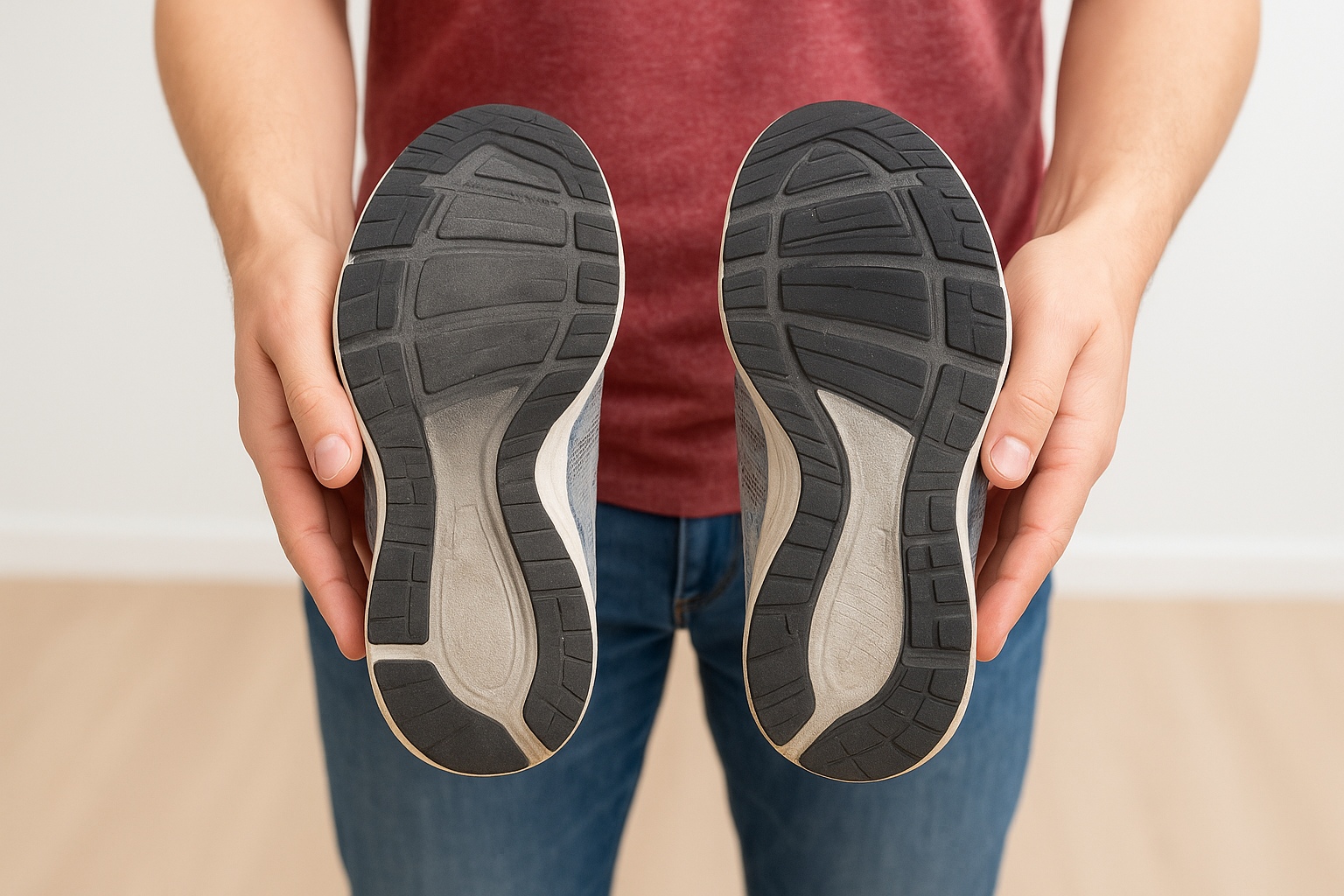
- Inner heel and forefoot worn: likely overpronation
- Outer edge from heel to little toe worn: likely underpronation
- Even wear across the full sole: likely a neutral gait pattern
Try the wet foot test at home
Wet the bottom of your foot and step firmly onto a piece of cardboard or a dark surface. A wide, full footprint with almost no arch gap indicates a low arch linked to overpronation, while a thin connecting strip or no mid-foot contact points toward a high arch and underpronation.
The wet foot test shows your static arch shape, not your dynamic movement pattern, so treat it as a starting point rather than a final answer.
Get a proper in-store or clinic assessment
Many specialist running stores offer a basic treadmill video assessment at no charge. Your local podiatrist goes further with pressure plate gait analysis, measuring exactly how force moves through your foot during walking and running.
Getting a professional read means you’re not guessing at your shoe type or spending money on orthotics that don’t match your actual mechanics.
Shoes and treatment options that actually help
Once you know your pronation pattern, choosing the right footwear becomes much more straightforward. Overpronation vs underpronation calls for opposite shoe features, and picking the wrong type can accelerate injury rather than prevent it. Shoe manufacturers label their running shoes by support category, and understanding what those labels mean lets you make a smarter purchase.
Footwear features to match your gait
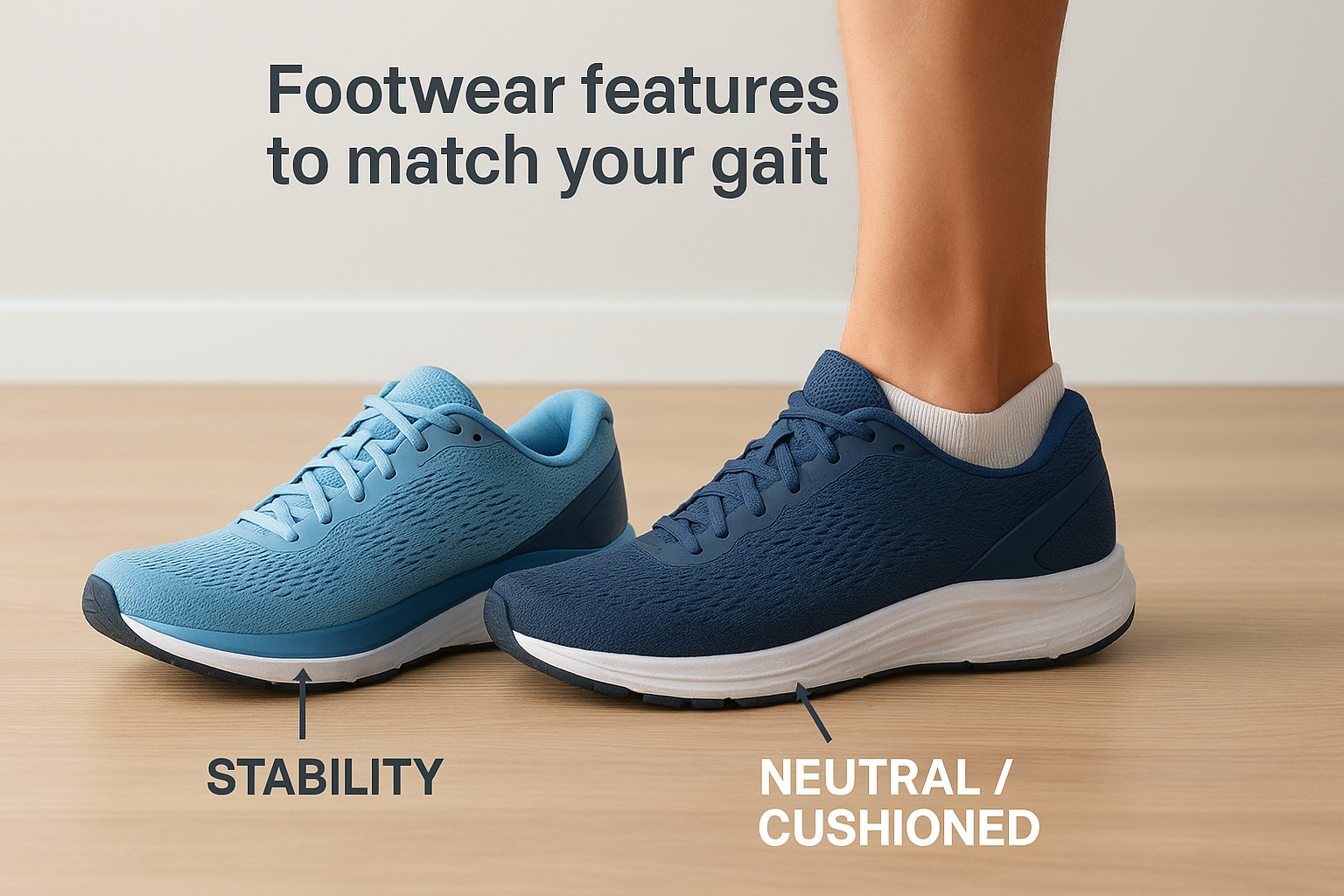
Overpronators need stability or motion-control shoes that limit excessive inward rolling. These shoes contain a denser foam section along the inner midsole, called medial post support, which resists arch collapse during each stride. Underpronators need the opposite approach: neutral or cushioned shoes with soft, flexible midsoles that allow your foot to absorb impact without pushing it further outward.
Avoid buying shoes based purely on appearance or brand. The support structure built into the midsole matters far more than anything you see on the outside.
When orthotics and podiatry make sense
Footwear alone does not always resolve the issue, particularly if your pronation problem is severe or you have a history of recurring lower limb injuries. Custom orthotics prescribed by a podiatrist are shaped specifically to your foot structure, correcting alignment in a way that off-the-shelf insoles simply cannot replicate. Your podiatrist can also identify contributing factors like hip weakness, calf tightness or ankle instability and build a targeted strengthening and stretching programme around your specific mechanics.
Combining the right footwear with a professional treatment plan gives you the best chance of staying active without the same injuries cycling back every few months.
Next steps for happier feet
Understanding the difference between overpronation vs underpronation gives you a real advantage when it comes to choosing footwear, managing recurring pain, and preventing new injuries from developing. Start with your worn shoe soles and the wet foot test to get a rough picture of your gait pattern. From there, match your shoe type to your pronation direction using the guidance covered earlier in this article.
If your pain keeps coming back despite changing your footwear, or if you have high arches, flat feet, or a history of ankle sprains, a clinical gait assessment will give you far more reliable answers than any home test. A podiatrist can measure exactly how your feet move under load and recommend whether custom orthotics or a targeted rehab programme would make the biggest difference for your situation.
Book a gait analysis with the team at ModPod Podiatry and get a clear plan for your feet. Book your appointment online to get started.

