

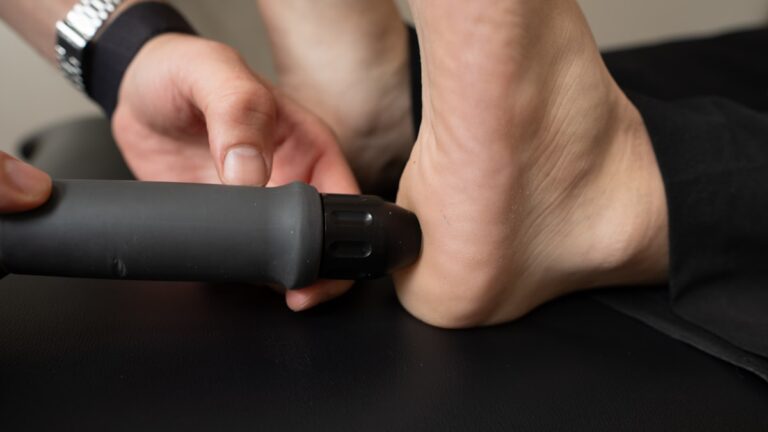
If you have had plantar fasciitis for more than three months and conservative treatment has not resolved it, shockwave therapy is likely the next step your podiatrist will discuss. Shockwave therapy — formally known as ESWT (extracorporeal shockwave therapy) — uses high-energy acoustic waves to stimulate healing in damaged tissue. For chronic heel pain, research consistently reports a 70–80% success rate. At ModPod Podiatry’s Sydney clinics, we use ESWT regularly for patients who have worked through stretching, orthotics, and footwear modifications without sufficient improvement. This post explains how shockwave therapy works, what the clinical evidence shows, what to expect during treatment, and what it typically costs in Sydney.
What Is Shockwave Therapy?
ESWT delivers focused acoustic energy — pressure waves — through the skin to the affected tissue. The device is applied directly over the heel, and pulses are transmitted at controlled intervals. The treatment takes around 10–15 minutes per session and does not require anaesthesia or needles.
Shockwave therapy is not the same as ultrasound. Ultrasound uses low-intensity continuous waves for imaging or minor inflammation. ESWT uses high-intensity pulses specifically designed to trigger a biological healing response in damaged, often calcified tissue.
How Does It Work Mechanically?
The acoustic energy does three things that matter clinically:
- Neovascularisation: Stimulates the formation of new blood vessels in tissue that has become chronically deprived of circulation — a key feature of chronic plantar fasciitis.
- Collagen production: Triggers fibroblast activity, which promotes the synthesis of new collagen fibres. Chronic plantar fascia tissue is often disorganised; ESWT encourages proper structural repair.
- Calcification disruption: Breaks up calcium deposits that can form within the fascia after prolonged inflammation, improving tissue integrity.
These mechanisms explain why shockwave therapy works well in chronic cases but is less appropriate for acute injuries, where inflammation is still in an active protective phase.
What Does the Evidence Say?
The evidence base for ESWT in plantar fasciitis is strong, particularly for cases lasting more than three months. A systematic review by Rompe et al. found clinically significant improvements in pain and function compared to sham treatment, with success rates of 70–80% in chronic plantar fasciitis. NICE (the UK National Institute for Health and Care Excellence) has reviewed the evidence and considers ESWT a suitable option for patients who have not responded to conservative management.
Results build progressively after treatment ends. Most patients see measurable improvement at six weeks and continue to improve through 12 weeks. The tissue repair continues long after the sessions are complete.
Who Is Shockwave Therapy Suitable For?
ESWT is recommended for patients with chronic plantar fasciitis — typically defined as symptoms present for three months or longer that have not resolved with conservative treatment. Conservative measures include:
- Regular calf and plantar fascia stretching
- Custom orthotics or supportive prefabricated insoles
- Footwear modifications
- Load management and activity modification
If you have completed 12 or more weeks of consistent conservative management without adequate improvement, shockwave therapy is a logical next step before considering injections or surgical options.
Who Should Not Have Shockwave Therapy?
ESWT is contraindicated for:
- Acute plantar fasciitis (symptoms fewer than six weeks old)
- People taking anticoagulant medications (blood thinners)
- Pregnancy
- Active infection at the treatment site
- Certain circulatory or neurological conditions affecting the foot
- Known malignancy in the treatment area
Your podiatrist will review your history before proceeding. If there is any uncertainty, we take a conservative approach.
What to Expect: Sessions, Sensations, and Recovery
How many sessions will I need?
The standard protocol is three to five sessions, spaced one week apart. Some patients respond well after three sessions; others benefit from the full five. Your podiatrist will reassess after each session and adjust accordingly.
Does shockwave therapy hurt?
There is discomfort during treatment — most patients describe a deep, aching pressure or brief stinging sensation as each pulse is delivered. The intensity is adjustable, and your podiatrist will start conservatively and increase as tolerated. The treatment itself lasts 10–15 minutes, so the discomfort is brief.
For 24–48 hours after a session, some patients experience increased local soreness. This is expected and indicates the tissue is responding. It generally settles within two days.
When will I notice improvement?
Most patients do not notice significant improvement during the treatment course itself. Results build over six to twelve weeks after the final session. This is important to understand: shockwave therapy initiates a healing process that continues long after the appointments end. Expecting immediate relief after session one leads to unnecessary disappointment.
Australian Context: Cost, Medicare, and Private Health
In Sydney, shockwave therapy typically costs between $80 and $150 per session, depending on the clinic and clinical complexity.
Private health insurance rarely covers ESWT directly under standard Extras cover, as it falls outside most fund definitions of podiatry treatment. Some funds (Medibank, BUPA, HCF, NIB) may offer partial rebates depending on your specific policy — check with your fund before your first appointment.
Medicare does not currently fund ESWT when delivered by a podiatrist under standard consultation. However, patients on a Medicare Enhanced Primary Care (EPC) plan may receive a rebate on the podiatry consultation component. If you are seeing a GP for your heel pain, ask about a Team Care Arrangement — this provides up to five subsidised allied health visits per calendar year.
ModPod Podiatry offers shockwave therapy across our Sydney clinics. Our podiatrists will confirm availability at your preferred location during your initial assessment.
How Shockwave Therapy Fits Into Overall Plantar Fasciitis Management
Shockwave therapy is not a standalone cure. For the best outcomes, ESWT is used alongside other evidence-based strategies. Understanding how long plantar fasciitis takes to heal helps set realistic expectations throughout your recovery — and shockwave therapy can meaningfully accelerate that timeline in the right candidates.
After completing a course of ESWT, most patients transition to a maintenance programme: regular stretching, appropriate footwear, and periodic orthotic review. The goal is not just pain relief but durable resolution.
Frequently Asked Questions
Q: How many shockwave therapy sessions do I need for plantar fasciitis?
A: Most patients complete three to five sessions, spaced one week apart. The total number depends on your response after each session. Your podiatrist will review your progress and adjust the plan accordingly.
Q: Is shockwave therapy painful?
A: There is discomfort during treatment — most patients describe a deep aching or pressure sensation. The intensity is adjustable, and the treatment takes 10–15 minutes. Some soreness for 24–48 hours afterwards is normal and expected.
Q: Does Medicare or private health cover shockwave therapy?
A: Private health Extras cover rarely includes ESWT directly. Medicare does not fund it under standard podiatry consultation, but an EPC plan from your GP may provide rebates on the consultation component. Check with your fund for your specific policy details.
Q: How long until shockwave therapy works?
A: Most patients notice improvement six to twelve weeks after their final session. Results build progressively as the tissue repairs. Expecting immediate relief during the treatment course is unrealistic — the process takes time.
Q: Can shockwave therapy help if I have had plantar fasciitis for years?
A: Yes — ESWT is specifically effective for chronic, long-standing plantar fasciitis. Patients who have struggled with heel pain for one to three years often respond well, provided there are no contraindications.
Ready to Take the Next Step?
If your heel pain has persisted beyond three months and conservative treatment has not given you sufficient relief, shockwave therapy is worth a serious conversation with your podiatrist. We assess each patient thoroughly before recommending ESWT — it is not appropriate for every case, but when it is, the outcomes are reliable.
Book online to arrange an appointment at ModPod Podiatry. Our Sydney podiatrists will assess your heel pain, review your history, and advise whether shockwave therapy is the right next step for you.

