

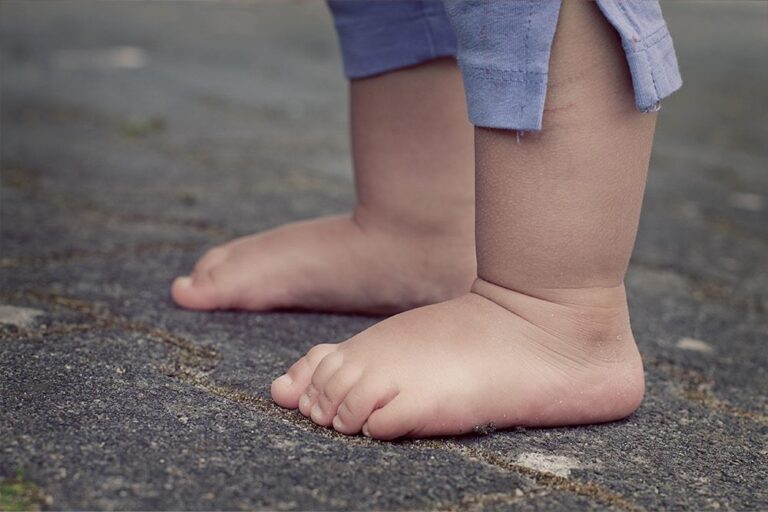
Your toddler stands up and you notice their feet look completely flat. No arch at all. It’s natural to wonder if something is wrong — but in most cases, flat feet in young children are a normal part of development.
That said, there are times when flat feet do need attention. This guide will help you understand what’s going on with your child’s feet, what to watch for, and when it’s time to see a podiatrist.
What Are Flat Feet in Children?
Flat feet — also called pes planus — means the arch of the foot sits low or touches the ground when standing. In babies and toddlers, this is almost universal. A fat pad fills the arch area, and the ligaments and muscles that shape the arch haven’t finished developing yet.
There are two types of flat feet in children. Flexible flat feet are by far the most common. The arch disappears when standing but reappears when the child sits or stands on tiptoes. Rigid flat feet are rare. The arch is absent in all positions, and the foot may feel stiff. This type is more likely to cause problems and needs assessment.
Understanding your child’s foot anatomy can help you make sense of what you’re seeing. The bones, muscles, and ligaments of the foot work together to form the arch — and in young children, that system is still maturing.
When Do Arches Develop?
Most children develop a visible arch between ages 3 and 6. The timeline varies, and some children take longer than others. Here’s a rough guide:
0–2 years: Flat feet are normal. The arch is hidden by a fat pad and the foot is still very flexible.
3–5 years: The arch starts to appear. You may notice it when your child stands on tiptoes or sits with their feet dangling.
6–8 years: By this age, most children have a formed arch. If the feet are still flat at age 6 or older, it’s worth getting them checked.
Genetics play a role too. If you or your partner have flat feet, your child is more likely to as well. That doesn’t mean there’s a problem — it just means the arch may be lower than average.
Red Flags: When Flat Feet Need Attention
Flat feet alone — without any symptoms — are rarely a concern in young children. But certain signs suggest the feet may need professional assessment:
Pain or aching. If your child complains of sore feet, ankles, knees, or legs — especially after activity — the flat foot position may be placing extra stress on those structures.
Tripping or clumsiness. Children with significant flat feet sometimes trip more than their peers. The foot can roll inward (overpronate), which affects balance and coordination.
Fatigue. If your child tires faster than expected during walking or sport, their feet may be working harder to compensate for a lack of arch support.
Uneven shoe wear. Check the soles of your child’s shoes. If one side wears down faster than the other — especially the inner edge — it’s a sign of overpronation linked to flat feet.
Avoiding activity. Some children don’t complain of pain directly but start avoiding running, sport, or long walks. This can be a subtle sign of discomfort.
Flat feet persisting past age 6. If the arch hasn’t developed by school age, an assessment can determine whether treatment would help.
How a Podiatrist Assesses Your Child’s Feet
A podiatry assessment for flat feet in children is painless and non-invasive. At ModPod Podiatry, a typical assessment includes several key components.
First, we observe your child standing, walking, and running. This gives us a clear picture of how their feet function during movement — not just how they look when still.
We use digital video analysis to record your child’s gait from multiple angles. This allows us to slow the footage down and examine foot, ankle, and knee alignment in detail. It’s one of the most useful tools for identifying overpronation and other biomechanical issues.
A pressure plate assessment may also be used. Your child walks across a sensor plate that maps how pressure distributes across the sole of the foot. This shows us exactly where load is falling and whether the arch is bearing weight as expected.
We also check joint range of motion, muscle strength, and footwear. All of these factors influence how the flat foot position affects your child’s body.
The goal of the assessment isn’t to label the foot as “good” or “bad.” It’s to determine whether the flat foot position is causing — or is likely to cause — problems that would benefit from treatment.
Treatment Options for Children’s Flat Feet
Treatment depends on your child’s age, symptoms, and the severity of the flat foot position. Here are the main options.
Monitoring
If your child is under 6 with flexible flat feet and no symptoms, the best approach is often to monitor. We’ll check in at regular intervals to track arch development and make sure things are progressing as expected.
Orthotics
For children with symptomatic flat feet, custom orthotics can make a real difference. Orthotics sit inside the shoe and support the arch, reducing overpronation and taking stress off the feet, ankles, and knees.
Children’s orthotics are designed to guide foot development — not force the foot into a position. They’re comfortable, and most kids adapt to them within a week or two.
Strengthening Exercises
Specific exercises can help strengthen the muscles that support the arch. These include towel scrunches, marble pickups, and calf raises. We’ll show your child how to do them and make them fun enough to stick with.
Footwear Advice
The right shoes matter. For children with flat feet, we recommend shoes with a firm heel counter (the back of the shoe should feel rigid, not squishy), a flexible forefoot, and a removable insole if orthotics are needed. We’ll give you specific recommendations based on your child’s needs.
What About Surgery?
Surgery for flat feet in children is rare and only considered in severe cases that don’t respond to other treatments. The vast majority of children with flat feet do well with orthotics, exercises, and footwear changes alone.
When to Book an Appointment
If your child is over 6 and still has flat feet, or if they’re experiencing pain, fatigue, or difficulty keeping up with their peers, it’s a good idea to get a professional assessment. Even if the flat feet turn out to be nothing to worry about, an assessment gives you clarity and peace of mind.
Early identification means early intervention — and that can prevent small issues from becoming bigger problems down the track.
At ModPod Podiatry’s children’s podiatry clinics, we see kids with flat feet every week. Our podiatrists have the experience and the technology — including digital video analysis and pressure plate assessment — to give you a clear answer about your child’s feet.
We have 5 clinics across Sydney — in the CBD, Mosman, Dee Why, Rose Bay, and North Ryde — so there’s always one close to you. Book a children’s podiatry appointment today and let us take a look.