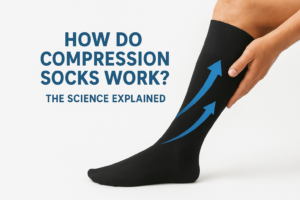

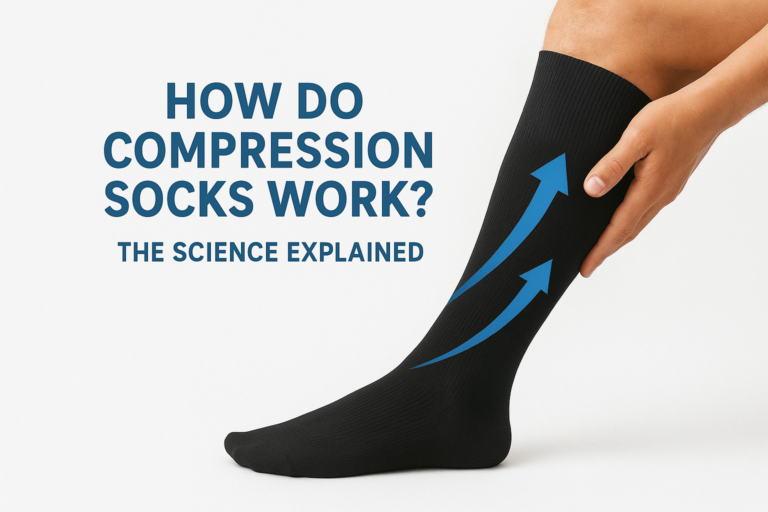
If you’ve ever pulled on a pair of compression socks after a long shift on your feet or a big training run, you’ve probably wondered what they’re actually doing beyond just feeling snug. How do compression socks work comes up constantly in our clinics across Sydney, usually from patients dealing with tired, aching legs or swelling that won’t settle by evening. The short answer involves graduated pressure and how your circulatory system moves blood back up to your heart, but the mechanics are worth understanding properly.
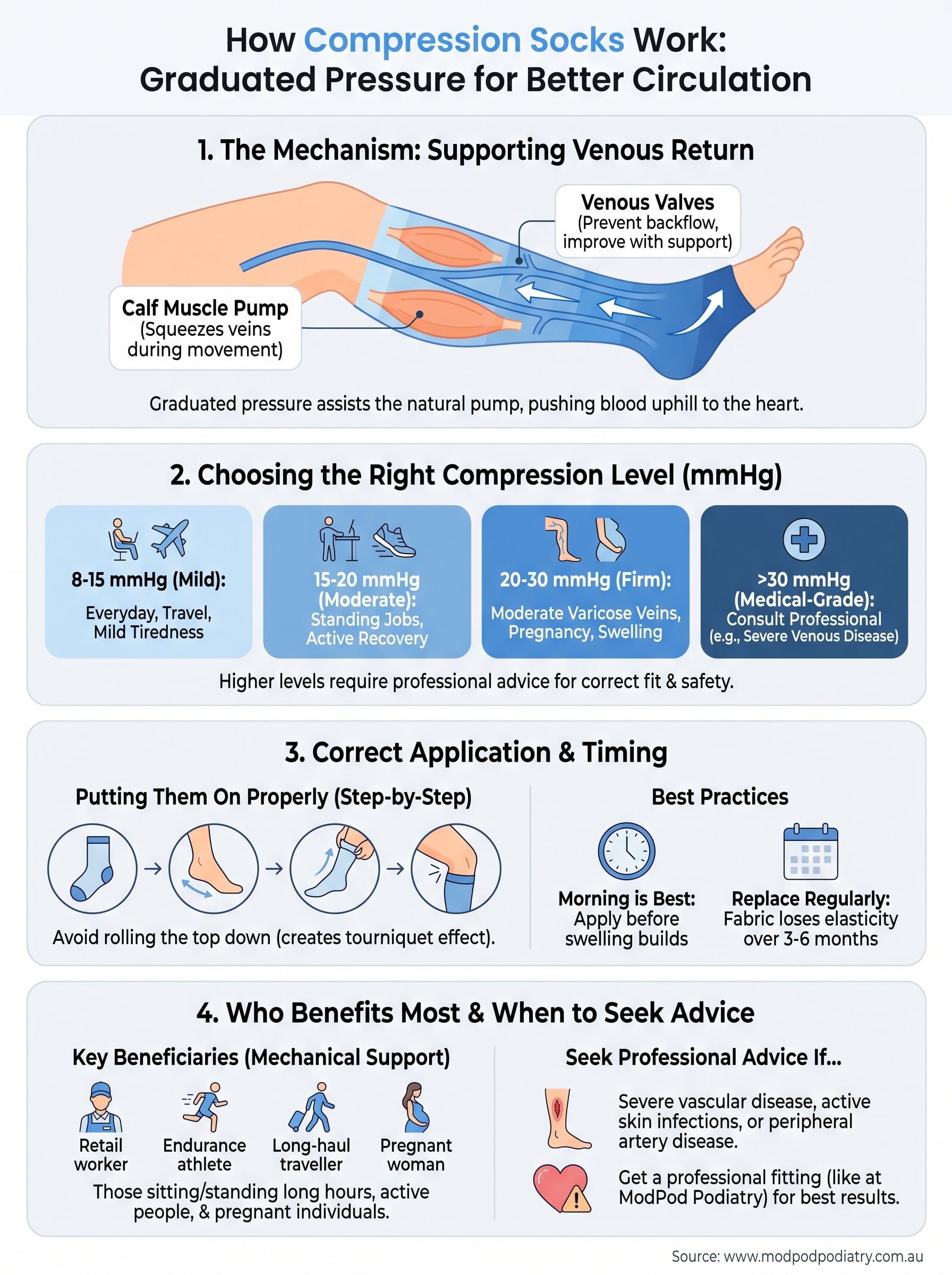
Compression socks apply graduated pressure, tightest at the ankle and gradually looser towards the knee or thigh. This pressure gradient supports your veins and calf muscles, helping push deoxygenated blood upward against gravity rather than letting it pool in your lower legs. The result is improved circulation, reduced swelling, and less muscle fatigue.
In this article, we’ll break down the actual science behind compression, including venous return, calf muscle pump function, and why the right compression level and fit matter for genuine results. As podiatrists who assess gait and lower limb function daily, we’ll also cover when compression socks genuinely help and when they’re not the right solution for your symptoms.
Why compression socks matter for your circulation
Your veins have a genuinely tough job. Arteries get help from your heart’s pumping action to push blood out to your tissues, but veins have to move blood back up against gravity with far less pressure behind them. This uphill battle is especially hard in your lower legs, where blood has the longest distance to travel back to your heart. Understanding this venous return process is the key to understanding why compression socks work at all.
The venous return problem
Inside your leg veins sit a series of one-way valves that stop blood from flowing backward and pooling at your ankles. When these valves work well and your calf muscles are active, blood moves upward in a steady rhythm. When you sit or stand still for long stretches, though, that rhythm slows right down. Blood lingers in your lower legs, pressure builds in the veins, and fluid starts leaking into surrounding tissue. That’s the swelling many people notice by the end of a long flight, a busy retail shift, or a day spent mostly at a desk.
The calf muscle pump
Your calf muscles act as a secondary pump for your circulatory system, squeezing the deep veins running through them every time you walk, flex your foot, or contract your calf. Compression socks work alongside this natural pump rather than replacing it. The graduated pressure narrows the diameter of your veins slightly, which means the same volume of blood moves through a smaller space more efficiently. Less pooling happens, valve function improves, and blood gets pushed upward with less backward flow between muscle contractions.
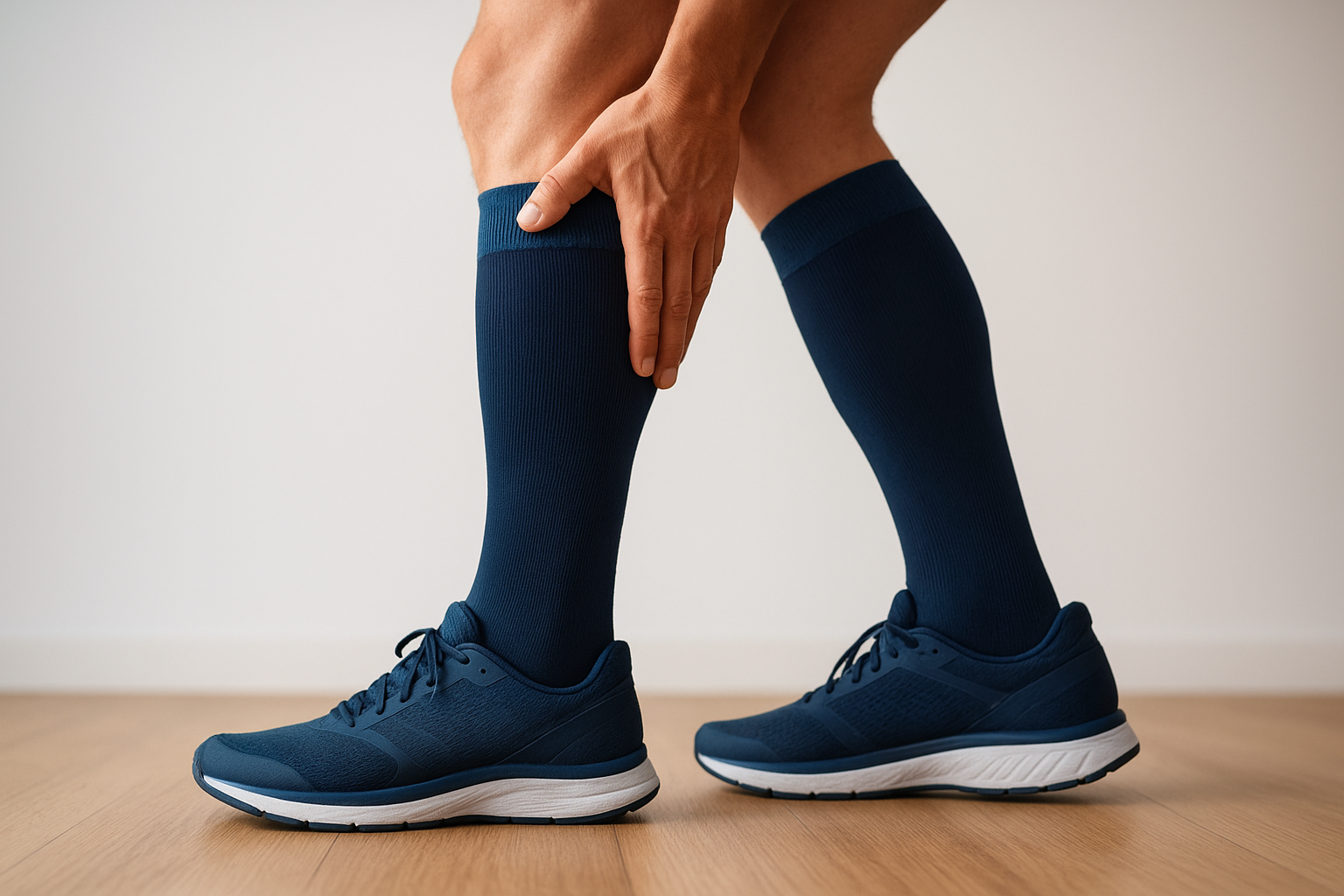
Compression socks don’t create circulation, they help your calf muscle pump do its job more efficiently.
What happens without enough support
Without adequate compression, gravity and inactivity work together against your circulation. Fluid accumulates around your ankles and lower calves, veins can stretch and weaken over time, and some people develop visible varicose veins or ongoing heaviness in their legs. Athletes often notice a related but distinct issue: increased muscle oscillation during running or jumping, which contributes to fatigue and micro-damage in the muscle fibres. Graduated compression addresses both problems from slightly different angles, supporting venous return for circulation-related symptoms and reducing muscle vibration for performance-related fatigue.
Why the science holds up
Research published through bodies like the Australian Institute of Sport and clinical circulation studies consistently shows measurable reductions in venous pooling and subjective leg fatigue when graduated compression is worn correctly. The effect isn’t dramatic for everyone, and it’s not a substitute for treating underlying vascular conditions, but for otherwise healthy legs dealing with prolonged standing, sitting, or exercise load, the physiological logic is sound and well documented. We see this play out regularly in our Sydney clinics: patients who stand all day at work or train several times a week for endurance sport report noticeably less end-of-day swelling and heaviness once they start wearing properly fitted compression socks. It’s a simple mechanical solution to a genuinely mechanical problem, which is part of why it’s stood up so well to scrutiny over decades of vascular research.
How to choose the right compression level and fit
Getting the pressure and sizing right matters more than most people realise. Too loose and you get minimal benefit, too tight and you risk cutting off circulation rather than helping it. Compression levels are measured in millimetres of mercury (mmHg), the same unit used for blood pressure, and different ranges suit different needs.
Matching mmHg to your goal
Mild compression suits everyday wear and mild tiredness, while higher ranges are reserved for medical conditions and usually need a health professional’s input.
| Compression level | Typical use |
|---|---|
| 8-15 mmHg | Everyday comfort, long flights, mild tiredness |
| 15-20 mmHg | Standing jobs, travel, general athletic recovery |
| 20-30 mmHg | Moderate varicose veins, post-exercise swelling, pregnancy-related swelling |
| 30-40 mmHg | Medical-grade, prescribed for significant venous disease or post-surgical swelling |
The right compression level depends on your symptoms, not on buying the strongest pair you can find.
Anything above 20-30 mmHg should really be discussed with a podiatrist or GP first, since medical-grade compression can interact with existing vascular or cardiac conditions.
Getting the fit right
Fit matters just as much as pressure rating. A sock that’s the correct mmHg but the wrong size will bunch, roll, or fail to apply pressure where it’s needed. Measure your ankle circumference, calf circumference, and leg length before buying, and check the manufacturer’s sizing chart rather than guessing from your shoe size. Length matters too, knee-high socks suit most circulation concerns, while thigh-high or full compression tights are better for pregnancy-related swelling or varicose veins higher up the leg.
When professional fitting helps
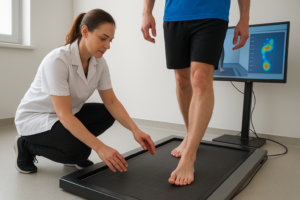
Some patients, particularly those with diabetes, poor circulation, or unusual leg shape, benefit from a proper fitting session rather than an off-the-shelf purchase. At ModPod Podiatry, we assess gait and lower limb function alongside sizing, so the compression you’re wearing actually matches what your legs need rather than what happened to fit on the shelf. Getting this step right early saves money and frustration, since an ill-fitting pair often gets abandoned in a drawer within weeks.
How to wear compression socks correctly
Getting the mmHg and fit right is only half the job. Even a perfectly sized pair of compression socks won’t do much if you’re putting them on wrong or wearing them at the wrong times. Proper technique matters because the graduated pressure only works when the sock sits flush against your skin from ankle to knee, with no folds or bunching disrupting the gradient.
Putting them on properly
Rolling the sock down into a doughnut shape before sliding it over your foot, then unrolling it gradually up your leg, gives you the most even pressure distribution. Try this sequence:
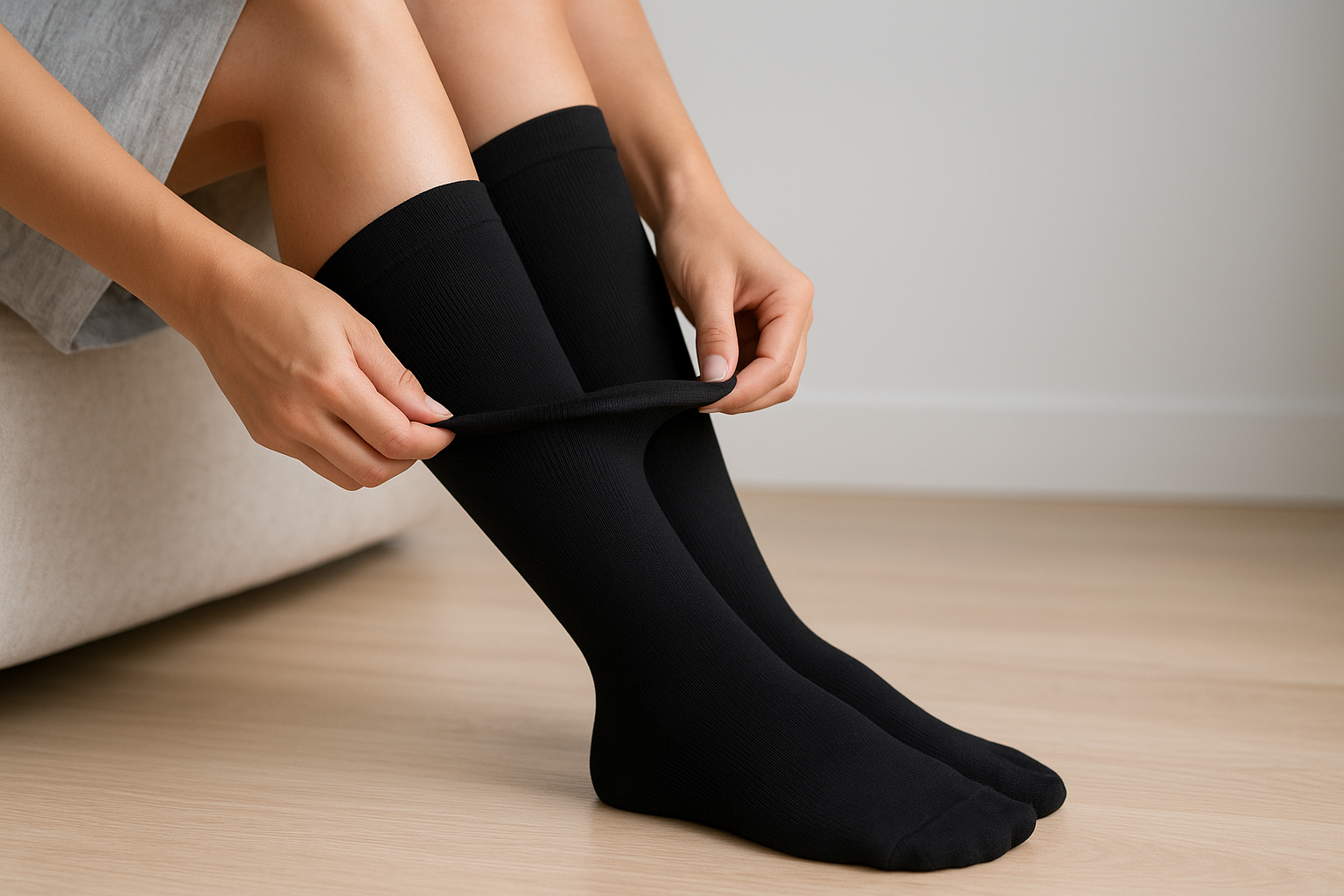
- Turn the sock inside out down to the heel
- Slip your foot in and align the heel pocket correctly
- Unroll the fabric upward in small sections, smoothing as you go
- Check for wrinkles or twists behind the knee and at the ankle
- Confirm the toe seam sits flat, not pinched
Skipping steps here is the main reason people say compression socks don’t work for them, when really the sock just isn’t applying pressure where it should.
A bunched compression sock can create a tourniquet effect instead of gradual support, so smoothing it properly matters as much as the mmHg rating.
Timing and duration
Morning application works best, ideally before swelling has had a chance to build up during the day. Once fluid has already pooled in your lower legs, getting a sock on comfortably becomes harder and the benefit is smaller. Wearing them for a full workday, a long flight, or the duration of a training session and recovery window generally gives the best result, though medical-grade pairs should follow whatever schedule your podiatrist or GP recommends.
Common mistakes worth avoiding
Rolling the top edge down to make them easier to remove creates a tight band that restricts circulation rather than supporting it, essentially undoing the entire purpose of graduated compression. Wearing a pair that’s stretched out or has lost elasticity after months of daily washing is another common issue, since compression fabric typically needs replacing every three to six months with regular use.
Who benefits most from compression socks
Compression socks help a wide range of people, but some groups notice the difference far more than others. Recognising where you fit on that spectrum helps you set realistic expectations and know whether over-the-counter socks are enough or whether you need a proper assessment first.
Everyday and occupational use
Anyone standing or sitting for long stretches is a strong candidate. Retail and hospitality workers, nurses, teachers, office staff on long desk shifts, and frequent flyers all deal with the same basic problem: prolonged stillness slows venous return and lets fluid build up around the ankles. Long-haul travellers in particular benefit, since sitting for hours in a pressurised cabin combines poor circulation with reduced cabin pressure, a combination well documented by aviation health research.
Athletes and active people
- Runners and cyclists managing muscle vibration during long sessions
- Team sport players needing faster recovery between training days
- Anyone returning from a lower limb injury who needs extra venous support during rehab
- Endurance athletes training multiple times a week who report less next-day heaviness
Athletic use tends to focus on recovery and reduced fatigue rather than treating an underlying condition, so lighter compression grades usually suffice here.
Pregnancy and medical conditions
Pregnant women frequently develop swelling and varicose veins as blood volume increases and hormonal changes soften vein walls, making graduated compression genuinely useful throughout the second and third trimester. People with diagnosed venous insufficiency, mild varicose veins, or a history of swelling after surgery also see measurable benefit, though these cases often call for a higher mmHg rating and proper medical guidance rather than a generic pair from the pharmacy.
Compression socks work best for people whose circulation problem is mechanical, not for those whose symptoms point to a deeper vascular issue needing separate treatment.
When they’re not the answer
Severe vascular disease, active skin infections, or peripheral artery disease are situations where compression can do more harm than good, and a podiatrist or vascular specialist should assess before you wear them at all.
Getting the most from your compression socks
Compression socks work by supporting a process your body already runs, using graduated pressure to help your calf muscle pump push blood back towards your heart. Get the mmHg, fit, and timing right, and most people notice less swelling, less heaviness, and quicker recovery after long days or hard training sessions. Skip those steps, or wear a pair that doesn’t suit your actual circulation needs, and you’re left with a snug sock that does very little.
Sydney patients dealing with persistent swelling, varicose veins, or leg fatigue that doesn’t improve with over-the-counter socks shouldn’t just guess at compression levels indefinitely. A proper lower limb assessment picks up whether your symptoms are mechanical or something that needs separate treatment, and gets you into the right product the first time. If that sounds like where you’re at, book an appointment with one of our podiatrists and we’ll sort out what your legs actually need.