
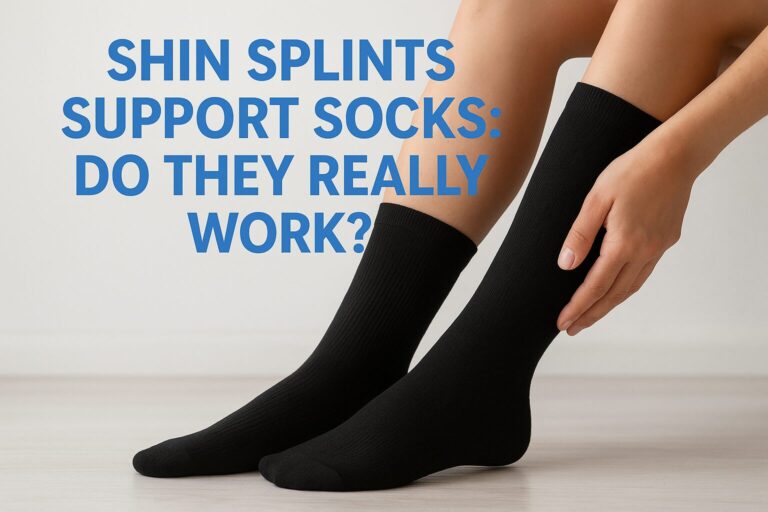
That ache down the front of your shin after a run isn’t something you can just stretch away. If you’ve started searching for shin splints support socks, chances are you’re already dealing with that dull, gripping pain along the shinbone and you want to know if compression is worth the money before you buy another pair of socks that sit in a drawer.
The short answer is that support socks can help, but they’re not a fix on their own. Graduated compression improves blood flow and reduces muscle vibration during activity, which eases discomfort for a lot of runners and athletes. What they won’t do is correct the underlying biomechanical issue, whether that’s overpronation, poor footwear, or a training load that’s ramped up too fast.
In this article, we’ll break down what the evidence actually says, how compression socks compare to sleeves, when they genuinely help versus when they just mask the problem, and what to do if your shin pain keeps coming back despite wearing them.
Why compression matters for shin splint pain
What’s actually happening in your shin
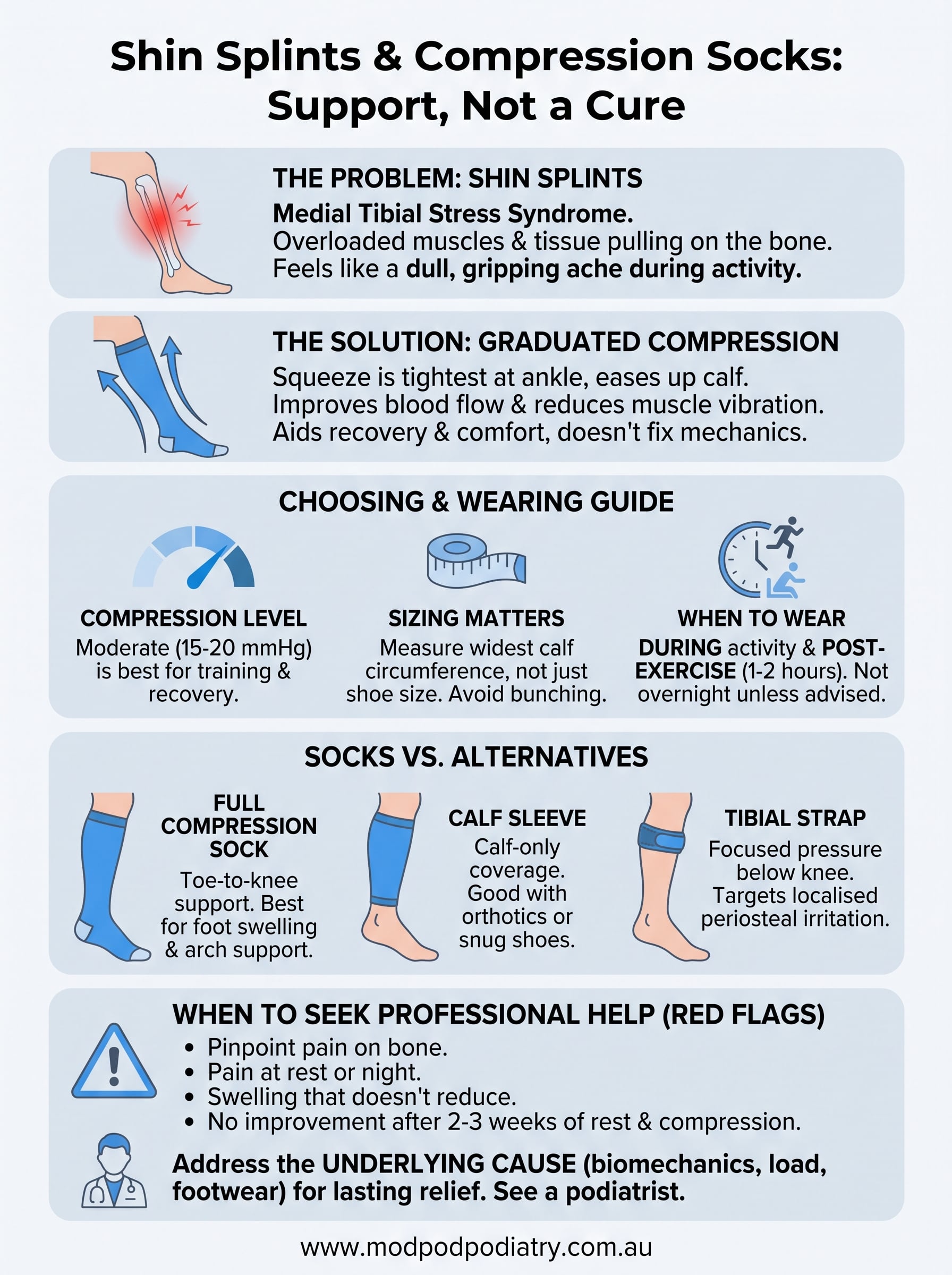
Shin splints, or medial tibial stress syndrome as podiatrists call it, happen when the muscles and connective tissue pulling on your shinbone get overloaded faster than they can recover. Every step sends a small shockwave through the tibia, and the muscles along the front and inside of your lower leg have to absorb that load. When training volume jumps too quickly, or your foot mechanics force those muscles to work harder than they should, the tissue where muscle meets bone becomes inflamed and sore. That’s the deep, gripping ache you feel, not a stress fracture, but a warning sign that the tissue is under more strain than it can handle.
How graduated compression eases the symptoms
Here’s where graduated compression earns its place in your kit bag. Support socks are knitted tighter at the ankle and gradually looser as they move up the calf, which pushes blood back toward the heart more efficiently than a loose sock ever could. Better circulation means more oxygen reaching fatigued muscle tissue and faster clearance of the metabolic waste that builds up during a run. Compression also reduces the amount your calf and shin muscles vibrate with each footstrike, a phenomenon researchers call muscle oscillation. Less vibration means less micro-trauma accumulating in the same overloaded tissue that’s already inflamed.
Compression socks calm the symptoms of shin splints, but they don’t fix the mechanical fault that caused them.
There’s a proprioceptive angle too. The snug fit gives your brain constant feedback about where your lower leg is in space, which some runners find improves their control and reduces the jarring, uneven loading that aggravates shin splints in the first place. It’s a subtle effect, but for someone already managing inflamed tissue, subtle can be the difference between finishing a run comfortably and pulling up sore at the two-kilometre mark.
What the research actually shows
Studies on compression garments and exercise-induced muscle damage show mixed but generally positive results for recovery and perceived soreness, though the effect on actual injury prevention is less clear cut. The Better Health Channel, run by the Victorian Government, notes that supportive footwear and gradual training progression remain the primary defences against shin splints, with compression garments sitting alongside these as a supportive measure rather than a standalone treatment (see Better Health Channel on shin splints). That lines up with what we see clinically at ModPod: patients who wear shin splint compression socks during runs often report less discomfort and quicker settling of symptoms afterwards, but the ones who recover fully and stay pain-free are the ones who also address footwear, training load, and any biomechanical issue driving the overload. Compression buys you comfort and a bit of protection. It doesn’t rewrite your gait or fix worn-out running shoes.
How to choose and wear shin splint support socks
Getting real benefit from shin splint support socks comes down to fit, compression level, and timing, not just picking the first pair you find at the sports store. A sock that’s too loose won’t push blood back up your leg, and one that’s too tight in the wrong spot can cut off circulation and make things worse.
Check the compression rating
Compression is measured in millimetres of mercury (mmHg), and the number on the packet tells you how firm the graduated squeeze actually is. Most runners managing shin splints do best in the moderate range rather than the extremes.
| Compression level | mmHg range | Best for |
|---|---|---|
| Light | 8-15 mmHg | General comfort, travel, everyday wear |
| Moderate | 15-20 mmHg | Active recovery, training runs, mild shin splints |
| Firm | 20-30 mmHg | Post-injury recovery under clinical guidance |
| Medical grade | 30+ mmHg | Prescribed only, not for self-selected sports use |
Choose moderate compression for training and save firm compression for when a podiatrist has actually recommended it.
Get the sizing right
Sizing usually goes by calf circumference and shoe size rather than the small, medium, large guesswork you’d use for regular socks. Measure the widest part of your calf before you buy, because a sock built for a smaller leg will roll down and bunch behind the knee, which defeats the graduated effect entirely.
Know when to wear them
Timing matters more than most runners realise:
- During activity: wear them for runs, gym sessions, or anything that loads the shin repeatedly.
- Post-exercise: keep them on for an hour or two afterwards to support venous return while the muscle recovers.
- Overnight: skip it unless a podiatrist has specifically advised it, since prolonged firm compression while sedentary offers little extra benefit and can feel uncomfortable.
Replace your pair every four to six months of regular use. The elastic fibres lose their graduated squeeze well before the fabric looks worn out, so a sock that still looks fine might already be doing nothing for your circulation.
Socks vs calf sleeves vs other shin supports
A full compression sock isn’t the only option on the shelf, and it isn’t always the right one either. Calf sleeves, tibial straps, and rigid shin guards all target the same problem from different angles, so picking between them depends on what’s actually driving your discomfort.
Full socks versus calf sleeves
Sleeves cover the calf and shin without wrapping the foot, which suits runners who already wear orthotics or a snug-fitting shoe and don’t want extra bulk under the arch. Socks give you compression from toe to knee in one piece, which some people prefer for the added arch and ankle support, particularly if swelling or fatigue shows up in the foot as well as the shin. Neither option is objectively better; it’s a question of where your symptoms sit and what fits comfortably inside your footwear.
Straps, sleeves, and rigid guards compared
Tibial compression straps work differently again. Rather than graduated squeeze along the whole limb, a strap applies focused pressure just below the knee to offload tension from the tibia’s periosteum, the tissue layer most irritated in shin splints. Rigid shin guards, by contrast, are built for impact protection in contact sports and do almost nothing for circulation or muscle vibration.
| Support type | How it works | Best suited to |
|---|---|---|
| Compression socks | Graduated squeeze, toe to knee | General shin splint discomfort, swelling in foot and calf |
| Calf sleeves | Graduated squeeze, calf only | Runners wanting compression without foot bulk |
| Tibial straps | Localised pressure below the knee | Targeted relief from periosteal irritation |
| Rigid shin guards | Impact absorption | Contact sports, not for circulation-based relief |
Match the support to the symptom: circulation and vibration call for compression, localised tibial tenderness often responds better to a strap.
Which one actually suits your shin splints
Before you buy, think about where the pain sits and what you’re doing when it flares. Someone with diffuse aching along a broad stretch of shin usually gets more from a sock or sleeve, while someone with a sharp, pinpoint spot of tenderness closer to the knee might find a strap more effective. If you’re not sure which category you fall into, that’s a sign worth raising with a podiatrist rather than guessing through several products.
When socks alone won’t fix your shin splints
Socks can’t do anything about a training plan that’s overloading your legs faster than they can adapt, and they definitely can’t fix a stress fracture. If your shin pain hasn’t improved after two to three weeks of rest, reduced mileage, and consistent compression wear, that’s your cue to stop self-managing and get a proper assessment. Persistent shin pain that doesn’t settle with the basics is one of the clearest signals that something structural, rather than just muscular, is going on.
Red flags that need more than a sock
Certain symptoms point straight past shin splints toward something a podiatrist needs to rule out. Watch for:
- Pinpoint tenderness over one exact spot on the bone rather than a broad ache along the shin
- Pain that wakes you at night or persists at rest, not just during activity
- Swelling that doesn’t reduce with elevation and compression
- Pain that’s getting worse week on week despite reduced training load
- Numbness, tingling, or a change in skin colour in the foot or lower leg
Any of these deserves a clinical look, since a tibial stress fracture can present very similarly to shin splints in the early stages but needs a completely different treatment approach, including a period of no weight-bearing impact.
If rest and compression haven’t shifted your shin pain in a few weeks, the problem is bigger than what a sock can treat.
Why the underlying cause needs attention
Underneath most stubborn cases sits a mechanical issue that socks were never designed to fix. Overpronation, a leg length difference, worn-out running shoes, or a sudden jump in training volume all load the tibia unevenly, and no amount of graduated compression corrects that. Gait analysis and a biomechanical assessment identify exactly where the extra load is coming from, which is the only way to actually stop the cycle of flare-ups rather than just softening each one.
Working through this with a podiatrist typically means a proper history, a look at your footwear and training pattern, and sometimes pressure plate analysis to see how your foot loads through each step. From there, treatment might include custom orthotics, a structured return-to-running plan, or targeted strengthening, none of which a compression sock can replace on its own.
Getting back to pain-free movement
Support socks earn their place in a runner’s kit, but they’re one tool among several, not a cure sitting in a drawer waiting to solve everything. Graduated compression eases the ache, calms muscle vibration, and speeds recovery between sessions, which matters when you’re trying to keep training consistent. Yet if your shin pain keeps returning despite the right sock, the right fit, and sensible training load, that’s your body telling you the actual cause is still there, unaddressed and untreated.
Getting properly assessed beats guessing through another few pairs of socks. A podiatrist can work out whether biomechanical correction through custom orthotics, footwear changes, or a structured loading plan is what your shins actually need. If you’ve been managing shin splints for weeks without real progress, book online with ModPod Podiatry and get a proper answer instead of another temporary fix.