
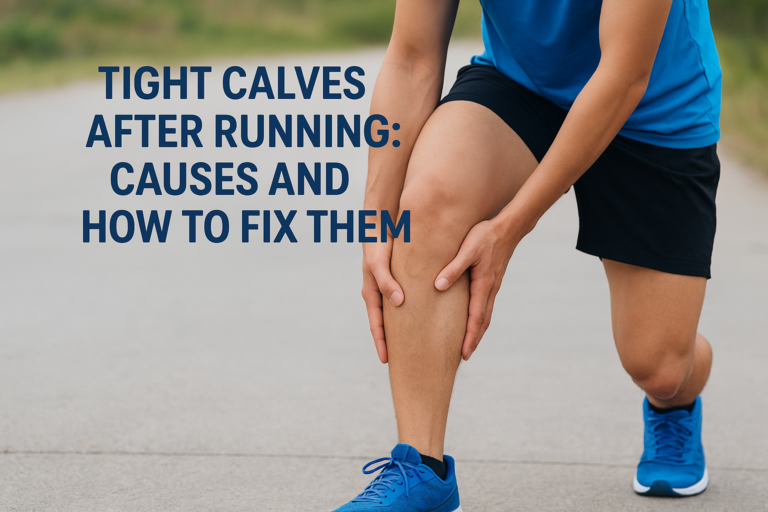
That deep, aching tightness in your calves after a run isn’t something you should just stretch and ignore. Tight calves after running are one of the most common complaints we see at ModPod Podiatry, and they’re often an early warning sign rather than a normal side effect of training. Left unchecked, this tightness can drag on for weeks and set you up for bigger problems like Achilles tendinopathy or plantar fasciitis.
The good news is that tight calves usually come down to a handful of identifiable causes, from training load errors to biomechanical issues like poor ankle mobility, worn-out shoes, or an inefficient running gait. Once you know which one applies to you, the fix is usually straightforward.
In this article, we’ll walk through why your calves tighten up after running, how to tell the difference between normal muscle fatigue and something that needs professional attention, and the stretches and strengthening exercises that actually work. We’ll also cover when it’s time to book in for a proper gait analysis rather than trying to stretch your way out of a recurring problem.
Why your calves feel tight after running
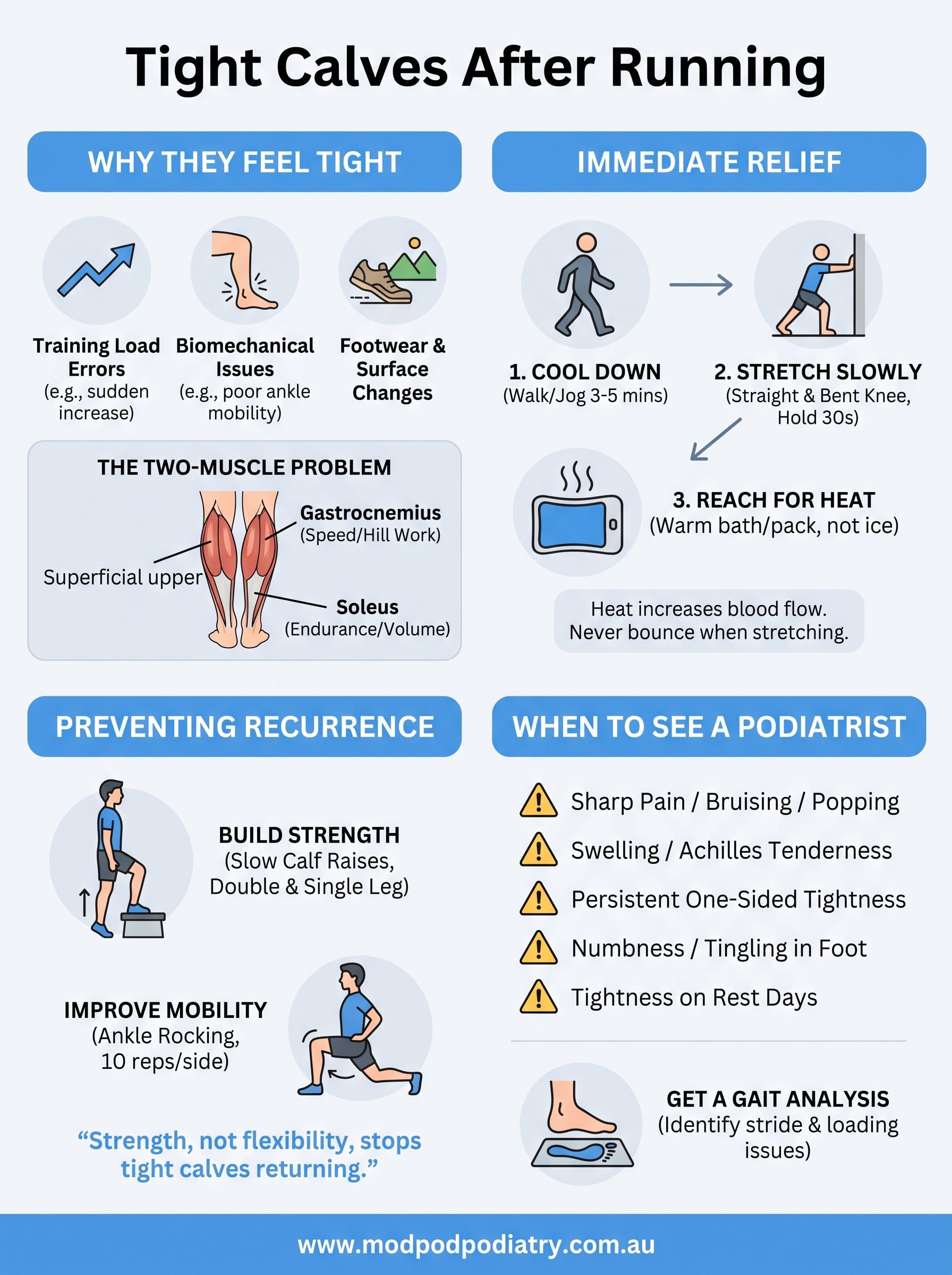
Tight calves are your body’s way of telling you that the demand placed on the gastrocnemius and soleus muscles has outpaced their capacity to cope. Every stride you run involves your calf complex absorbing load, storing energy like a spring, then releasing it to push you forward. When that cycle happens thousands of times over a run, and the muscle can’t recover fast enough between contractions, you end up with the tight, ropey feeling most runners know all too well. Tight calves after running are rarely random, they usually trace back to one of a few specific triggers.
Training load and recovery gaps
Ramping up your weekly kilometres, adding hill sessions, or throwing in intervals without easing your body into it is the single biggest cause we see in clinic. Sudden increases in training load don’t give the calf muscles time to adapt, so they respond by staying contracted and guarded, which you feel as tightness rather than pain. Skipping rest days compounds the problem because the micro-damage from one run hasn’t repaired before you load the muscle again.
Tight calves are usually a loading problem, not a flexibility problem.
Ankle mobility and running gait
Limited ankle dorsiflexion forces your calf muscles to work harder to generate propulsion, because your body compensates for the mobility you don’t have. Runners with stiff ankles or a habit of landing on their toes rather than transitioning through midfoot to forefoot tend to overuse the gastrocnemius and soleus on every single step. Gait quirks like overstriding, excessive heel whip, or running with a forward-leaning trunk also change how much work the calf has to do, and none of these show up until you’re deep into a run or the day after.
Footwear and surface changes
Old shoes with worn-out midsoles lose their ability to cushion and support the foot, so the calf steps in to do extra stabilising work it wasn’t built to sustain long-term. Switching to a minimalist or low-heel-drop shoe too quickly has the same effect, because it shifts load from the Achilles and calf in a way your muscles haven’t adapted to yet. Running on hills, sand, or uneven trails after training mostly on flat pavement puts unfamiliar demands on the calf that can leave it tight for days.
The two-muscle problem
Many runners don’t realise the calf is actually two muscles with different jobs, and tightness in one often means something different to tightness in the other.
| Muscle | Location | Main job | Common tightness trigger |
|---|---|---|---|
| Gastrocnemius | Superficial, forms the visible calf bulge | Powers push-off, active during faster running | Speed work, hill sprints, sudden pace increases |
| Soleus | Deep, sits below the gastrocnemius | Stabilises the ankle, works during slower, sustained effort | Long steady runs, high weekly volume |
Understanding which muscle is complaining helps you target the right fix instead of guessing. If tightness shows up mainly after hard sessions, it’s usually the gastrocnemius asking for more recovery. If it builds gradually across a long run, the soleus is more often the culprit, and that points towards an endurance or biomechanical issue rather than a pure overload problem. Either way, dehydration and low magnesium can make any of these triggers feel worse, since a poorly fuelled muscle cramps and guards more readily than one that’s properly hydrated.
Once you’ve narrowed down which of these is driving your tightness, you’re in a much better position to fix it rather than just masking it with a foam roller after every run.
(Word count target roughly 588 words)
How to relieve tight calves straight after a run
What you do in the ten minutes after you stop running matters more than anything you do the next morning. Tight calves after running respond best to a structured cool-down and targeted stretching, not a quick five-second stretch against a wall before you jump in the shower. Get the sequence right and you’ll walk normally within an hour instead of hobbling down stairs for two days.
Cool down before you stop moving
Jogging or walking for five minutes at an easy pace before you fully stop lets blood keep flushing through the calf rather than pooling and causing the muscle to seize up. A gradual cool-down works because it gives the gastrocnemius and soleus a chance to release gradually instead of shutting down hard mid-contraction. Try this order:
- Walk for 3 to 5 minutes immediately after finishing
- Do 2 to 3 minutes of gentle ankle circles and toe raises
- Move straight into calf stretches while the muscle is still warm
- Hydrate with water and a source of electrolytes before you sit down
Stretch the right muscle, not just any muscle
Because the gastrocnemius and soleus behave differently, one stretch won’t cover both. Hold each position slowly and never bounce, since that triggers the stretch reflex and tightens the muscle further instead of releasing it.
| Stretch | Target muscle | How to do it | Hold time |
|---|---|---|---|
| Straight-leg wall calf stretch | Gastrocnemius | Back leg straight, heel down, lean into wall | 30 seconds x 3 |
| Bent-knee wall calf stretch | Soleus | Back leg bent, heel down, lean into wall | 30 seconds x 3 |
| Downward dog pedal | Both | Alternate pressing each heel down | 20 reps |
Stretch slowly and hold, never bounce, if you want the tightness to actually release.
Reach for heat, not ice, in most cases
Icing makes sense for a swollen, injured Achilles, but plain post-run tightness usually responds better to warmth. Heat increases blood flow to the calf and helps the muscle fibres relax out of their guarded state, whereas ice can make an already tight, non-injured muscle feel stiffer once it wears off. A warm shower, a heat pack, or a warm bath with the calves submerged for 10 to 15 minutes works well as a same-day fix while you address the underlying cause.
Exercises to strengthen your calves and stop the tightness returning
Stretching after a run treats the symptom, but building calf strength is what stops the tightness coming back week after week. Tight calves after running often signal that the muscle is being asked to absorb more load than it’s conditioned for, so the long-term fix is progressive strengthening rather than more stretching. Aim to do these two to three times a week, not daily, since the calf needs recovery time to adapt just like any other muscle you’re trying to build up.
Build a base with slow calf raises
Slow, controlled calf raises teach the gastrocnemius and soleus to handle load through their full range, which is exactly what’s missing when tightness shows up mid-run. Start with both feet on flat ground before progressing to a single leg, and always lower slower than you rise to build eccentric strength, the type that protects against strains.
- Double-leg calf raise: 3 sets of 15, 2 seconds up, 3 seconds down
- Single-leg calf raise: 3 sets of 10 per side once double-leg feels easy
- Bent-knee calf raise: 3 sets of 15 to target the soleus specifically
Add eccentric loading for the soleus
Because the soleus does most of its work during slow, sustained running, it responds best to slow eccentric loading rather than fast, bouncy movements. Standing on a step with your heel hanging off the edge, rise up on both feet, shift weight to one leg, then lower that heel slowly over 4 to 5 seconds. This drill is one of the most effective ways we’ve seen runners fix soleus tightness that’s been dragging on for months despite regular stretching.
Strength, not flexibility, is usually what stops tight calves coming back for good.
Improve ankle mobility alongside strength
Stiff ankles force the calf to overwork on every stride, so pairing strength work with mobility drills gives you a more complete fix. Kneel in a lunge position with your front foot flat, then rock your knee forward over your toes without lifting your heel, repeating 10 times per side before switching legs. Doing this before a run, rather than after, tends to make the biggest difference to how your calves feel by the final kilometre.
Give the plan time to work
Muscle adaptation takes weeks, not days, so expect gradual improvement over four to six weeks of consistent strength work rather than an overnight fix. Track how your calves feel after the same training session each week, since a steady drop in tightness is the clearest sign the exercises are doing their job.
When to see a podiatrist about tight calves
Most tight calves settle within a week of consistent stretching, cool-downs, and a lighter training load. Persistent calf tightness that doesn’t budge after two to three weeks of doing the right things, though, stops being a simple overload problem and starts being a sign that something structural or biomechanical needs a proper look. That’s the point where a podiatrist can save you months of frustration compared to guessing your way through more foam rolling.
Warning signs that go beyond normal tightness
Sharp pain, bruising, or a popping sensation during a run are never things to stretch through, since these point towards a calf strain or tear rather than ordinary muscle fatigue. Swelling around the Achilles, tenderness that’s worse in the morning, or a tight calf paired with heel pain are classic signs of Achilles tendinopathy starting to develop, and it responds far better to early treatment than to a wait-and-see approach.
- Pain that gets worse rather than better over successive runs
- Tightness on one side only, especially if it’s always the same leg
- A visible lump, dent, or asymmetry in the calf muscle
- Numbness, tingling, or a cold sensation in the foot
- Tightness that’s present even on rest days, not just after running
If tight calves keep coming back despite doing everything right, the problem usually isn’t the calf itself.
What a podiatry assessment actually involves
A proper assessment goes well beyond asking where it hurts. At ModPod Podiatry, our podiatrists use pressure plate gait analysis and biomechanical assessment to see exactly how your foot strikes the ground, how your ankle moves through each phase of the stride, and whether one side of your body is compensating for the other. This is the kind of detail you simply can’t get from watching a slow-motion video on your phone or guessing from how your shoes are wearing down.
| Assessment tool | What it shows | Why it matters for calf tightness |
|---|---|---|
| Pressure plate gait analysis | Foot strike pattern and load distribution | Reveals overstriding or forefoot overload |
| 3D foot scanning | Foot shape and alignment | Identifies structural causes of compensation |
| Biomechanical assessment | Ankle and hip range of motion | Pinpoints mobility restrictions driving tightness |
Eligible patients can claim these consultations under a Medicare EPC plan, and HICAPS claiming on-site means most private health rebates come off the fee before you even leave the clinic. Booking early, rather than after the tightness has become a genuine injury, is usually what separates a two-week fix from a two-month one.
Getting back to comfortable, pain-free running
Tight calves after running almost always trace back to a mix of training load, ankle mobility, or footwear, and each of those has a clear, practical fix once you know which one applies to you. Sorting out the cool-down, adding the right stretches, and building calf strength over a few weeks will resolve most cases without any need for imaging or extended time off training. Ongoing tightness that doesn’t respond to these steps, though, is your body telling you there’s a biomechanical piece you can’t fix with a foam roller alone.
Rather than guessing your way through another training block, get a proper gait assessment and find out exactly what’s driving the tightness. Our podiatrists use pressure plate analysis and biomechanical testing to build a treatment plan specific to your stride, not a generic stretching handout. Book an appointment online and get back to running without watching the clock on your next cool-down.