
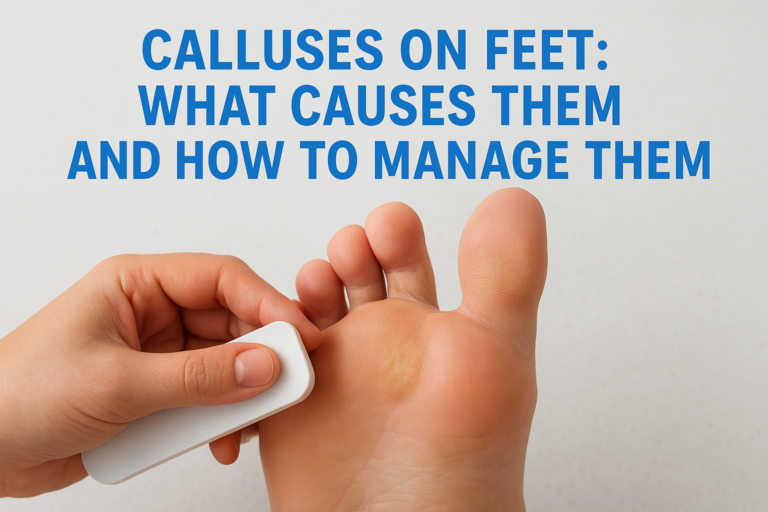
A callus is a patch of thick, hardened skin that builds up where your skin is pressed or rubbed again and again. What causes calluses on feet comes down to one mechanism: repeated friction and pressure. Ill-fitting shoes, long hours on your feet, thongs, running, bunions and the way you walk are the usual triggers. Your skin responds by laying down extra protective layers.
At ModPod Podiatry, our APodA-registered podiatrists have treated thousands of Sydney feet over more than 20 years, and we see calluses every week. Most people want the hard skin gone. What they really need to know is why it formed, because a callus is usually a map of where your foot is overloaded.
This guide explains why the cause matters, then covers the footwear, lifestyle and structural causes in turn. You will learn how to recognise a callus and tell it from a corn or a plantar wart. You will also get safe home care, clear signs that you need a podiatrist, and a plan to stop calluses coming back.
Why knowing the cause of your calluses matters
Knowing what causes calluses on feet matters because the cause decides whether the callus stays gone. Remove the hard skin without changing the load behind it, and the skin rebuilds within weeks. Change the load, and the callus often fades on its own.
A callus is protection, not a disease
The thick skin is your body’s defence against repeated stress. The outer layer of your skin, the stratum corneum, is made of dead cells that are constantly shed. When friction or pressure hits the same spot day after day, the deeper layers speed up cell production and the outer layer thickens. Doctors call this hyperkeratosis. It is the same process that gives guitarists hard fingertips and rowers hard palms.
Under your feet, a thin, even layer of toughened skin is normal, particularly under the heel and the ball of the foot. The trouble starts when that layer becomes thick, yellow, painful or cracked. At that point the skin is telling you that one spot is taking more load than it was built for.
Why filing alone rarely fixes it
Trimming or filing a callus gives quick relief, because thick skin presses on the tissue underneath and removing it takes that pressure away. But the cause is still there. If you wear the same shoes, walk the same way and stand on the same floors, the skin rebuilds. Most people see a callus creeping back within a few weeks of a good clean-up.
We see the same patterns in our Sydney clinics again and again:
- A commuter in narrow work shoes whose callus under the ball of the foot returns every month.
- A runner whose heel callus appeared after a switch to a firmer shoe.
- A person with a bunion who keeps getting a callus on the inside of the big toe.
- Someone who lives in thongs over summer and has hard, cracked heels by March.
In each case the callus is the symptom. The footwear, foot shape or habit is the problem.
A callus is a signal about pressure, so fixing the pressure is what fixes the callus.
When a callus becomes a problem
Most calluses are harmless. Thick ones, though, can crack into painful fissures, and those cracks let bacteria in. A callus can also bruise underneath, which shows as dark red or brown spots within the hard skin. Pain from a callus often makes you shift your weight to avoid it, and that changes how you walk and can overload your knee, hip or the other foot.
People with diabetes, nerve damage or poor circulation need extra caution. If you cannot feel pressure properly, a callus can break down into an ulcer without much warning. If that applies to you, skip the home treatments below and have your feet checked by a podiatrist.
The main causes of calluses on feet
The main causes of calluses on feet are footwear that squeezes, rubs or slides, long periods of standing or walking, dry or thin skin, and going barefoot on hard ground. Structural causes come next, but footwear and activity account for most of what we see day to day.
How friction and pressure build a callus
Two forces do the work. Pressure is the downward load of your body weight on a small area of skin. Shear is the sideways drag when the skin moves against a sock or insole while the bone underneath stays still. Pressure alone tends to produce a thick callus over a bony point. Shear tends to produce a broader, rubbed patch.
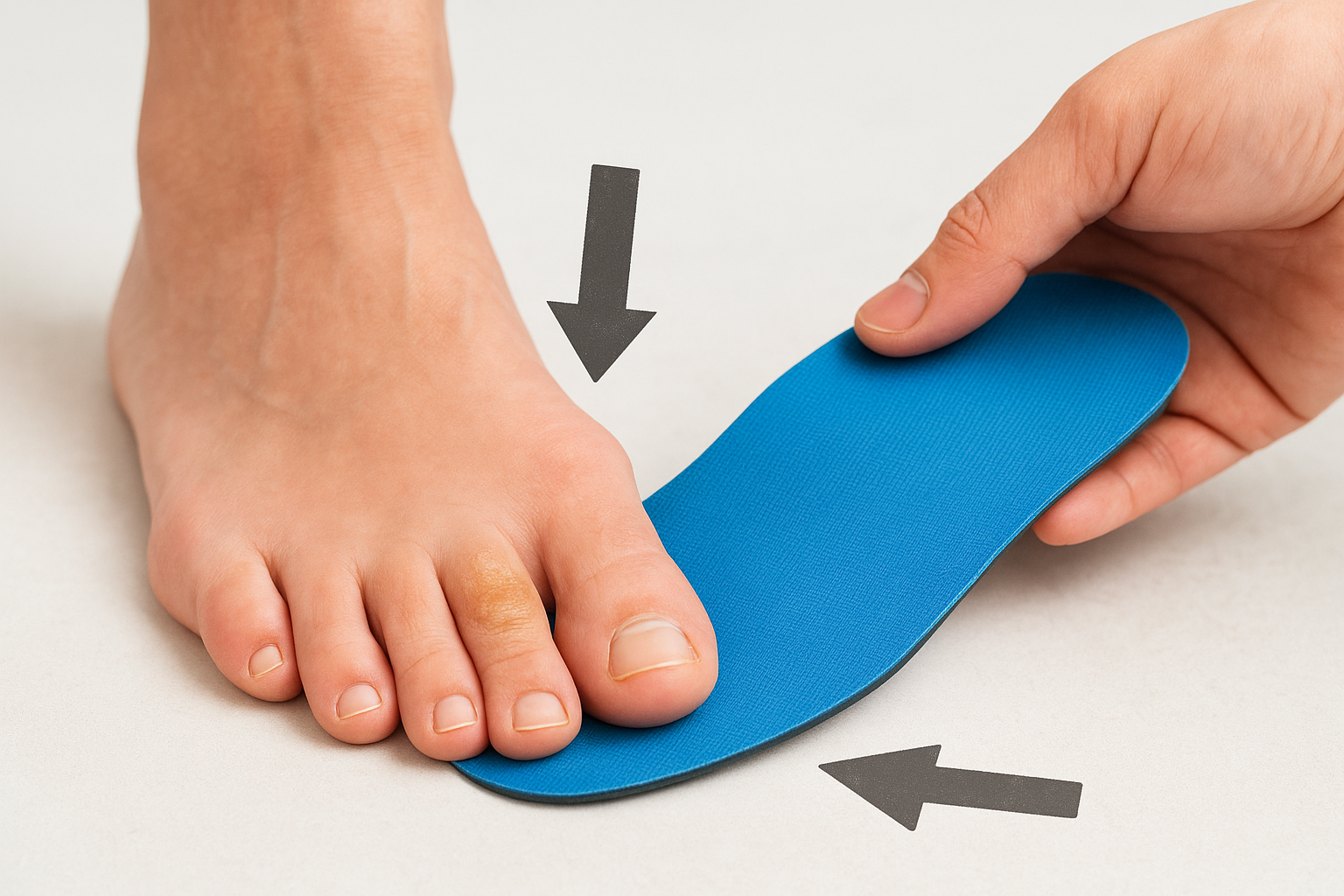
The process is gradual. A new pair of shoes or a sudden jump in training can start thickening within days, and a well-established callus takes weeks to months to form. That slow build is why people often do not connect the callus with the shoe change that caused it.
Footwear and socks
Shoes are the most common culprit. The table below shows how different choices tend to show up on your skin.
| Footwear or habit | Where the callus usually forms | Why it happens |
|---|---|---|
| Tight, narrow or pointed shoes | Sides of the big and little toes, ball of the foot | Toes are squeezed together and the forefoot is compressed |
| High heels | Ball of the foot | Body weight shifts forward onto the heads of the metatarsal bones |
| Thongs and open-backed sandals | Rim of the heel, tips of the toes | The heel pad spreads and the skin dries, and your toes grip to keep the thong on |
| Shoes that are too loose | Ball of the foot, toes, heel | Your foot slides and creates shear |
| Hard, thin or flat soles | Heel and ball of the foot | Little cushioning to absorb impact |
| No socks, or socks that bunch | Wherever the shoe or seam rubs | Moisture and friction on bare skin |
| Barefoot on hard floors or paving | Heel and ball of the foot | Direct pressure with no padding |
Fit matters more than price. A good shoe leaves a thumb’s width past your longest toe, has a toe box wide enough to spread your toes, and holds your heel firmly. Shoes that fit when new but stretch with wear can start causing calluses months later.
Activity, work and lifestyle
Time on your feet is a cause in its own right. Nurses, hospitality staff, retail workers and tradies on hard floors load the same spots for eight to ten hours a day. Runners and walkers repeat the same impact thousands of times per session, so a small mechanical fault gets multiplied. Cyclists can develop calluses under the ball of the foot from stiff shoes and cleats.
Hobbies and summer habits count too. Going barefoot on the deck, at the beach or around the pool strips away cushioning, and long days in thongs add the heel and toe problems described above. If a callus appeared after a change in routine, look at what changed first.
Skin, age and body factors
Some people are simply more prone. Dry skin cracks and thickens more readily, and sweaty feet can soften skin until it rubs. As you age, the natural fat padding under the heel and forefoot thins, so the bones sit closer to the skin and take more pressure. Carrying extra body weight also increases the load on every step.
Footwear and long hours on your feet cause most calluses, but dry skin and thinning padding decide who gets them first.
Structural foot problems and the way you walk
Structural problems cause calluses by shifting your weight onto spots that were not designed to carry it. If you have changed your shoes and still get calluses in the same place, your foot shape or walking pattern is the likely reason.
Foot shape and deformities
A bunion pushes the big toe towards the others and loads the inside of the joint, so calluses form on the inner edge of the big toe and under the joint. Hammertoes and claw toes raise the toe joints, which rub on the top of the shoe and cause corns and calluses on the knuckle and tip. Flat feet can overload the inner foot, while high arches reduce the contact area, so the heel and ball of the foot take more force per square centimetre.
Old fractures, bone spurs and arthritis can also change how load travels through the foot. Even a small bony prominence will attract a callus if it sits under repeated pressure.
Gait and biomechanics
Your walking pattern distributes load as you roll from heel to toe. If your foot rolls in too far, rolls out too little, or your calf muscles are tight and limit ankle movement, the forefoot ends up taking a heavier push-off. Differences in leg length, stiff big toe joints and weak foot muscles can all do the same.
The pattern of your callus is a rough footprint of that load. This table gives common links between location and likely cause.
| Callus location | Common causes |
|---|---|
| Under the ball of the foot | High heels, tight calves, high arches, prominent metatarsal heads, thin padding |
| Inner edge of the big toe | Bunion, foot rolling in, narrow shoes |
| Outer edge of the foot or little toe | Foot rolling out, narrow shoes, tight toe box |
| Heel and rim of the heel | Thongs and open-backed shoes, dry skin, firm heel strike, thinning heel pad |
| Tip of the toes | Claw toes, shoes too short, gripping in thongs |
This is a guide only. Several causes can overlap in one foot, which is why a hands-on assessment is more reliable than guessing.
Medical conditions that raise your risk
Diabetes does not cause calluses directly, but nerve damage and reduced circulation mean you may not feel a callus becoming a wound. Rheumatoid arthritis and other inflammatory conditions change foot shape over time. Conditions that cause muscle weakness or altered sensation can change how you load your feet as well.
At ModPod we use pressure plate analysis to measure where your foot actually takes load while you walk, and 3D scanning to capture its shape. That data shows whether a callus is a footwear problem or a mechanical one. When it is mechanical, custom orthotics can redistribute pressure away from the overloaded spot.
If a callus keeps returning in the same place despite better shoes, look at your foot structure and gait.
How to recognise a callus
A callus is a flat, wide patch of hard, yellowish or greyish skin that forms over a pressure point and feels duller to touch than the skin around it. It is easy to confuse with a corn or a plantar wart, and the right treatment differs for each, so it helps to know the signs.
What a callus looks and feels like
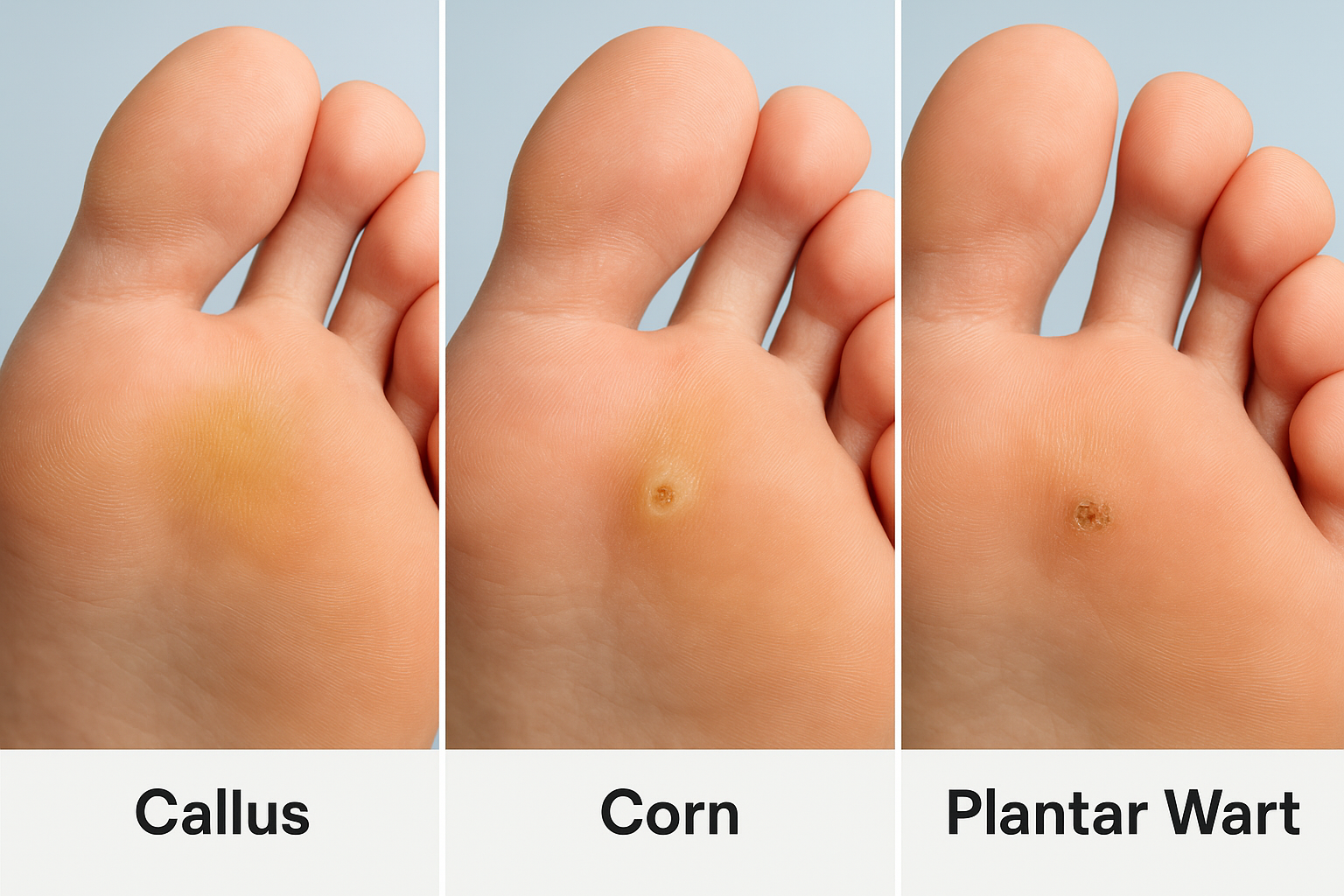
Calluses are broad with soft, uneven edges rather than sharply defined. The surface can be smooth, waxy or flaky, and the colour ranges from pale to yellow to light brown. Most calluses are slightly numb to light touch and become tender only with firm pressure or when they get thick. The usual sites are the heel, the ball of the foot and the side of the big toe.
You can often see the normal skin lines running across the surface. That detail helps separate a callus from a wart, as described below.
Callus, corn or plantar wart
These three are commonly mixed up. Compare them side by side.
| Feature | Callus | Corn | Plantar wart |
|---|---|---|---|
| Shape | Wide, flat, irregular edges | Small, round, defined | Small, round or rough, can cluster |
| Typical location | Heel, ball of foot, side of big toe | Top or tip of toes, between toes | Anywhere on the sole |
| Surface | Firm, yellowish, waxy | Hard core, or soft and rubbery between toes | Rough, often with tiny dark dots |
| Pain | Dull, tender under firm pressure | Sharp when pressed directly | Painful when squeezed from the sides |
| Cause | Friction and pressure | Concentrated pressure | Human papillomavirus entering broken skin |
A wart interrupts the normal skin lines, which run around it instead of across it. A corn is essentially a callus concentrated over a small area, often with a central core that presses inward. Because warts are infectious and calluses are not, treating one as the other wastes time.
Marks that should not be assumed to be calluses
Some skin changes on the sole look like a callus or wart but are not. A dark, brown or black mark that is new, changing in shape or colour, bleeding, or not healing needs to be seen by a doctor, because rare skin cancers can appear on the foot. Do not file or cut at an unexplained mark. A podiatrist can examine it and refer you on if needed.
A callus spreads, feels dull and follows your skin lines, while a changing dark mark is never something to file away.
How to manage calluses at home
The safest way to manage a callus at home is to soften it, thin it gently, moisturise daily and reduce the pressure that caused it. If you have diabetes, poor circulation or reduced sensation in your feet, do not self-treat and see a podiatrist instead.
A gentle soak, file and moisturise routine
Follow these steps once or twice a week.
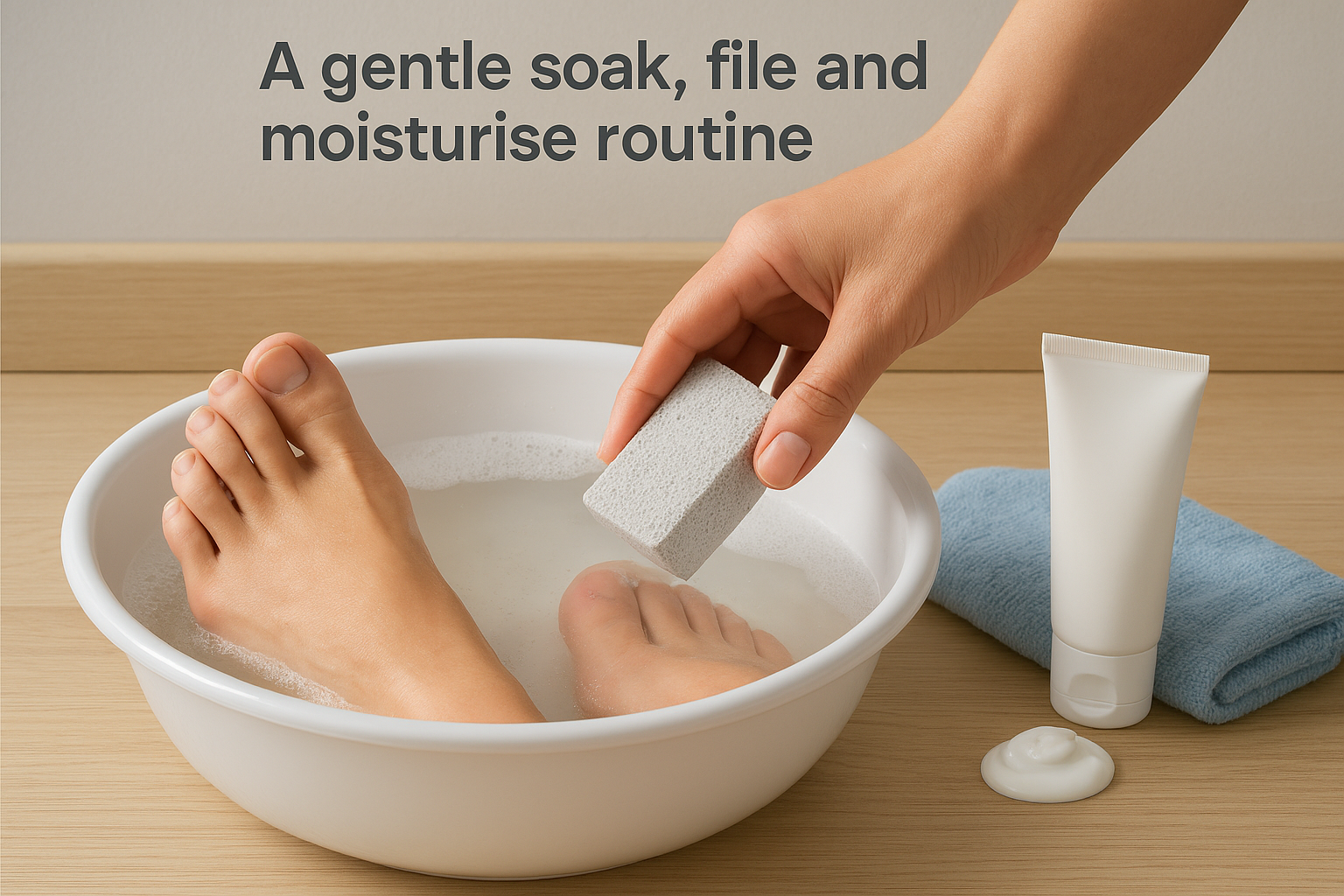
- Soak your feet in warm, not hot, water for 5 to 10 minutes, or work straight after a shower.
- Pat the skin lightly so it stays damp.
- Use a pumice stone or fine foot file in one direction for a minute or two. Your goal is to thin the callus, not remove it.
- Stop if the skin looks pink or feels tender. A sore or bleeding spot means you have gone too far.
- Dry your feet and apply a urea-based moisturiser to the callus. Avoid the gaps between your toes.
- Moisturise daily and repeat the filing only when the callus has thickened again.
Urea softens thick skin over time, so regular use does more than occasional heavy filing. Expect gradual improvement over a few weeks, not an overnight change.
Reduce the pressure while the skin recovers
Padding takes load off the spot. Silicone or felt pads can cushion a callus or surround it with a donut shape, so the hard area sits in the gap. Gel toe separators or sleeves help where toes rub. Cushioned insoles can help with general forefoot or heel load, though they will not fix a structural cause.
Check your socks as well. Choose snug, seamless socks that do not bunch, and avoid wearing the shoes you suspect are causing the problem every day. Rotating between two pairs gives the skin time to recover.
What to avoid
A few common habits do harm.
- Cutting or shaving a callus with a blade or scissors. This risks cuts and infection.
- Using a coarse grater-style file with heavy pressure.
- Applying strong acid-based corn removers, which can burn the healthy skin around the callus.
- Soaking for long periods in very hot water, which damages skin.
- Treating a callus at all if you have diabetes, nerve damage or poor circulation.
Thin the callus gently and take the pressure off, but never cut it, and never self-treat if you have diabetes.
When to see a podiatrist for calluses
See a podiatrist if a callus is painful, cracked, bleeding or keeps returning, or if you have diabetes, poor circulation or reduced feeling in your feet. Seeking help early usually means simpler treatment and a clearer answer about the cause.
Signs it is time to book
Book an assessment if any of the following applies:
- You have diabetes, nerve damage or circulation problems, and you have any callus at all.
- The callus is painful enough to change how you walk.
- You see redness, warmth, swelling, pus or a cracked, bleeding surface.
- There are dark spots within the callus, or the callus has changed colour.
- You cannot tell whether it is a callus, corn or wart.
- The callus returns within weeks of home care.
What a podiatrist does
First, your podiatrist examines the skin and asks about your footwear, work and activity, then checks how your foot moves. Next, they remove the thick skin with a sterile scalpel, which is a standard podiatry technique and usually painless, as the hard layer is dead tissue. You walk out with immediate relief from pressure.
The more valuable part is working out why it formed. At ModPod, that can include pressure plate gait analysis, a footwear review, padding or offloading, and, where mechanics are the cause, custom orthotics made from a 3D scan of your foot. If a bunion or toe deformity is driving the problem, we discuss options for managing it.
Booking at ModPod
You do not need a GP referral to see a podiatrist. Our clinics in Sydney CBD, Mosman, Dee Why, Rose Bay and North Ryde offer same-week appointments in most cases. We claim private health rebates on site through HICAPS, and eligible patients with a GP-prepared plan may be able to use Medicare EPC items. Ask us when you book and we will check what applies to you.
A podiatrist removes the callus in minutes, then finds out why it formed so it does not come back.
How to stop calluses coming back
You stop calluses coming back by fixing the cause: shoes that fit, cushioning where you need it, skin kept supple, and mechanical problems addressed. Prevention takes a few habits, not a big overhaul.
Get your footwear right
Use this checklist when you buy or review shoes:
- Shop in the afternoon, when feet are slightly larger.
- Leave about a thumb’s width between your longest toe and the end of the shoe.
- Choose a toe box wide enough to let your toes spread.
- Make sure the heel is held firmly without slipping.
- Check that the shoe bends at the ball of the foot, not in the middle.
- Replace worn-out shoes, especially running shoes, before the cushioning collapses.
- Keep thongs for the beach and pool, and wear supportive shoes for longer walks and work.
Build simple daily habits
Wear socks that fit and wick moisture. Moisturise your feet daily, particularly the heels, and check them every week or two for new thickening, redness or cracks. Keep your toenails trimmed straight across so they do not push your toes against the shoe. Wear gloves for manual work to protect your hands as well.
If calluses keep forming in the same place despite these steps, the cause is likely mechanical. That is the point where a gait assessment and, if suited, custom orthotics pay for themselves.
Treat the cause, not just the callus
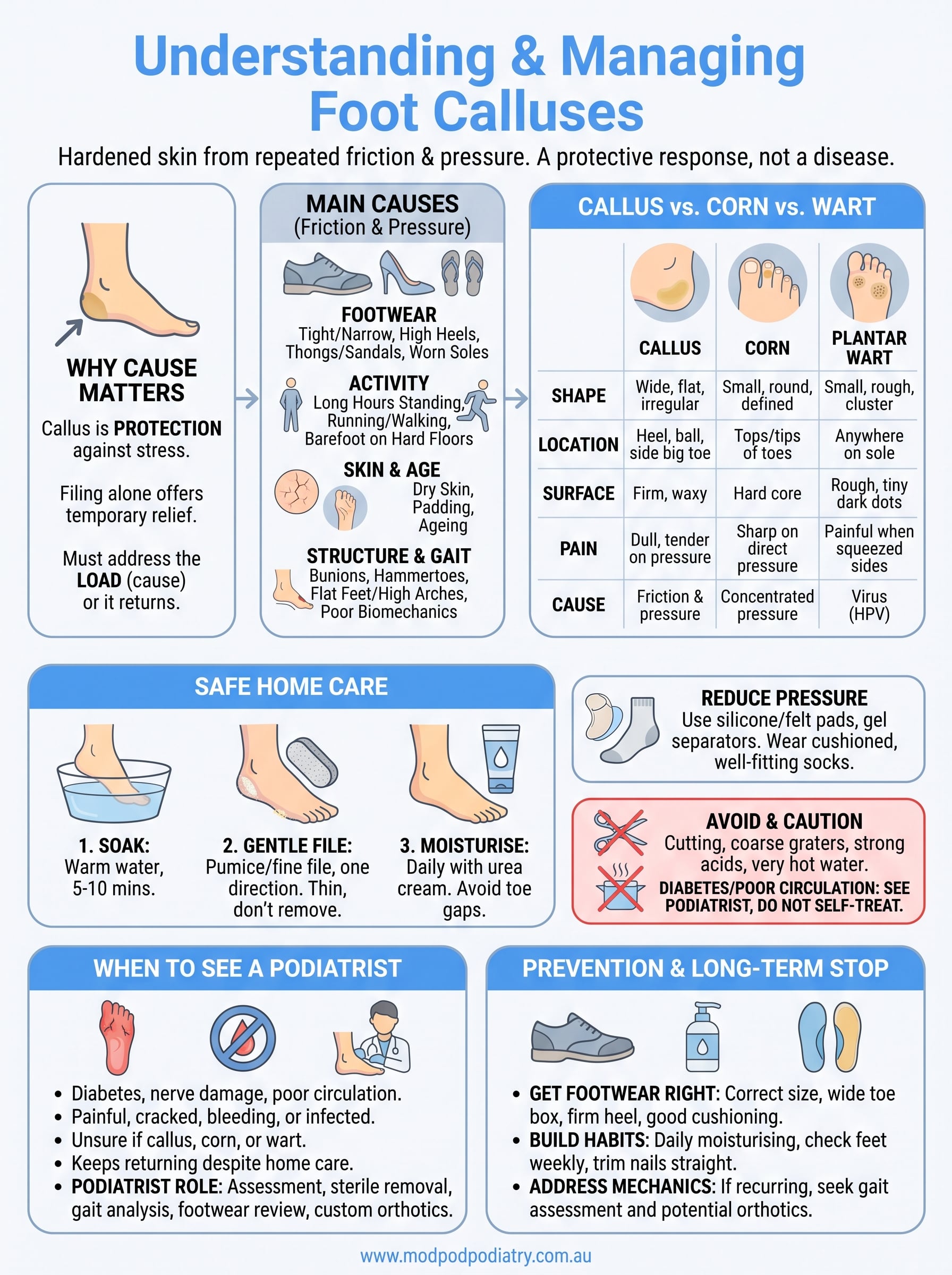
Calluses form when friction and pressure repeat, and the usual drivers are shoes that do not fit, long hours on your feet, dry or thin skin, and foot structure or gait that overloads one spot. Home care can thin a callus and ease discomfort, but it only lasts when you change the pressure behind it.
If your calluses are painful, cracked or recurring, or if you have diabetes or circulation problems, get them assessed rather than managing them alone. To find out exactly why your calluses keep forming and get a plan that fits your feet, book an appointment with a ModPod podiatrist at the Sydney clinic nearest you.