
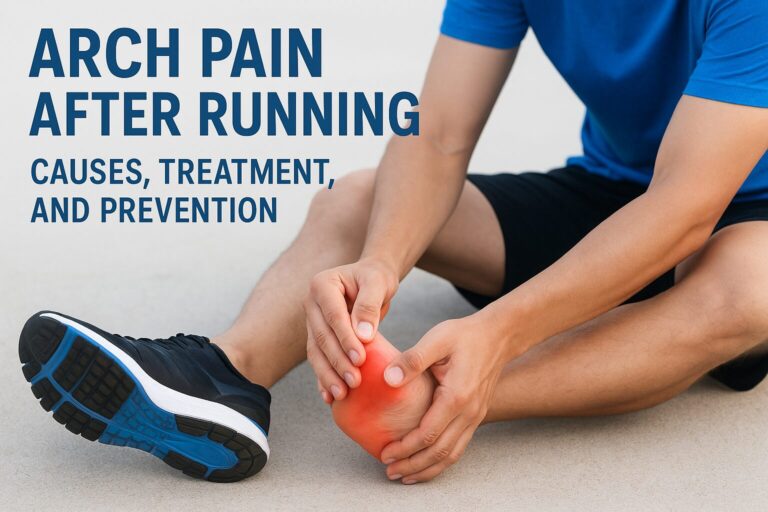
You finished your run, kicked off your shoes, and now there’s a dull ache spreading through the sole of your foot. Arch pain after running is one of the most common complaints we see at ModPod Podiatry, and it affects everyone from weekend joggers to seasoned marathon runners. Sometimes it fades within a day. Other times, it lingers and gets progressively worse with each session.
The cause isn’t always obvious. It could be plantar fasciitis, posterior tibial tendon strain, a stress reaction, or simply a training load your foot wasn’t ready for. Pinpointing the actual structure involved matters because the treatment path differs significantly depending on what’s driving the pain. A generic "rest and ice" approach often falls short when the underlying issue goes unaddressed.
With over 20 years of treating runners across our five Sydney clinics, our podiatry team has assessed and managed thousands of arch pain cases. This article breaks down the most common causes, what you can do about them at home, when to seek professional assessment, and how to reduce your risk of recurrence so you can get back to running with confidence.
Why arch pain shows up after a run
Running places far greater demand on your foot than walking does. With every stride, your arch acts as a natural shock absorber, compressing under load and then recoiling to propel you forward. Over the course of a 5-kilometre run, that cycle repeats thousands of times. When the tissues involved, primarily the plantar fascia, intrinsic foot muscles, and posterior tibial tendon, accumulate more load than they can comfortably handle, pain is the result.
The forces your arch absorbs during running
Your foot hits the ground with a force roughly two to three times your body weight during running. The arch flattens slightly on impact to distribute that force, then stiffens through push-off to transfer energy forward. This process relies on a coordinated interaction between ligaments, tendons, and small muscles working in sync. When any one component is fatigued, overloaded, or structurally compromised, the entire system becomes less efficient and more vulnerable to injury.
The arch doesn’t fail all at once. It accumulates stress gradually, which is why arch pain after running often starts as mild discomfort before becoming a persistent problem.
Why symptoms often appear after, not during, a run
Many runners notice that the pain actually peaks once they stop, not while they’re moving. This happens because running keeps blood flowing to the tissues and temporarily masks irritation. Once you sit down or lie still, the inflammatory response catches up and stiffness sets in. This pattern is particularly common with plantar fascia irritation, where the first few steps after rest can be the most painful part of the day.
How training load tips the balance
Your tissues adapt positively to running stress, but only when the load is applied with sufficient recovery between sessions. Increasing your distance, pace, or weekly volume too quickly doesn’t give the arch enough time to rebuild between efforts. The same applies to switching surfaces or returning to training after a break. Your cardiovascular fitness often recovers faster than your tendons and fascia, which means your lungs may feel ready long before your foot structures are prepared for the workload you’re asking of them.
Running in worn-out shoes, or footwear that doesn’t suit your foot mechanics, compounds the problem further. A shoe that has lost its cushioning or no longer supports your arch correctly shifts more stress directly onto soft tissue with every kilometre you run.
The most common causes of arch pain after running
Several structures run through your arch, and each one can become the source of pain when it takes on more load than it can handle. The location, timing, and character of your discomfort help narrow down which tissue is involved and what kind of intervention will actually address it.
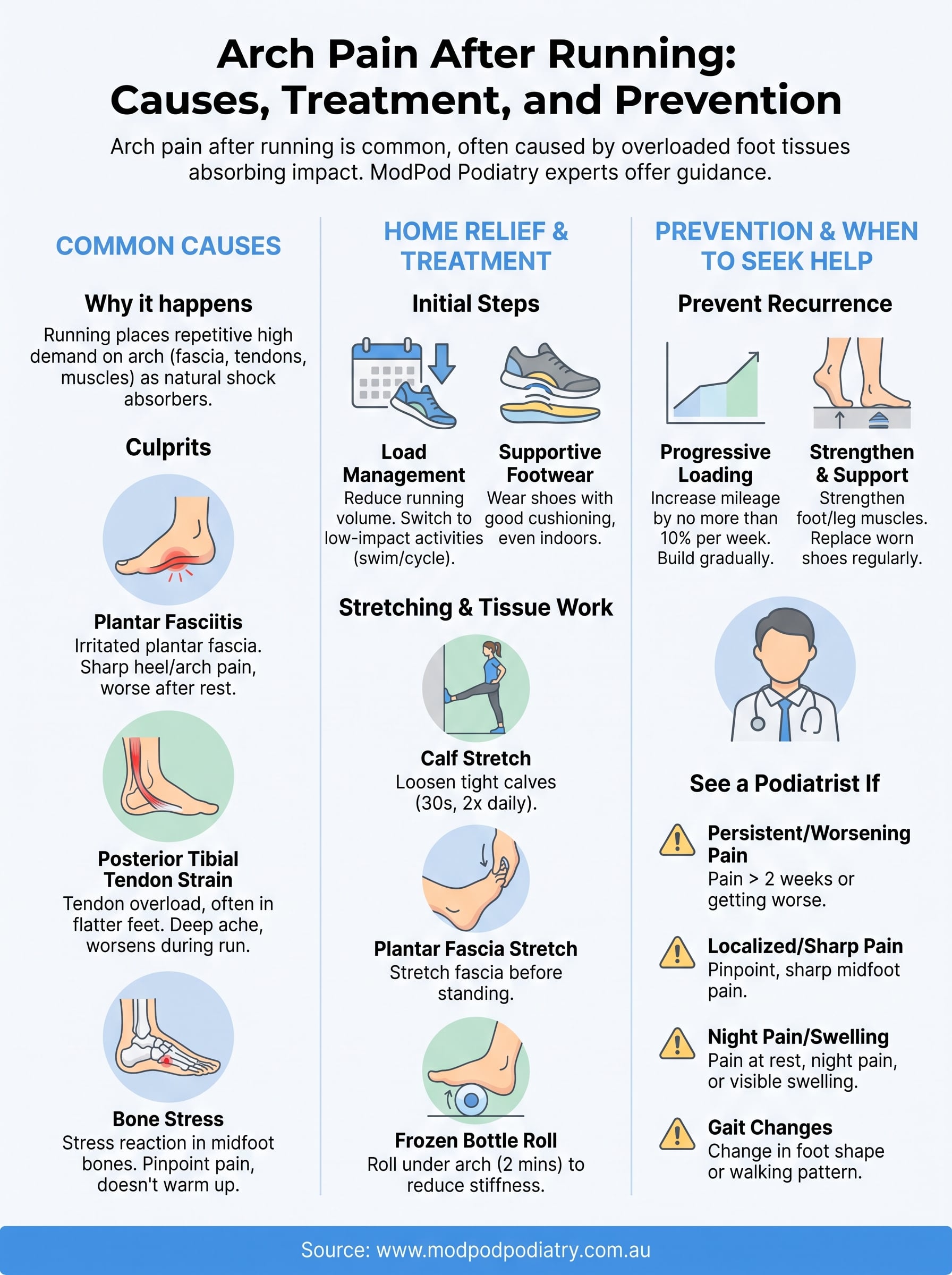
Plantar fasciitis
Plantar fasciitis is the most frequently diagnosed cause of arch and heel pain in runners. It involves irritation of the plantar fascia, a thick band of connective tissue running from your heel bone to the base of your toes. When this tissue is overloaded repetitively, small tears develop that trigger inflammation and pain.
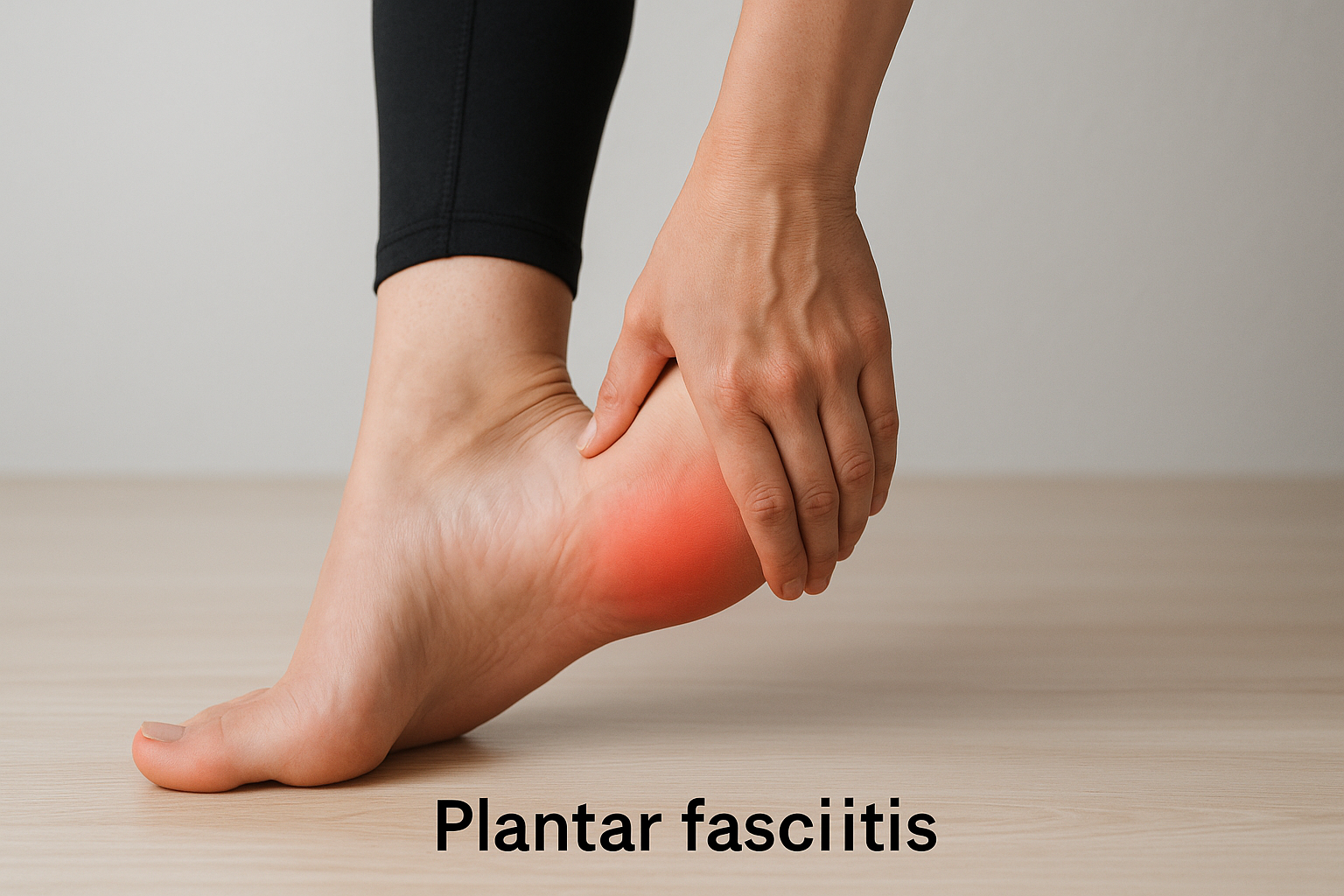
If your pain is sharpest with your first steps in the morning and eases as you move around, plantar fasciitis is the most likely explanation.
The classic symptom pattern is pain that is worst after periods of rest and tends to settle during a run, only to return once you stop. Runners who have increased their mileage quickly, switched to minimal footwear, or have either very flat or very high arches carry a higher risk of developing this condition.
Tendon and bone-related causes
The posterior tibial tendon runs along the inside of your ankle and attaches into the midfoot. When it becomes strained or inflamed, you feel a deep ache along the inner arch that tends to worsen throughout a run rather than ease. Runners with flatter foot posture or significant overpronation are particularly prone to this type of tendon overload.
Bones in the midfoot can also develop stress reactions from cumulative loading. Unlike soft tissue pain, bone-related arch pain after running tends to be more pinpoint in location and does not improve once you warm up, which is a key sign that imaging and a structured recovery plan are needed.
How to get relief at home without making it worse
Managing arch pain after running at home comes down to two things: reducing the stress on irritated tissue and supporting it while it recovers. Doing too much too soon is the most common mistake runners make. Keeping some movement in your day is generally better than complete rest, but that movement needs to stay within a range that does not provoke your symptoms.
Load management first
Your first step is to cut your running volume significantly while symptoms are active. This does not mean stopping all activity, but it does mean replacing high-impact sessions with lower-load alternatives like swimming or cycling until your arch can handle the ground contact again. Running through sharp or worsening pain almost always extends your recovery time rather than shortening it.
Reducing your load for one to two weeks early on will almost always get you back to full training faster than pushing through and letting the injury escalate.
Stretching and soft tissue work
Two of the most effective exercises for arch pain are calf stretching and plantar fascia mobilisation. Tight calf muscles increase the pull through the plantar fascia with every step, so loosening them directly reduces strain on your arch. Try these each morning before you take your first steps:
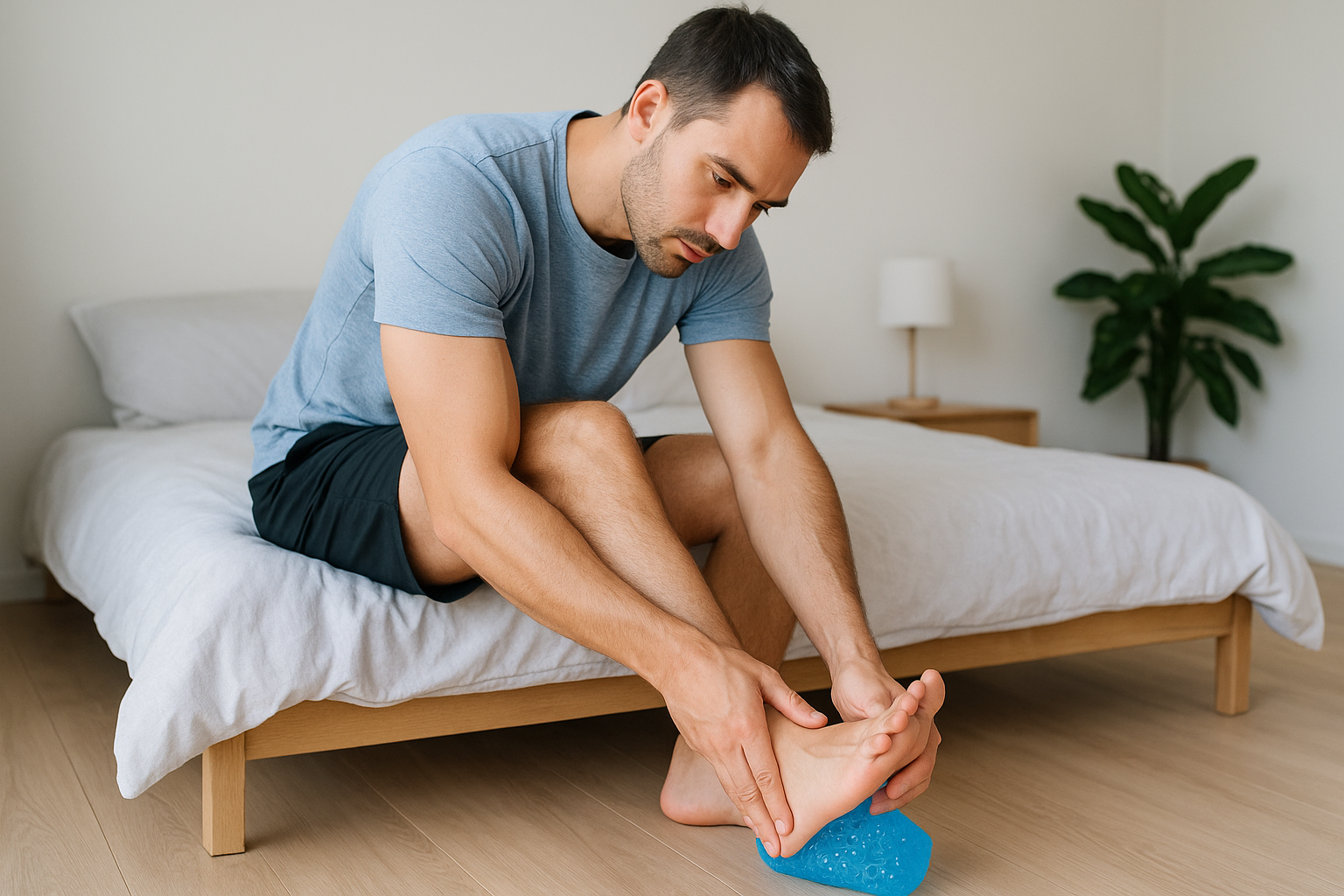
- Plantar fascia stretch: sit on the edge of your bed and pull your toes back toward your shin for 30 seconds before standing
- Calf stretch against a wall: hold for 45 seconds on each leg, keeping your heel flat on the ground
- Frozen bottle roll: roll slowly under your arch for two minutes to reduce morning stiffness
Check that your running shoes still have adequate cushioning and replace them if they have more than 700 kilometres on them. Wearing supportive footwear around the house, rather than walking barefoot on hard floors, reduces the load on your arch throughout the entire day.
When to stop running and see a podiatrist
Home management works well for mild arch pain after running, but some symptoms signal that the injury is beyond what rest and stretching can resolve on their own. Knowing when to step back from training and seek a professional assessment can save you from a longer and more complicated recovery down the track.
Warning signs you should not ignore
If your arch pain has been present for more than two weeks despite reducing your load, or if it is getting worse rather than plateauing, that is a clear signal to book an appointment. Pain that is sharp and localised to a specific spot on your midfoot may indicate a stress reaction in the bone, which requires imaging to confirm and should not be run through under any circumstances.
Running on an undiagnosed stress fracture can turn a six-week recovery into a six-month one.
Other signs that warrant professional attention include:
- Pain that wakes you at night or is present at rest
- Visible swelling or bruising along the arch or inner ankle
- Arch pain that starts earlier and earlier into each run with each session
- Any change in the shape of your foot or the way your ankle sits
What a podiatrist will assess
Your podiatrist will examine how your foot functions during both standing and movement, looking at your arch posture, ankle mobility, and the way load distributes across your foot. A pressure plate gait analysis can identify the specific biomechanical patterns driving your injury, which means your treatment plan targets the actual cause rather than just the symptoms.
Depending on what they find, your management may include one or more of the following:
- Custom orthotics to correct foot mechanics and reduce load through the arch
- Shockwave therapy to stimulate healing in chronic soft tissue injuries
- A structured return-to-running program with clear milestones
- Footwear advice tailored to your foot type and training goals
How to prevent arch pain from coming back
Once your arch settles down, the priority shifts to keeping it that way. Arch pain after running has a frustrating tendency to return when the habits that triggered it in the first place go unchanged. Addressing those habits directly, rather than waiting for symptoms to flare up again, is what separates runners who stay healthy long-term from those who cycle through the same injury repeatedly.
Build your training load progressively
Your tendons and fascia adapt more slowly than your cardiovascular system does. Increasing your weekly mileage by no more than 10 percent per week gives your arch time to catch up with the demands you are placing on it. The same principle applies when returning from a break, switching to a firmer running surface, or adding speed work to your programme.
A structured training plan with built-in recovery weeks does more to protect your arch than any single piece of footwear or equipment.
Replace your running shoes before the cushioning breaks down rather than after. Most running shoes lose meaningful support between 600 and 800 kilometres, well before the upper shows obvious wear. Rotating between two pairs also extends the lifespan of both and gives each shoe time to decompress between sessions.
Strengthen the foot and lower leg
Passive solutions like orthotics and supportive footwear reduce load on your arch, but strengthening the muscles that support it gives you active protection that works regardless of what you are wearing. Calf raises, single-leg balance work, and short foot exercises all build the strength your foot needs to handle running demands without relying entirely on passive structures.
Aim to include two short strength sessions per week targeting the foot and lower leg. Ten minutes added to an existing workout is enough to make a measurable difference over time.
Getting back to pain-free running
Arch pain after running rarely resolves on its own if the underlying cause goes unaddressed. The runners who recover fastest are the ones who act early, adjust their load, and get a clear picture of what is actually driving the problem rather than guessing and hoping symptoms fade between sessions.
Most cases respond well to a combination of targeted stretching, load management, and footwear review. When those measures fall short, a biomechanical assessment gives you specific answers about why your arch is struggling and what your foot needs to handle running demands without breaking down.
Your arch is built to absorb thousands of impacts every single run. With the right support, it can do exactly that. If pain has been holding you back, booking a professional assessment is the most direct path forward. Book an appointment online and let our podiatry team help you get back to running without the discomfort.