


That ache under your foot could mean a few different things, and lumping every case under one label makes it harder to sort out. The debate around arch pain vs plantar fasciitis comes up constantly in our clinics because the two overlap so much that patients often can’t tell where one ends and the other begins.
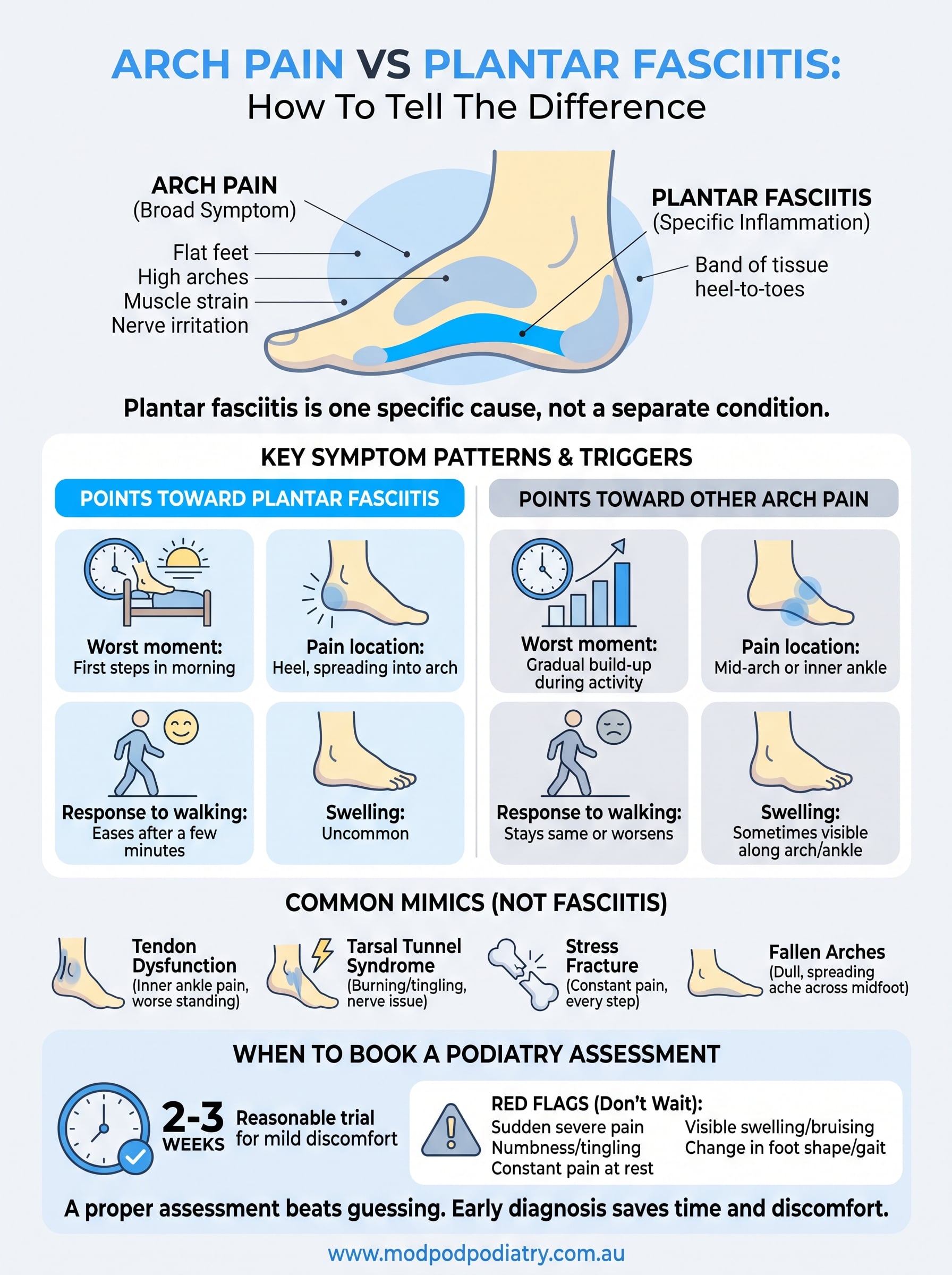
Here’s the short answer: plantar fasciitis is one specific cause of arch pain, not a separate condition altogether. Arch pain is the broader symptom, and it can come from flat feet, high arches, muscle strain, or nerve irritation, whereas plantar fasciitis points to inflammation of a particular band of tissue running from your heel to your toes, usually worst with first steps in the morning.
In this guide, we’ll walk through how the pain feels, where it sits, what triggers it, and how each condition typically develops over time. By the end, you should have a clearer idea of what’s likely going on with your feet, and whether it’s time to book in with one of our podiatrists for a proper assessment.
Why the distinction matters for your recovery
Getting the diagnosis right isn’t just academic. Treatment plans differ significantly depending on what’s actually causing your arch pain, and starting with the wrong approach can leave you limping along for months longer than necessary. We see this constantly: someone stretches their calves religiously for general arch discomfort, gets no relief, then discovers three months later that the real problem was a nerve entrapment or a stress fracture that stretching never touched.
The underlying cause dictates the fix
Consider two patients with sore arches. One has plantar fasciitis from overloading the plantar fascia during a sudden increase in running distance. The other has arch pain from posterior tibial tendon dysfunction, a completely different structure that’s slowly stretching and weakening. The first patient needs load management, stretching, and possibly a night splint. The second needs arch support and, in some cases, a referral for imaging because untreated tendon dysfunction can progress to a collapsed arch that’s much harder to reverse.
Treating the wrong tissue rarely fixes the pain, it just delays the correct treatment.
Here’s a rough breakdown of how the two paths tend to diverge in our clinics:
| Factor | Plantar fasciitis | Non-fasciitis arch pain |
|---|---|---|
| Typical first-line treatment | Stretching, taping, orthotics | Depends on cause; may include strengthening, footwear change, or imaging |
| Recovery timeframe | 6-12 weeks with consistent management | Varies widely, sometimes longer if misdiagnosed |
| Risk if untreated | Chronic heel pain, gait changes | Progressive deformity (e.g. flat foot), nerve damage |
| Need for imaging | Rarely, unless atypical | More often required |
Delayed diagnosis compounds the problem
Left alone, either condition tends to get worse rather than better on its own. Plantar fasciitis that goes untreated can shift your gait, which then loads your knees, hips, and lower back unevenly. Arch pain from other causes, particularly tendon or joint problems, can quietly progress until the structural change becomes permanent. According to Healthdirect Australia, plantar fasciitis symptoms often worsen without proper management of load and footwear, which mirrors exactly what we observe in patients who put off seeing a podiatrist.
Money matters here too. Booking a proper assessment early usually costs less overall than months of trial-and-error self-treatment, mismatched orthotics, or repeated GP visits chasing the wrong lead. Sorting out arch pain vs plantar fasciitis at the outset saves you time, discomfort, and unnecessary expense down the track.
How to tell the difference between the two conditions
Spotting the difference starts with paying attention to where the pain sits and when it flares up. Plantar fasciitis almost always centres on the heel, near where the fascia attaches to the bone, and it’s sharpest during those first few steps after rest. General arch pain, by contrast, tends to sit further forward along the middle of the foot and doesn’t always ease once you’re moving.
Location, timing, and triggers
Watch how your pain behaves across a normal day. Plantar fasciitis classically eases after a few minutes of walking, only to flare again after long periods of standing or sitting. Non-fasciitis arch pain often does the opposite, building steadily the longer you’re on your feet, with little relief from a warm-up period.
If your pain gets better as you walk, suspect the fascia; if it gets worse, look elsewhere.
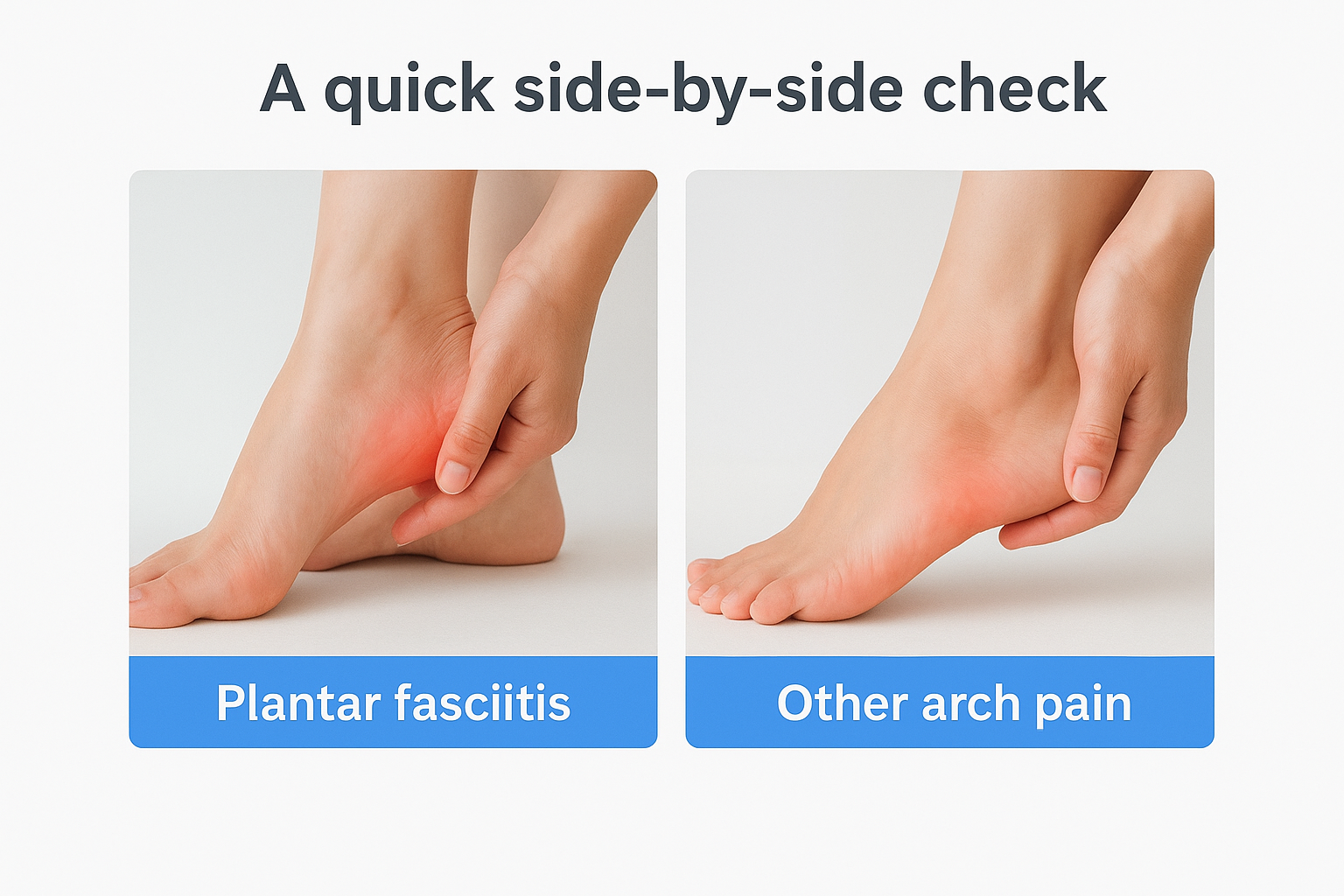
A quick side-by-side check
Use this table as a starting point, not a diagnosis:
| Symptom pattern | Points toward plantar fasciitis | Points toward other arch pain |
|---|---|---|
| Worst moment | First steps in the morning | Gradual build-up during activity |
| Pain location | Heel, spreading into arch | Mid-arch or inner ankle |
| Response to walking | Eases after a few minutes | Stays the same or worsens |
| Swelling | Uncommon | Sometimes visible along the arch or ankle |
| History | Sudden increase in activity or standing | Gradual onset, flat feet, or ageing tendons |
Notice any swelling along the inner ankle rather than just the heel, and you’re probably dealing with something other than fasciitis, possibly a tendon issue. Feeling pain that shifts location from week to week is another red flag worth mentioning to your podiatrist, since fasciitis tends to stay put once it settles in.
Other conditions that mimic arch pain
Not every ache under your foot fits neatly into plantar fasciitis or a straightforward arch strain. Several other conditions produce near-identical symptoms, which is exactly why self-diagnosis from a search engine so often leads people astray. Knowing the usual suspects helps you describe your symptoms more precisely when you do see someone.
Tendon and nerve culprits
Posterior tibial tendon dysfunction causes pain along the inner ankle and arch, often mistaken for fasciitis because both worsen with standing. Tarsal tunnel syndrome, a nerve compression issue, produces burning or tingling rather than the sharp, stabbing pain typical of fasciitis, and it can radiate into the toes. Both conditions tend to respond poorly to fascia-specific stretches, which is often the first clue that something else is going on.
Burning or tingling under the arch usually points to a nerve, not the fascia.
Bone and structural causes
A stress fracture in one of the midfoot bones can mimic arch pain almost perfectly, especially in runners who’ve ramped up mileage too quickly. Unlike fasciitis, stress fractures usually hurt with every step, not just the first ones, and they don’t ease with a warm-up. Fallen arches, whether from ageing, weight gain, or long-term overpronation, create a duller, more diffuse ache that spreads across the whole midfoot rather than sitting at the heel.

Here’s a quick reference for the usual mimics:
- Posterior tibial tendon dysfunction: inner ankle and arch pain, worse standing
- Tarsal tunnel syndrome: burning, tingling, sometimes numbness
- Stress fracture: constant pain, no morning-specific pattern
- Fallen arches: dull, spreading ache across the midfoot
Each of these needs a different management plan, which is why guessing rarely pays off for long.
When to book a podiatry assessment
Waiting too long is the most common mistake we see with arch pain. Two to three weeks of home stretching and rest is a reasonable trial for mild discomfort, but if nothing’s changed by then, self-treatment has done its job of ruling out the simple stuff and it’s time for a proper look. Pain that keeps returning at the same intensity, regardless of what you try, usually means the underlying cause hasn’t been addressed at all.
Red flags that need attention sooner
Certain symptoms shouldn’t wait out the usual trial period. Book in straight away if you notice any of the following:
- Sudden, severe pain after a specific incident, such as landing awkwardly or a long run
- Numbness, tingling, or burning anywhere under the foot or into the toes
- Visible swelling or bruising along the arch or inner ankle
- Pain that’s constant, with no let-up even at rest
- A noticeable change in your foot shape or the way you’re walking
Pain that doesn’t respond to two weeks of sensible self-care has earned itself a professional opinion.
What a proper assessment involves
Expect more than a quick chat and a squeeze of the arch. A thorough podiatry assessment includes watching how you walk, checking joint and tendon movement, and often using gait analysis or pressure plate scanning to see exactly how load moves through your foot. That data separates plantar fasciitis from tendon dysfunction, nerve irritation, or a stress fracture far more reliably than guesswork ever could.
Don’t rely on internet forums alone
Searching your symptoms will throw up dozens of conflicting opinions, and most people land somewhere between reassured and more confused than before. A clinical examination picks up subtle differences, like where swelling sits or how pain shifts with movement, that no forum thread can assess from a description alone.
Getting clarity on your foot pain
Sorting out arch pain vs plantar fasciitis comes down to paying attention to where it hurts, when it flares, and how it behaves once you’re moving. Heel pain that eases after a few steps points one way, while a dull ache that builds through the day points another, and swelling, numbness or a constant throb suggests something else entirely. None of this replaces a proper look at your foot, but it gives you the right questions to ask.
Guessing costs you time you don’t need to lose. If your arch or heel pain has hung around longer than a couple of weeks, or something about it doesn’t fit the usual pattern, get it checked properly rather than cycling through stretches that may be aimed at the wrong tissue. Our podiatrists use gait analysis and pressure plate scanning to pinpoint exactly what’s driving your pain, then build a plan around it. You can book an appointment online with one of our Sydney clinics this week.