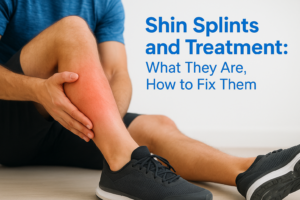

If your knees ache after a run or your shoes wear out oddly fast on one edge, you’ve probably wondered how to tell if you overpronate. Overpronation happens when your foot rolls inward too much as it strikes the ground, and left unchecked it can drag your ankles, knees and hips out of alignment over time. It’s one of the most common gait issues we see across our Sydney clinics, and most people can spot the early signs themselves before it becomes a real problem.
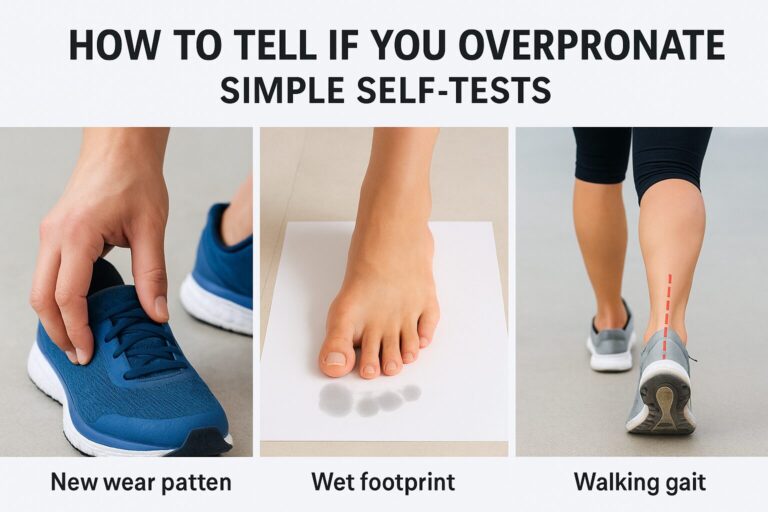
You don’t need a lab to get a decent read on your own gait. A handful of simple self-tests, done at home with things you already own, will tell you a lot. Checking your shoe wear patterns, looking at your wet footprint, and watching how your ankles move when you walk or run are all quick ways to flag overpronation.
In this guide, we’ll walk you through each self-test step by step, explain what the results actually mean, and help you decide when it’s worth booking a proper gait analysis with one of our podiatrists rather than guessing at home.
Why it matters if you overpronate
A small amount of inward roll is normal and even useful. Your foot is meant to pronate slightly on impact to absorb shock, then push off from a stable position. Overpronation happens when that inward roll goes too far or lasts too long through your stride, so your arch collapses more than it should and your ankle rolls inward past the point where your body can control it well.
The knock-on effects up the chain
Once that inward roll becomes excessive, the strain doesn’t stay in your feet. It travels up through your ankles, knees, hips and even your lower back, because your whole leg has to twist inward to compensate for the collapsing arch. We regularly see patients with shin splints, plantar fasciitis, Achilles tendon irritation and even knee pain that trace straight back to an untreated overpronation pattern.
Overpronation rarely stays a foot problem for long, it becomes a knee, hip or back problem if you ignore it.
Who’s most at risk
Certain groups are more prone to this pattern than others, which is why it’s worth checking yourself even if nothing hurts yet.
- People with naturally flat feet or low arches
- Runners and walkers logging high weekly distances
- Children whose arches are still developing
- Anyone who’s put on significant weight quickly
- People wearing worn-out or poorly supportive footwear
Spotting overpronation early means you can address it with the right footwear, orthotics or targeted exercises before it turns into a nagging injury that sidelines you from sport or even ordinary daily walking. The self-tests below give you a genuinely useful first read on where you sit, long before you’d need to book anything.
Step 1. Check your shoe wear pattern
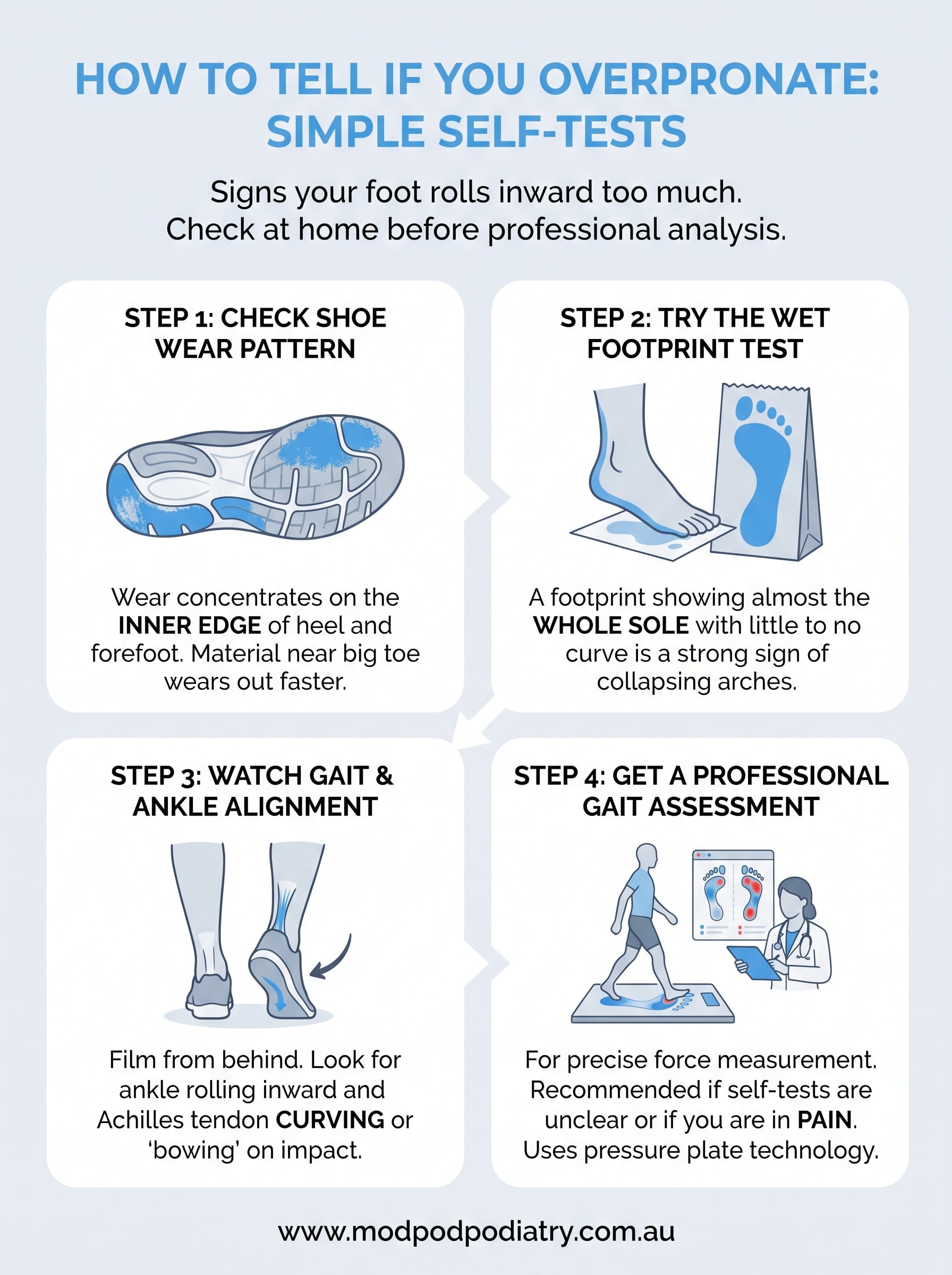
Grab your most-worn pair of trainers or work shoes and flip them over. Your shoe wear pattern is one of the clearest clues your body leaves behind, and it costs you nothing to read it. Look specifically at the outsole under the ball of your foot and heel, then compare the inner and outer edges.
What overpronation looks like on the sole
With overpronation, wear concentrates on the inner edge of the heel and stretches forward along the inside of the forefoot, often chewing through the material near your big toe faster than anywhere else. Neutral wear sits more evenly across the middle of the sole.
If the inside edge of your shoe is thinner than the outside, your foot is rolling in more than it should.
A quick checklist to run through
- Stand the shoe on a flat surface and check if it leans inward
- Compare both shoes, since one foot often overpronates more
- Check if the upper leans or bulges toward the inside
- Note if you’re replacing shoes more often than the usual 500-800km mark
Step 2. Try the wet footprint test
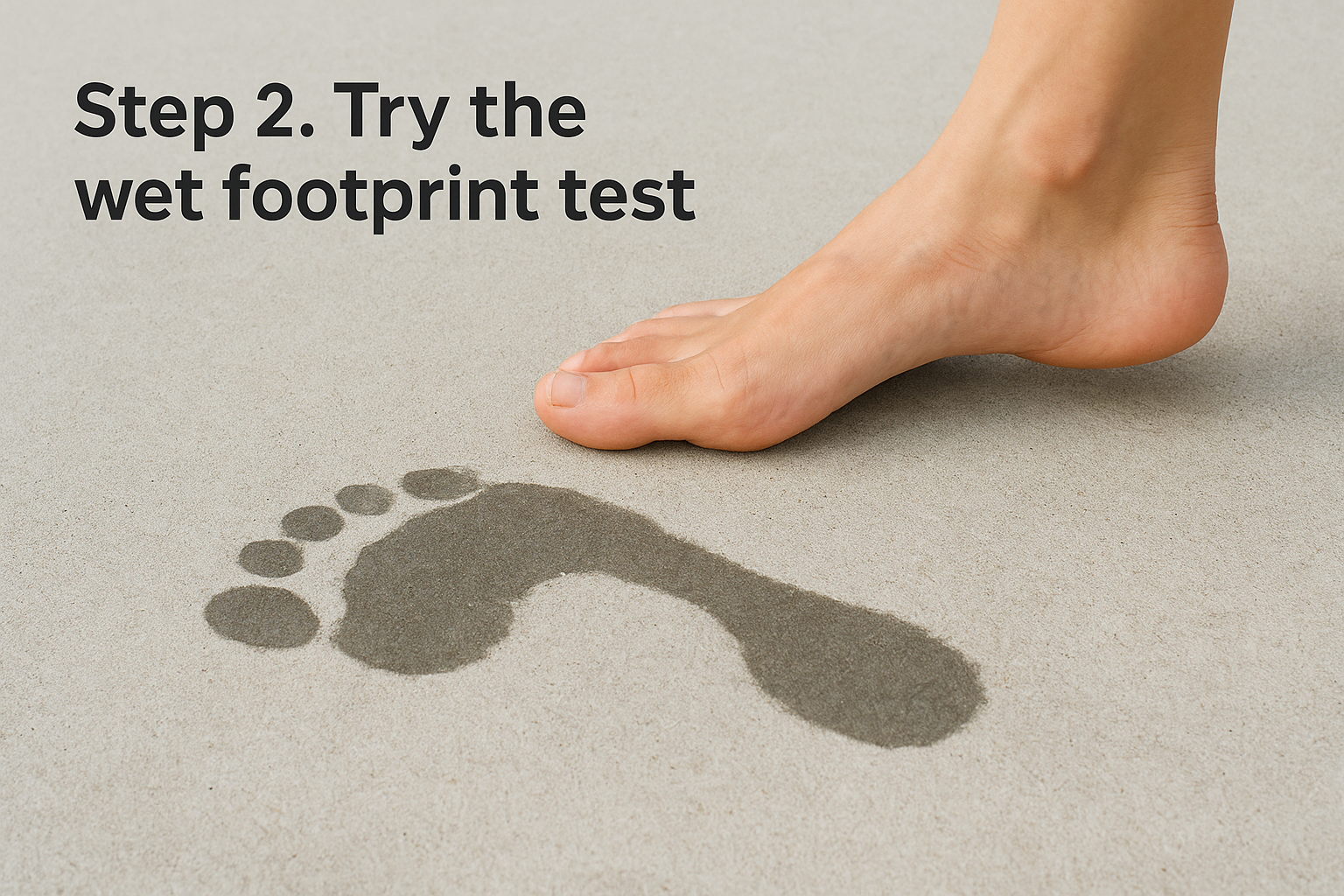
Wet your foot properly, then step onto a dry surface that shows moisture clearly, like a paper bag, a concrete path, or a dark bath mat. The wet footprint test gives you a rough map of your arch shape, which is one of the biggest drivers of overpronation. Step down normally with your full body weight, then lift straight off without shifting or smearing the print.
Reading the shape you left behind
Look at the middle section of the print, the part connecting your heel to the ball of your foot. A normal arch leaves a curved band roughly half the width of your foot. Flat feet leave almost the entire sole visible, with barely any curve inward, and that shape correlates strongly with overpronation.
A footprint showing almost the whole sole with no curve is a strong sign your arches are collapsing inward.
Comparing your results
| Print type | What you’ll see | Likely pattern |
|---|---|---|
| High arch | Thin band, heel and forefoot barely connected | Underpronation |
| Normal arch | Curved band, roughly half foot width | Neutral |
| Flat/low arch | Full sole visible, little to no curve | Overpronation |
Step 3. Watch your gait and ankle alignment
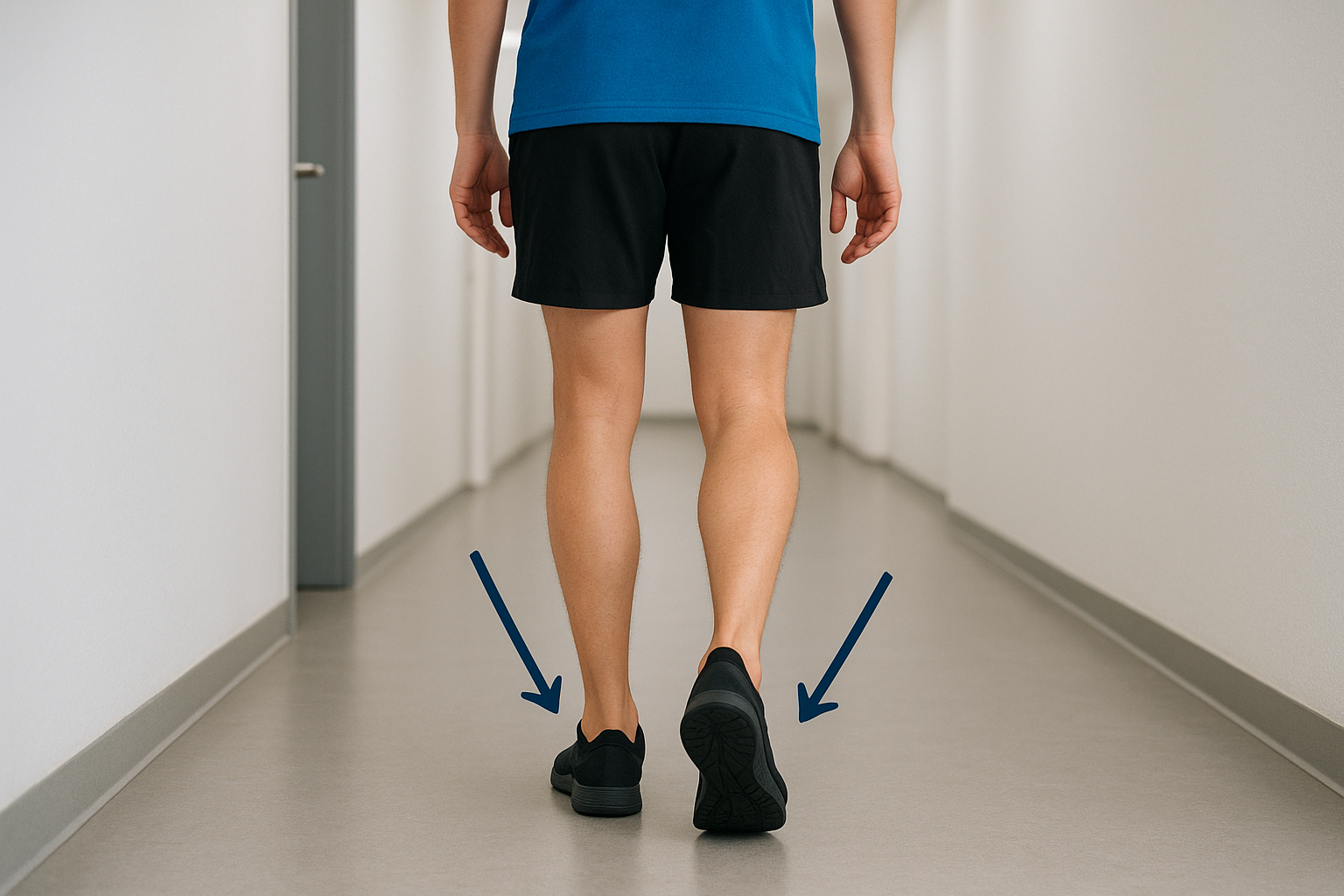
Static tests only tell you so much, because overpronation really shows up when your foot is moving under load. Watching your gait and ankle alignment while you walk or run gives you a much clearer picture than a shoe or footprint ever will. Ask someone to film you from behind on your phone, walking normally down a hallway or jogging on the spot, then play it back in slow motion.
What to look for in the footage
Focus on your ankle bone and Achilles tendon as your heel strikes the ground. With overpronation, you’ll see your ankle roll inward and your Achilles form a slight curve rather than staying straight, sometimes called a "bowing" pattern. Your knee often follows, drifting inward too, which is exactly the chain reaction we talked about earlier.
A straight Achilles that suddenly curves inward on impact is one of the clearest visual signs of overpronation.
A simple way to score yourself
- Film from behind, not the side, for the clearest view
- Watch three to five strides, not just one
- Compare left and right ankles for differences
- Repeat barefoot and in shoes to see if footwear masks the roll
Step 4. Get a professional gait assessment
Home tests are a useful starting point, but they can’t measure force, timing or muscle activity the way a professional gait assessment can. If your shoe wear, footprint and video all point the same way, or if you’re already getting pain, it’s worth booking a proper assessment rather than guessing further. Our podiatrists use pressure plate technology and 3D scanning to see exactly how your foot loads through each phase of your stride, something no phone camera can capture.
What actually happens during the assessment
You’ll walk and jog across a pressure-sensitive plate while a podiatrist records force distribution under your foot in real time, then reviews the data with you against your footwear and injury history.
Numbers from a pressure plate settle arguments that eyeballing a video never can.
When it’s worth booking rather than waiting
- You’re in pain now, not just curious
- Your self-tests gave mixed or unclear results
- You’re training for an event and can’t afford setbacks
- A child’s arches look flat and aren’t improving with age
You can book a same-week appointment at one of our Sydney clinics through our online booking page.
Understanding what your feet are telling you
Your shoes, your footprint and that shaky phone video all tell the same story if you read them properly. None of these self-tests replace a proper diagnosis, but together they give you a solid, honest read on whether overpronation is shaping how you move. If two or three of them point the same way, that’s not a coincidence you should shrug off.
Treat what you’ve found as a starting point, not a verdict. Mild overpronation might just need better shoes or a few strengthening exercises. A more pronounced pattern, especially one already causing pain, deserves a proper look with pressure plate analysis and custom support rather than more guesswork at home.
If your results have you leaning toward the flat, collapsing end of that footprint chart, don’t wait for pain to force the issue. Book an assessment and ask about custom orthotics to see whether your stride needs proper correction.