

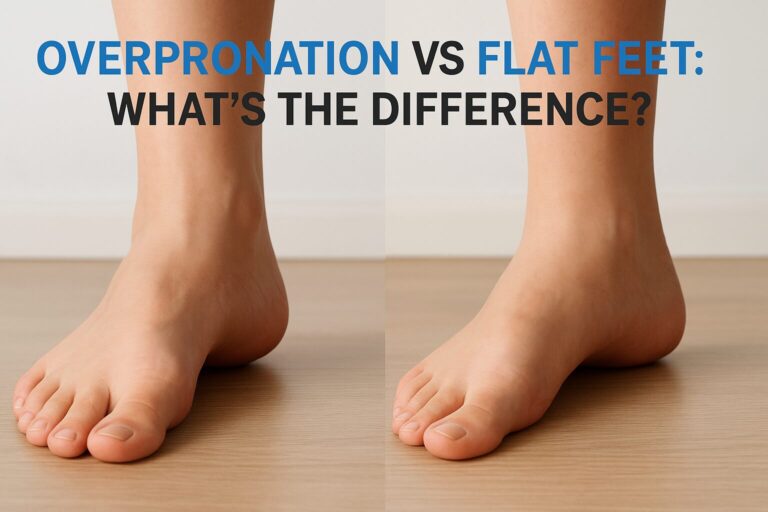
If you’ve been told you have flat feet, or you’ve noticed your shoes wearing down unevenly on the inside edge, you’ve probably wondered whether that’s the same thing as overpronation. It’s not, and the difference matters when you’re trying to work out why your feet, knees or hips ache after a run or a long day standing. Understanding overpronation vs flat feet is the first step to getting the right treatment rather than guessing at it.
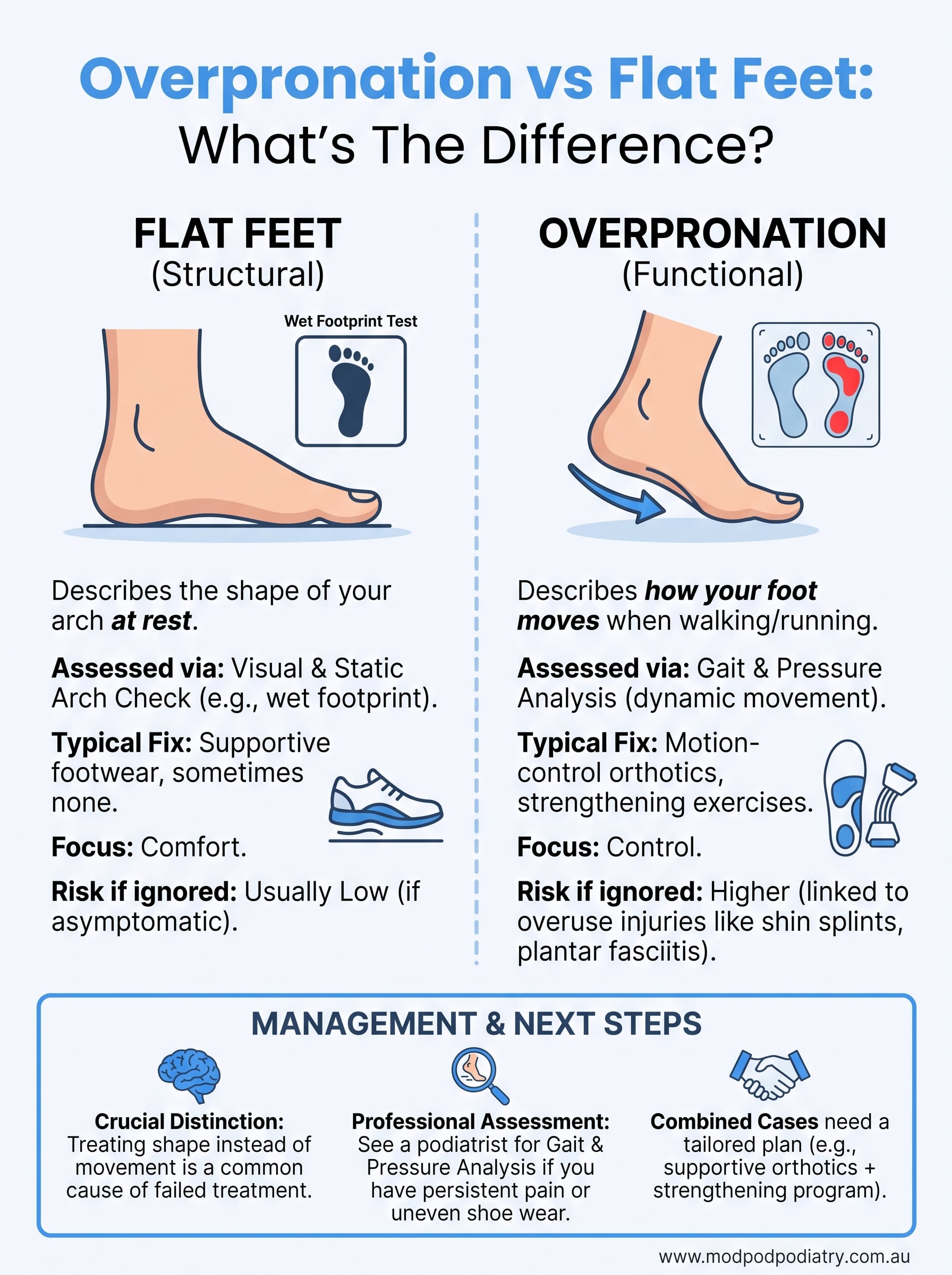
In short, flat feet describes the shape of your arch at rest, while overpronation describes how your foot moves when you walk or run. You can have flat feet without overpronating, and you can overpronate with a perfectly normal-looking arch. The two often get confused because low arches make overpronation more likely, but they’re assessed differently and don’t always need the same fix.
In this article, we’ll break down what each condition actually is, how a podiatrist identifies them through gait and pressure analysis, what causes them, and how they relate to each other in practice. If you’re dealing with heel pain, shin splints or recurring sports injuries, this is the groundwork you need before choosing orthotics, footwear or treatment.
Why the distinction affects your treatment and pain relief
Getting this wrong wastes money and time. A podiatrist who treats static flat feet the same way as dynamic overpronation might prescribe rigid orthotics for a foot that never needed correcting, or miss a mobility problem that’s actually driving your knee pain. Structure and movement respond to different tools, so the assessment has to separate them before treatment starts.
Flat feet without overpronation may need no treatment at all
Plenty of people walk around with low or absent arches and never develop pain, because their foot still controls its own motion through the gait cycle. In that case, chasing arch height with rigid supports can actually restrict a foot that’s functioning fine. Custom orthotics built for arch shape alone, without gait analysis, often fix nothing because the arch was never the problem.
Treating the shape of your foot instead of how it moves is the most common reason orthotics fail to fix the pain.
Overpronation left unmanaged tends to snowball
Excessive inward rolling loads the wrong tissues repeatedly, and that repetition is what turns a minor ache into a recurring injury. Shin splints, plantar fasciitis, Achilles tendinopathy and even knee and hip pain frequently trace back to uncontrolled pronation rather than arch height itself. Because the movement compounds with every step, waiting it out rarely works the way it might with a structural variation that’s stayed stable for years.
The practical difference in approach
Here’s roughly how the two problems get managed differently in a clinic setting:
| Feature | Flat feet (structural) | Overpronation (functional) |
|---|---|---|
| Assessed via | Visual and static arch check | Gait analysis, pressure plate |
| Main concern | Arch height at rest | Degree and timing of foot roll |
| Typical fix | Supportive footwear, sometimes none | Motion-control orthotics, strengthening |
| Risk if ignored | Usually low | Higher, linked to overuse injuries |
Separating these two questions, shape versus movement, is exactly why a proper biomechanical assessment matters more than a quick look at your arches in the mirror.
How to tell if you have flat feet, overpronation or both
Working this out yourself has limits, but there are a few checks that point you in the right direction before you book an appointment. Wet footprint tests, shoe wear patterns and a simple standing check all give clues, though none of them replace a proper gait assessment.
The wet footprint test at home
Wet the sole of your foot, step onto a dry surface like concrete or thick cardboard, and look at the print left behind.
- A full, solid print with barely any curve on the inside edge suggests flat feet.
- A print with a normal-looking arch doesn’t rule out overpronation, because that only shows up when you move.
- Uneven wear on the inside edge of old runners usually means the foot is rolling inward during push-off, which points to overpronation rather than arch shape alone.
A dry footprint can’t show you overpronation, because that only happens once your foot starts moving.
What a podiatrist checks that you can’t
Spotting a low arch is easy enough in a mirror, but measuring how much and how fast your foot rolls inward through each step needs proper tools. Pressure plate analysis captures the timing and distribution of load across your foot as you walk, while video gait analysis shows the ankle and heel motion frame by frame. Combining both is how a podiatrist confirms whether you’re dealing with flat feet, overpronation, or genuinely both together, since the two often overlap but rarely line up perfectly.
How to manage and correct each condition
Once you know whether you’re dealing with structural flat feet, functional overpronation, or both, the management path splits fairly clearly. Structural flat feet without pain usually just needs supportive, well-fitted footwear rather than correction, since there’s nothing to fix if the foot already controls itself through each step. Overpronation, on the other hand, responds to targeted intervention because it’s a movement pattern you can actually retrain and support.
You can’t stretch or strengthen your way into a higher arch, but you can absolutely retrain how your foot rolls.
Footwear and orthotics do different jobs
For structural flat feet, look for shoes with a firm heel counter and moderate arch support, nothing overly corrective. For overpronation, motion-control shoes or custom orthotics designed from pressure plate data help slow the inward roll at the right point in your stride, rather than just cushioning the arch.
Strength and mobility work matters for overpronation
Weak hip and ankle stabilisers let the foot collapse inward further than it should, so a proper plan usually includes:
- Calf and tibialis posterior strengthening
- Single-leg balance drills
- Hip abductor work to control lower limb alignment
- Gradual load increases if you’re returning to running
Combined cases need a tailored plan
If you’ve got low arches and significant overpronation together, expect a combined approach: supportive orthotics plus a strengthening programme, reassessed every few months as your gait changes.
When it’s time to see a podiatrist
Not every ache needs a clinic visit, but certain signs mean guesswork has run its course. Persistent heel or arch pain that lasts more than a couple of weeks, especially first thing in the morning, usually points to a mechanical issue that footwear changes alone won’t fix. Waiting it out often just gives the pattern more time to load the wrong tissues.
Warning signs worth booking for
Book an appointment if you notice any of the following:
- Pain that flares during or after running, walking or standing for long periods
- Visible inward rolling of the ankle that others have pointed out
- Uneven or rapid shoe wear on one side
- Recurring shin splints, plantar fasciitis or knee pain
- A child dragging their feet, tripping often, or avoiding sport
If your shoes, knees or heels keep telling you the same story, it’s time to get a proper gait assessment rather than another pair of insoles.
Why timing matters more than people think
Early assessment matters because overpronation compounds with every step you take on it untreated, while structural flat feet rarely change but benefit from confirmation either way. A podiatrist can run pressure plate and gait analysis in one visit, giving you a clear answer instead of months of trial and error with shoes and inserts. That single assessment often saves far more in wasted purchases than the consultation itself costs.
Knowing what your feet are telling you
Flat feet and overpronation aren’t the same problem, even though they show up together often enough to cause confusion. One describes arch shape, the other describes how your foot moves, and mixing them up means you risk treating the wrong thing while the real cause keeps loading your knees, shins or heels with every step. A wet footprint or a glance at your worn-out runners gives you a hint, but only a proper gait and pressure assessment tells you what’s actually happening underneath you.
If your feet, shins or knees have been sending you the same message for weeks, listen to it. Guessing at insoles or swapping shoes on a hunch rarely fixes a mechanical issue, and it wastes money you didn’t need to spend. A podiatrist can confirm exactly what’s going on in one visit and set you on the right path from there. Book an online appointment and get a clear answer instead of another guess.

