
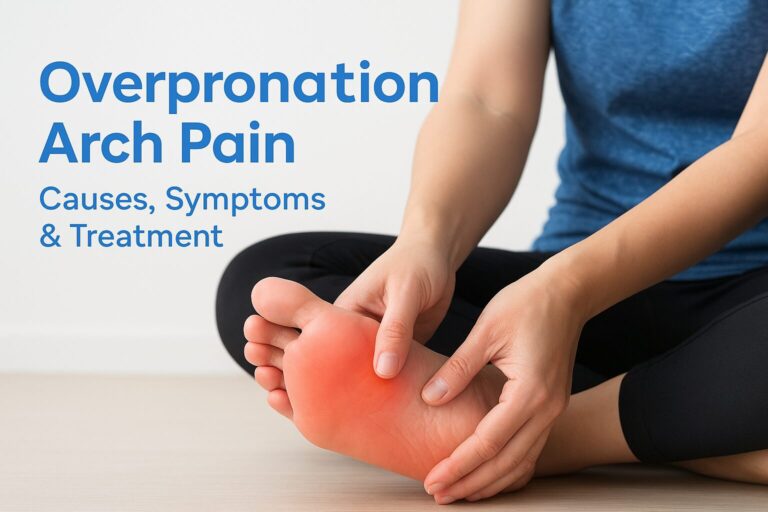
That deep ache along the inside of your foot after a run, a long shift on your feet, or even just walking the dog isn’t something you should ignore. Overpronation arch pain happens when your foot rolls too far inward with each step, flattening the arch and putting excess strain on the tissues that are meant to support it. It’s one of the most common reasons Sydney patients walk into our clinics asking why their feet hurt at the end of the day.
Ov0erpronation itself isn’t a disease, it’s a movement pattern, but left unaddressed it can lead to plantar fasciitis, shin splints, and even knee or hip pain further up the chain. The good news is that once you understand what’s driving the rolling motion, treatment is usually straightforward and doesn’t always mean surgery or months off your feet.
In this guide, we’ll walk through what causes overpronation, the warning signs to watch for, how podiatrists diagnose it using gait analysis, and the treatment options that actually work, from stretching and strengthening through to custom orthotics.
Why overpronation causes arch pain
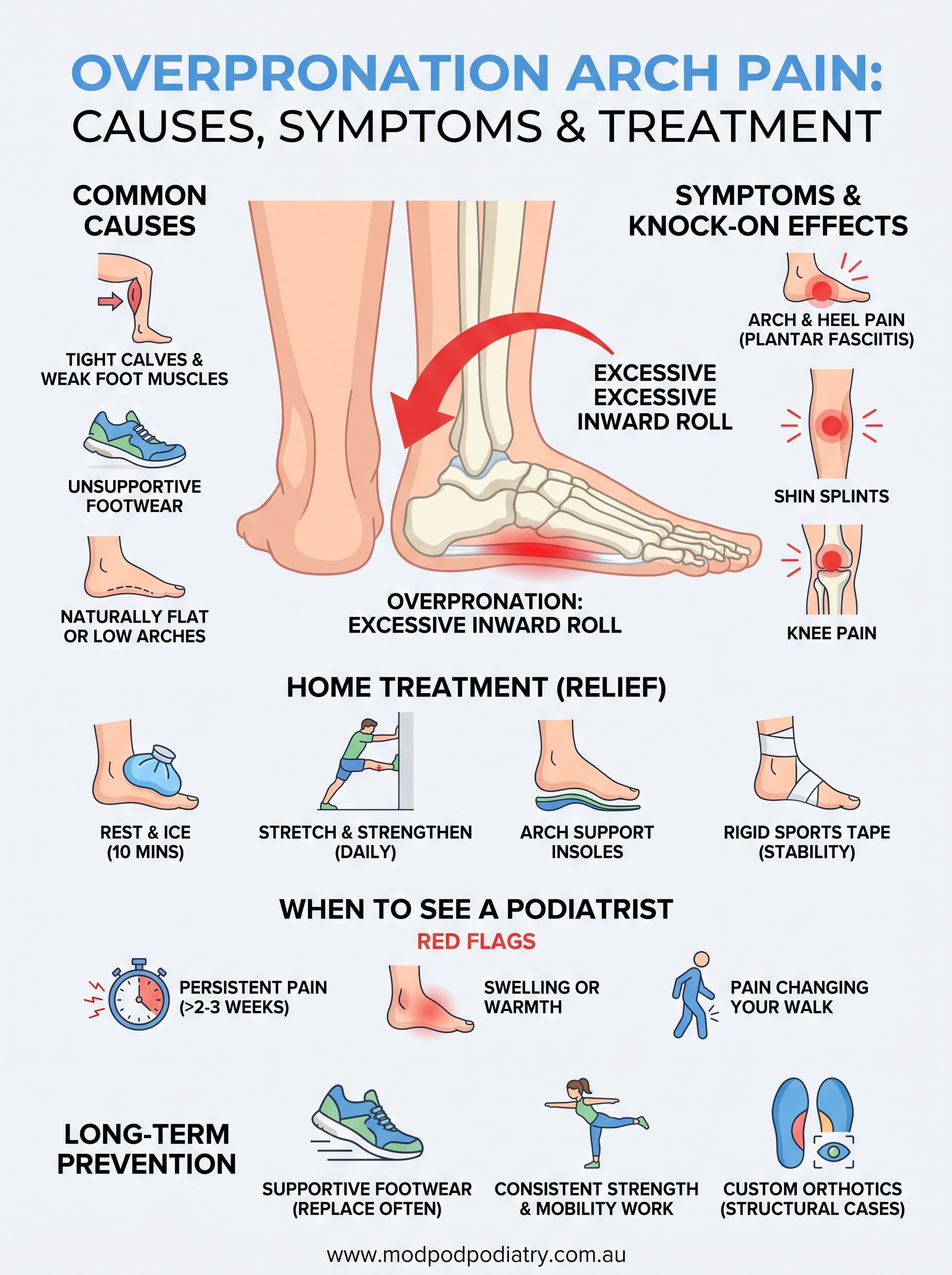
Every time your foot hits the ground, it’s meant to roll inward slightly to absorb shock, then push back outward as you propel forward. With overpronation, that inward roll goes too far and lasts too long, so your arch flattens more than it should and stays flattened through more of your stride. That extra collapse stretches the tissues underneath your foot far beyond what they’re built to handle, and that’s where the arch pain starts.
The mechanics of a collapsing arch
Your arch relies on a network of ligaments, tendons, and the plantar fascia, the thick band of tissue running from your heel to your toes, to hold its shape under load. When your foot rolls inward excessively, this network gets pulled and stretched with every single step, thousands of times a day if you’re on your feet at work or training for a run. Over weeks and months, this repetitive overstretching causes microscopic tearing and inflammation, particularly at the heel where the fascia attaches to the bone.
Overpronation doesn’t just flatten your arch, it repeatedly overstretches the tissue holding it up until something gives.
Why the pain shows up where it does
Most patients describe the pain as a dull ache or sharp stab along the inner edge of the foot, worst first thing in the morning or after standing for long periods. This happens because the tissue tightens up during rest, then gets wrenched again the moment you take those first steps of the day. Common contributing factors include:
- Flat or low arches you were born with
- Weak intrinsic foot muscles or tight calves
- Worn-out or unsupportive footwear
- Sudden increases in running distance or standing time
- Excess body weight adding load through the arch
The knock-on effects further up the chain
Because your foot is the foundation for everything above it, overpronation rarely stays contained to the arch. The inward rolling changes how your shin, knee, and even hip rotate during movement, which is why so many patients with untreated overpronation eventually develop shin splints or knee discomfort alongside their foot pain. Understanding this chain reaction is exactly why a proper assessment looks at your whole gait, not just where it hurts.
How to relieve overpronation arch pain at home
Before booking an appointment, there’s plenty you can do at home to calm overpronation arch pain and stop it getting worse. Rest from high-impact activity for a few days, ice the arch for ten minutes after being on your feet, and swap barefoot walking on hard floors for supportive slippers or shoes indoors.
Stretch and strengthen the right muscles
Tight calves and weak foot muscles are two of the biggest drivers of excessive rolling, so daily stretching and strengthening genuinely changes how your foot loads. Try these each morning and evening:
- Calf stretches against a wall, 30 seconds per side, three times
- Towel scrunches with your toes to build arch strength
- Rolling a frozen water bottle under the arch for five minutes
- Single-leg balance drills to improve ankle control
Consistent stretching and strengthening does more for arch pain than any single product you can buy.
Support the arch with what you already own
Simple, affordable support often makes an immediate difference. Off-the-shelf arch support insoles from a pharmacy can reduce strain while you work on the underlying weakness, and taping the arch with rigid sports tape before activity gives extra stability during the healing window. Footwear matters too: worn-out trainers with collapsed midsoles make overpronation worse, so check the tread and inner sole for uneven wear before you spend money on treatment elsewhere.
Giving these steps two to three weeks is reasonable. If the pain hasn’t eased, or it’s getting sharper rather than settling, that’s your signal to stop self-managing and get a proper assessment.
When to see a podiatrist for arch pain
Self-care works for mild cases, but certain signs mean it’s time to book with a podiatrist rather than keep guessing. Persistent arch pain that doesn’t ease within two to three weeks of rest, stretching, and off-the-shelf support is the clearest signal that something structural needs proper assessment.
Red flags that need professional attention
Watch for these signs that push your case beyond home management:
- Pain that wakes you at night or worsens with rest
- Swelling, redness, or warmth along the arch or heel
- Numbness or tingling spreading into your toes
- Pain severe enough to change how you walk
- Arch pain in a child, since growing feet need different management
Any one of these on its own is worth a booking, and a combination shouldn’t wait.
If arch pain is changing how you walk, that’s your body telling you it’s past the self-care stage.
What a podiatry assessment actually involves
Getting a proper diagnosis matters because arch pain can come from plantar fasciitis, tarsal tunnel irritation, or even a stress fracture, and each needs a different treatment path. A podiatrist will typically run a gait analysis, check your footwear wear patterns, and assess muscle strength and joint flexibility before recommending anything. Vague or worsening pain that hasn’t responded to two to three weeks of sensible self-treatment is exactly the sort of case worth bringing to a clinic rather than pushing through, especially if it’s starting to affect your training, work, or daily walking.
Preventing overpronation arch pain long term
Once your arch pain settles, the real work is stopping it coming back, and that means treating overpronation as an ongoing management job rather than a one-off fix. Long-term prevention hinges on three things: supportive footwear, consistent strength work, and catching changes in your gait before they turn into pain again.
Choose footwear that actually supports your gait
Quit rotating through worn-out trainers and start checking your shoes every few months for collapsed heels or uneven tread wear, since this is often where overpronation quietly creeps back in. Look for shoes with a firm heel counter and adequate arch support, and replace running shoes every 600 to 800 kilometres regardless of how they look on the outside.
Your shoes are either working with your arch or slowly undoing everything your treatment achieved.
Keep up the strength and mobility work
Dropping your stretching routine the moment pain disappears is the single biggest reason overpronation returns. Keep calf stretches, towel scrunches, and single-leg balance drills in your weekly routine even once you’re pain-free, treating them as maintenance rather than treatment.
Consider custom orthotics for structural cases
If your overpronation stems from a structural issue like naturally flat feet rather than just weak muscles, off-the-shelf insoles will only get you so far. Custom orthotics, built from 3D scanning and pressure plate analysis, correct the specific angle and timing of your roll rather than offering generic support. This matters most for runners, tradespeople on their feet all day, and anyone who’s had repeated flare-ups despite doing the stretching and footwear basics right.
Getting back on your feet
Overpronation arch pain isn’t something you have to live with, and it isn’t something that fixes itself if you keep ignoring it. Understanding why your foot rolls the way it does, whether that’s tight calves, worn shoes, or a structural flat foot, gives you a clear path forward instead of just guessing at fixes. Home care genuinely helps mild cases, but persistent or worsening pain deserves a proper look rather than another few weeks of hoping it settles on its own.
Rather than cycling through pharmacy insoles and generic advice, get an assessment that actually maps your gait and tells you what’s driving the problem. Our podiatrists across Sydney use gait analysis and pressure plate testing to build a treatment plan suited to your feet, not a generic one. If you’re ready to stop guessing and start fixing it, book an appointment online with ModPod Podiatry today.