

You’ve put in the training hours, dialled in your nutrition, and still something feels off when you run. Maybe it’s a niggling knee, a recurring shin complaint, or a sense that your stride just isn’t working with you. Gait analysis for runners strips away the guesswork by capturing exactly how your body moves through each phase of your running cycle, from initial foot strike to toe-off, so you can see what’s actually happening rather than relying on feel alone.
The information a proper gait analysis reveals goes well beyond whether you overpronate or supinate. It highlights asymmetries, timing issues, and compensatory patterns that often sit at the root of recurring running injuries. It also gives you a concrete basis for decisions about footwear, training modifications, and treatment, rather than picking shoes off a shelf because a colour looked right or a store employee watched you jog for three seconds.
At ModPod Podiatry, our podiatrists use pressure plate technology and biomechanical assessment to analyse running gait across our Sydney clinics. We work with runners at every level, from people training for their first 5K to competitive athletes chasing PBs, and we see firsthand how much clarity a thorough gait assessment brings. This article breaks down what gait analysis actually involves, what it can show you about your running mechanics, and how that information translates into practical improvements you can act on.
Why gait analysis matters for runners
Running looks simple from the outside, but your body executes a highly complex series of movements with every stride. Load distribution, joint angles, and muscle activation timing all shift within fractions of a second, and when even one element is off, those effects compound over hundreds or thousands of steps per session. That’s where gait analysis for runners becomes genuinely useful. Rather than waiting until something breaks down, a proper analysis gives you a clear picture of how your mechanics are working right now, so you can address small problems before they become significant ones.
Running injuries rarely happen by accident
Most running injuries don’t appear out of nowhere. They build gradually through repeated mechanical stress applied in the wrong direction or at the wrong intensity over time. Patellofemoral pain, iliotibial band syndrome, plantar fasciitis, and tibial stress fractures all share a common thread: they develop when tissue load consistently exceeds what that tissue can handle. A gait assessment identifies the specific movement patterns contributing to that excess load, whether it’s excessive foot pronation, a hip drop on one side, or a stride length that’s too long for your current strength base.
Understanding the mechanical cause of an injury is what separates a lasting recovery from repeating the same cycle of rest, return, and breakdown.
Without that understanding, you’re treating symptoms rather than causes. You might rest for two weeks, feel better, return to running, and find yourself back in exactly the same position within a month. Identifying the root cause breaks that cycle by pointing directly at what needs to change, whether that’s footwear, load management, or a specific movement pattern you’ve developed without realising it.
The connection between mechanics and performance
Injury prevention is one reason to get your gait assessed, but running economy is another equally compelling one. Running economy refers to how much oxygen your body uses to maintain a given pace, and your mechanics directly influence it. Runners who overstride, for example, create a braking force with each footstrike that their muscles then have to overcome to maintain forward momentum. That wastes energy on every single step. A gait assessment highlights these inefficiencies and gives you specific targets to work on, whether that involves cadence adjustments, trunk position, or arm carry.
Small mechanical changes can produce meaningful performance improvements over time. A podiatrist reviewing your running gait isn’t only looking for what’s wrong. They’re also identifying where you’re leaving efficiency on the table, which matters whether you’re chasing a personal best or simply trying to run further without feeling wrecked afterward.
Why feel alone isn’t enough
Runners often rely on how a session felt to judge whether their form is holding up. The problem with that approach is that your body is extremely good at compensating. A hip weakness on one side, for instance, often goes completely unnoticed because surrounding muscles quietly pick up the slack, at least until those muscles reach their own threshold. You might feel entirely comfortable running with a pattern that a camera and pressure plate would reveal as clearly asymmetrical and mechanically loaded.
Fatigue compounds this problem significantly. Your form at kilometre two looks nothing like your form at kilometre eighteen, and the patterns that emerge as you tire are often where injury risk spikes most sharply. A thorough gait assessment captures how your mechanics shift under fatigue, not just how they appear when you’re fresh and feeling controlled. That gives you a far more complete and honest picture of how your body actually moves through a full training run, rather than an idealised snapshot taken at the start of a session.
What a gait analysis can reveal
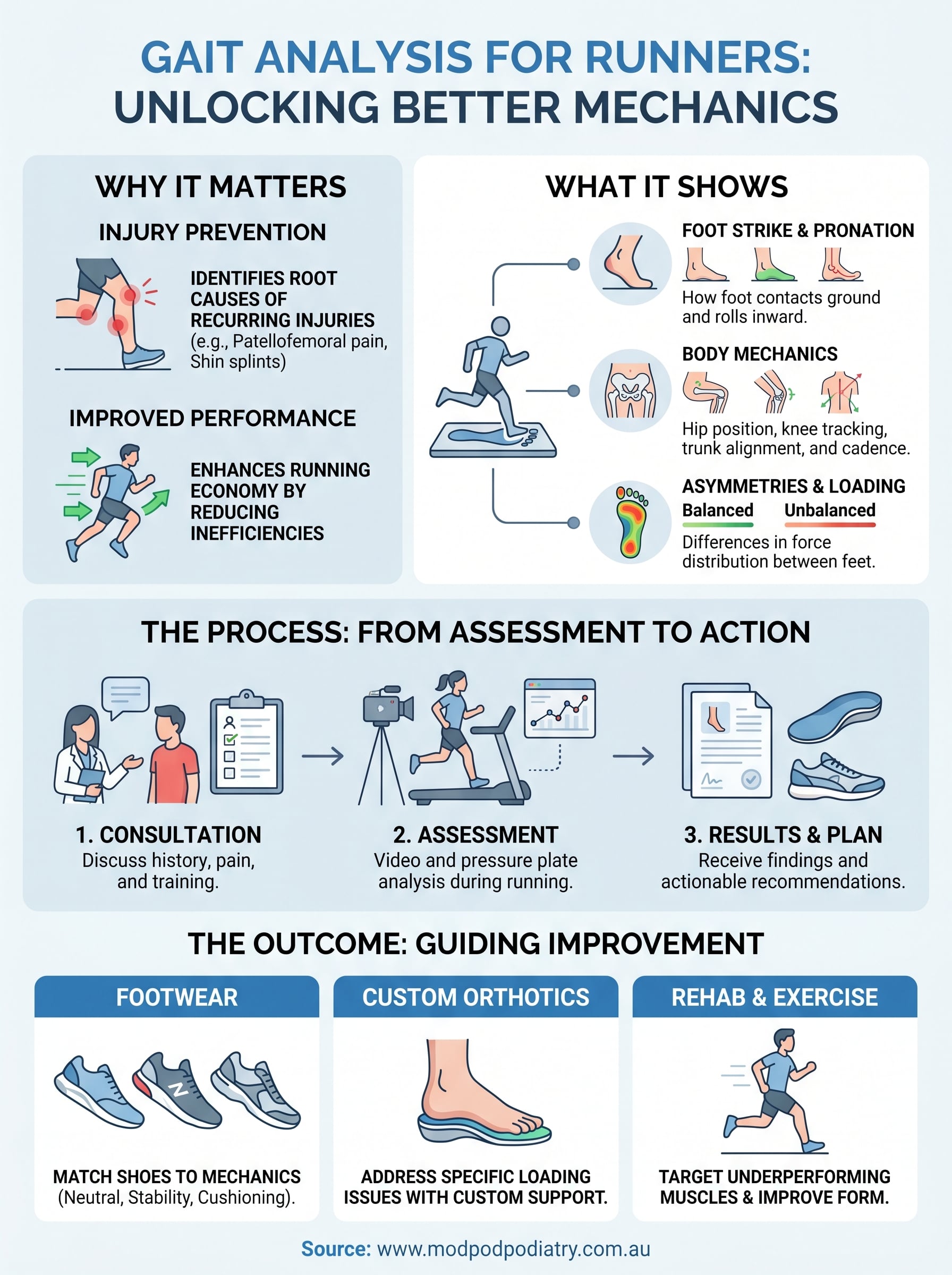
A single running stride involves your entire body working in sequence, and a gait analysis captures data from multiple points along that chain simultaneously. This gives your podiatrist a detailed picture that’s impossible to construct from observation alone. Rather than making educated guesses about why you might be developing pain or losing efficiency, they can point to specific measurements and patterns that either confirm a concern or rule it out.
How your foot contacts the ground
Your foot is the first point of contact with the ground, and the way it lands sets off a chain reaction through your ankle, knee, hip, and lower back. A gait analysis for runners examines where on your foot initial contact occurs, whether that’s your heel, midfoot, or forefoot, and how your foot then loads through to toe-off. It also measures the degree of pronation through your midfoot, which is the natural inward roll that occurs as your arch flattens to absorb load. Too much pronation, too little, or pronation that happens at the wrong point in your stride can all contribute to injury over time.
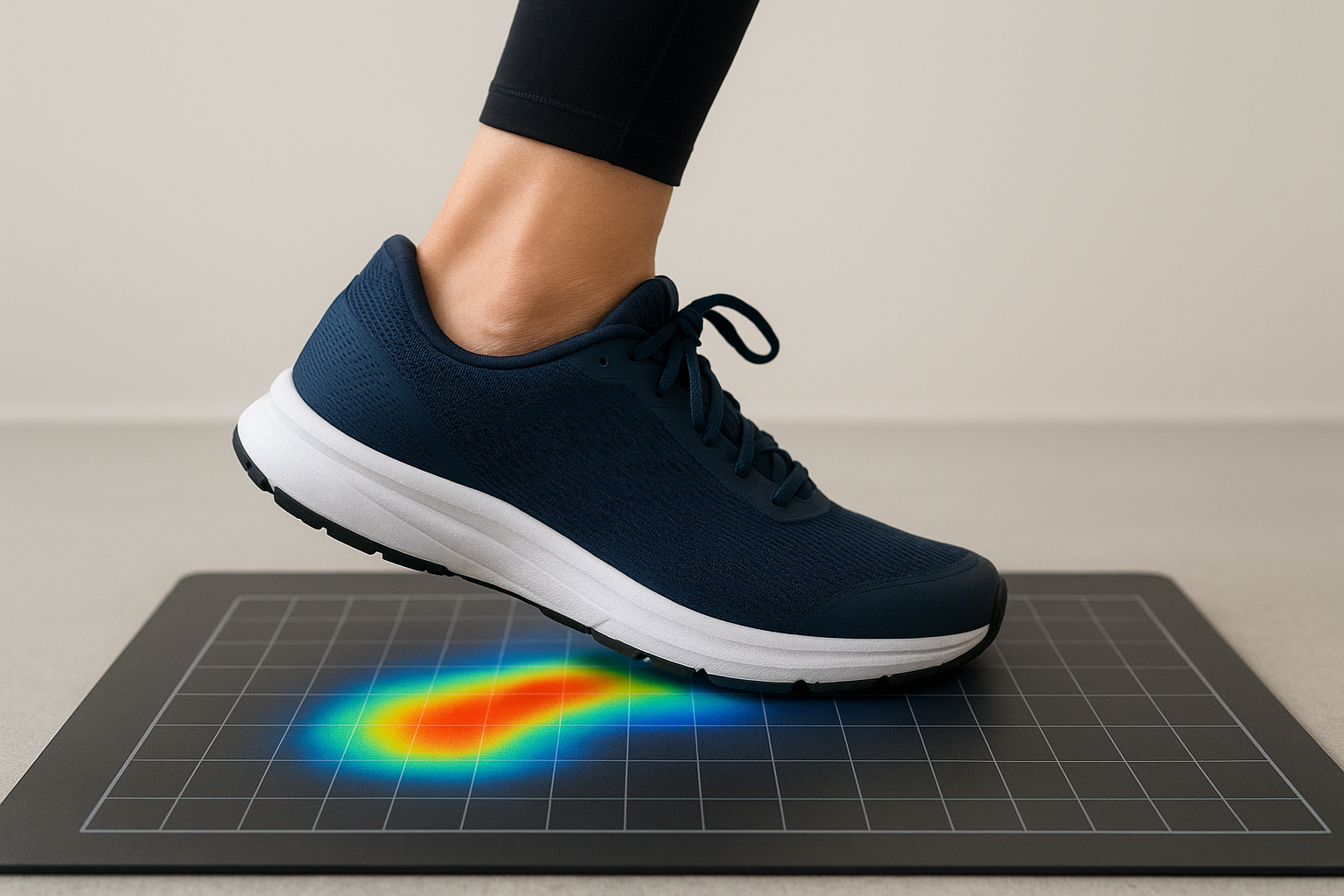
The pressure plate data your podiatrist reviews shows not just where you land, but how load moves across your entire foot with every step.
Beyond strike pattern and pronation, analysis also captures ground contact time and how symmetrically you load each foot. Runners often apply noticeably more force through one foot than the other without realising it, and that kind of asymmetry places uneven stress on joints and soft tissue across thousands of repetitions per session.
What happens above the ankle
Your foot mechanics don’t exist in isolation. Hip position, knee tracking, and trunk lean all influence how load travels through your lower limb, and a comprehensive gait assessment evaluates each of these elements together. A hip that drops on the opposite side during each stance phase, for example, shifts mechanical stress toward the knee and can contribute to iliotibial band problems. Equally, a forward trunk lean combined with a long stride length creates braking forces that reduce efficiency and increase load through the lower leg.
Cadence, vertical oscillation, and arm carry also fall within the scope of a thorough assessment, since each of these factors affects how smoothly energy transfers through your stride. Small deviations in any one of them often correlate with larger issues elsewhere in the chain, which is why your podiatrist examines the whole picture rather than a single variable in isolation.
Common gait patterns and red flags
Runners tend to develop predictable mechanical patterns, and many of those patterns carry recognisable risks. Understanding the most common gait issues helps you make sense of what a podiatrist looks for during an assessment and gives you context for interpreting the findings. Some patterns are widespread without being serious, while others are reliable red flags that point directly toward injury risk worth addressing before training loads increase further.
Overpronation and supination
Pronation is a normal part of your running stride. Your foot naturally rolls inward as your arch flattens to absorb shock, and that movement is both necessary and healthy. The issue arises when that inward roll extends too far or continues for too long into your loading phase, a pattern called overpronation. This places increased rotational stress on your ankle, shin, and knee, and it’s one of the most frequently identified patterns during a gait analysis for runners.
Supination, sometimes called underpronation, sits at the opposite end of the spectrum. Your foot stays on its outer edge rather than rolling inward adequately, which reduces your body’s ability to absorb impact. Runners with high, rigid arches are most prone to supinating, and they tend to experience higher rates of stress fractures and lateral ankle problems as a result.
Overstriding
Overstriding happens when your foot lands well ahead of your centre of mass with each step, and it’s one of the most common efficiency problems podiatrists identify. Each overstride creates a braking force that slows your forward momentum and forces your muscles to work harder just to maintain pace.

Increasing your cadence slightly, targeting around 170 to 180 steps per minute, is one of the most effective mechanical adjustments available to distance runners dealing with overstriding.
Beyond the energy cost, overstriding places significant load through your heel and lower leg, which contributes directly to conditions including tibial stress injuries and plantar fasciitis. Your cadence and stride length data from a professional assessment will make this pattern immediately visible if it is present.
Hip drop and asymmetry
Hip drop occurs when your pelvis dips down on the opposite side to your stance leg during each stride. This pattern reflects weakness in your hip abductor muscles, particularly the gluteus medius, and it places considerable stress on your iliotibial band and knee. Runners with this issue often attribute their lateral knee pain to footwear when the actual cause sits higher up the chain.
Significant asymmetry between your left and right side is another red flag worth addressing. A meaningful imbalance in ground contact time, loading force, or foot strike position indicates that one side of your body is compensating for a weakness or restriction on the other, and that compensation carries a cumulative injury cost.
Professional gait analysis: what to expect
Knowing what a session involves makes it much easier to prepare and get the most from it. A professional gait analysis for runners typically runs between 45 minutes and an hour, depending on how much ground your podiatrist needs to cover. You don’t need to be an elite athlete or have a diagnosed injury to attend. Many runners book an assessment simply to understand their mechanics better before increasing their training load or transitioning to a new shoe type.
Before you step on the treadmill
Your podiatrist will start with a conversation, not a run. They’ll ask about your running history, current training volume, and any pain or discomfort you’ve noticed, along with the footwear you typically train in. This background gives them essential context for what they’re about to observe, because mechanics rarely make sense without knowing the training load sitting behind them.
The questions asked before the cameras roll often reveal as much as the footage itself, particularly when a runner has adapted their stride to manage an existing pain point.
You’ll also undergo a standing and walking assessment to evaluate your posture, foot alignment, and how your lower limbs move at a slower pace. This static and low-speed check gives your podiatrist a baseline to compare against before the speed increases.
The running assessment itself
Once the background check is complete, you’ll run. Your podiatrist will use a combination of video footage and pressure plate data to capture your mechanics in detail. The pressure plate records exactly how load distributes across your foot with each step, while video allows review from multiple angles at reduced speed. You’ll run at a comfortable training pace rather than a sprint, since the goal is to replicate your typical conditions as closely as possible.
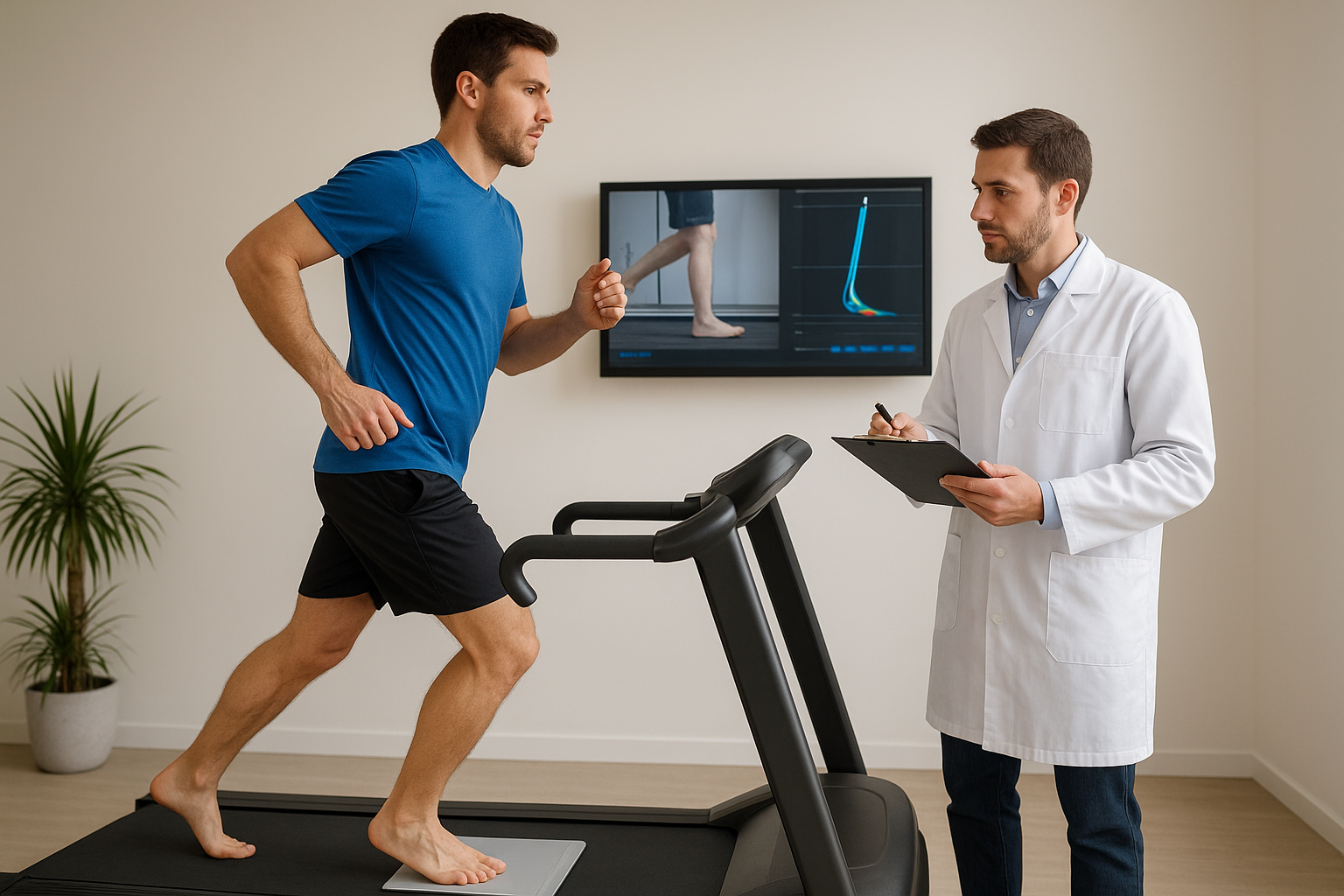
Your podiatrist may ask you to run for a longer period so they can observe how your mechanics shift as fatigue accumulates. This is an important part of the assessment that a brief in-store jog simply cannot replicate.
What you receive at the end
After reviewing the data, your podiatrist will walk you through their findings in plain language. You’ll receive a clear explanation of any patterns identified and what they mean for your injury risk and performance, along with specific steps recommended in response. Those steps might include footwear changes, orthotic prescription, strengthening exercises, or a referral for further assessment if something warrants a closer look. Nothing gets handed to you without a clear explanation attached to it.
Treadmill vs overground testing
Both treadmill and overground testing have a role in gait analysis for runners, and each captures different aspects of how you move. The setting you run in during your assessment isn’t a minor logistical detail. It directly shapes what data gets collected and how accurately that data reflects your real-world running. Understanding the difference helps you know what to expect and gives you better context for interpreting the findings your podiatrist shares with you afterward.
Running on a treadmill
Treadmill testing is the most common format used in clinical gait assessments, and for clear reasons. A fixed belt speed and controlled environment allow your podiatrist to observe your mechanics consistently across multiple strides without the variables that outdoor conditions introduce. Camera angles can be set precisely, pressure plate integration is straightforward, and your podiatrist can adjust speed incrementally to see how your form responds as the session progresses.
Treadmill mechanics do differ subtly from overground running, mainly because the belt moves beneath you rather than you pushing off a stationary surface, but those differences are generally small enough that the clinical findings remain relevant and actionable.
One limitation worth noting is that not all runners move identically on a treadmill compared to how they run outside. If you’re unaccustomed to treadmill running, your stride may feel unfamiliar during the first few minutes. Your podiatrist will typically allow a warm-up period before collecting meaningful data to account for that adjustment phase.
Overground running
Overground testing captures your mechanics the way they actually operate during a real training session. Your foot pushes off a stationary surface, which produces slightly different muscle activation patterns compared to treadmill running, particularly through your calf and during hip extension. For runners who find treadmills awkward or who train exclusively on roads and trails, overground assessment gives a more representative picture of their typical mechanics under familiar conditions.
The practical challenge with overground testing is that it requires more space and more sophisticated camera setups to capture consistent footage across multiple strides. Not every clinic can accommodate it within their facility. Your podiatrist will advise which format suits your situation based on your running background, the specific questions your assessment needs to answer, and the available equipment. Either format can produce findings that directly inform your footwear choices, orthotic prescription, or movement adjustments, so the goal remains consistent regardless of which approach your podiatrist uses.
DIY gait check at home: limits and tips
A professional assessment gives you the most complete picture, but there are things you can observe yourself between appointments that are worth paying attention to. Self-checking your running mechanics won’t replace pressure plate data or slow-motion video, but it can help you notice obvious patterns and decide sooner whether a full gait analysis for runners is worth booking.
What you can assess yourself
The most practical home check involves filming yourself running. Set your phone up at knee height and record yourself from the side and from directly behind while running at your usual pace. Even standard smartphone footage, when reviewed frame by frame, can show you whether your foot lands well ahead of your body, how much your hips drop on each side, and whether one arm swings differently from the other. These visual cues often highlight the most obvious asymmetries without requiring any specialist equipment.
Your shoes also tell a story. Turn your running shoes over and look at the wear pattern on the outsole. Heavy wear on the outer heel of one shoe and more even wear on the other, for instance, can indicate asymmetrical loading between your left and right foot. Significant wear on the outer edge across both shoes may suggest you’re supinating, while wear concentrated toward the inner forefoot often aligns with overpronation tendencies.
What your shoes show you is a historical record of how you’ve been running, which makes them one of the most useful self-assessment tools you have access to.
Where home checks fall short
The core limitation of any home assessment is that you can’t measure what you can’t see. Camera angles, lighting, and your own movement during filming make it genuinely difficult to capture consistent footage that reveals subtle mechanics. You can spot something obvious like a severe heel strike or a dramatic hip drop, but smaller timing issues, loading asymmetries, and compensatory patterns that develop under fatigue won’t show up clearly in a casual phone recording.
Your ability to interpret what you see also has a ceiling. Identifying a pattern is only useful if you understand what it means and what to do about it. Without that clinical context, you risk making footwear or training changes based on incomplete information, which can create new problems rather than resolve the original one. Home checks work best as a prompt to book a professional assessment rather than as a substitute for one.
How results guide shoes, orthotics and rehab
The data your podiatrist collects during a gait analysis for runners only becomes useful when it directly informs the decisions you make about footwear, support, and rehabilitation. That translation from findings to action is where the assessment earns its value. Rather than making choices based on marketing claims or general advice, you’re working from specific measurements tied to your own movement patterns, which makes every recommendation far more precise and far more likely to produce a lasting result.
Matching footwear to your mechanics
Shoe recommendations based on gait data look very different from what you’d receive in a general running shop. Your podiatrist knows exactly how your foot loads through each phase of your stride, which means they can identify whether you need a neutral shoe, a stability shoe, or something with additional cushioning in a specific zone. A runner who supinates, for example, typically benefits from a softer, more cushioned shoe that compensates for reduced natural shock absorption, while a runner with significant overpronation may need a stability shoe that limits excessive inward roll through the midfoot.
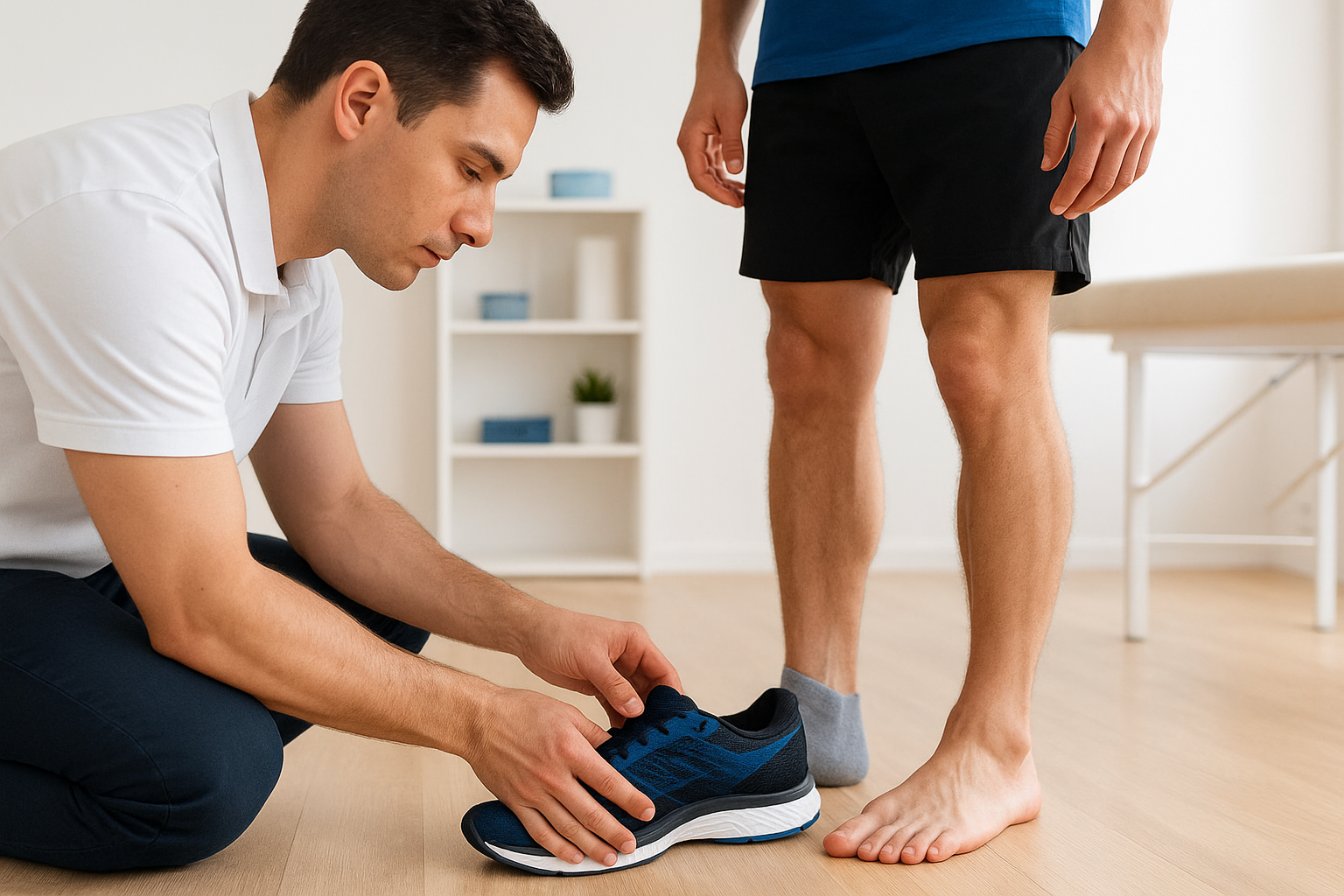
Wearing the wrong shoe type for your mechanics doesn’t just reduce comfort; it actively reinforces the patterns contributing to your injury risk.
When orthotics add what shoes can’t
Some mechanical patterns won’t resolve with footwear alone. Custom orthotics, prescribed following a full assessment, address specific loading issues that even a well-chosen shoe can’t correct. Where an off-the-shelf insole applies a generalised correction across the whole foot, a custom orthotic targets the exact degree and location of support your mechanics require. This might mean controlling a specific phase of pronation, redistributing load away from an overworked structure, or improving the alignment between your foot and ankle during your stance phase.
Your podiatrist designs the orthotic around the pressure plate data and video findings from your session, so the device reflects your actual movement rather than a standard template.
Connecting results to your rehab exercises
Gait findings identify which muscles are underperforming and which structures are absorbing more load than they should. This gives your podiatrist a clear basis for prescribing targeted strengthening work rather than generic exercises. A runner with hip drop, for instance, receives a program focused on gluteus medius strength and hip stability, which directly addresses the pattern causing excess knee stress. Runners with overstriding patterns might work on cadence drills and ankle stiffness exercises. Each recommendation follows logically from what the assessment revealed, which keeps your rehab time focused and your return to full training as direct as possible.
How often to recheck and when to see a podiatrist
Your running mechanics aren’t static. Training load, strength changes, injury history, and even footwear wear all shift how your body moves over time, which means a single gait analysis for runners doesn’t stay accurate indefinitely. Treating your assessment as a one-off event misses a significant part of its value. Scheduling rechecks at the right intervals keeps your footwear, orthotics, and training adjustments aligned with how you’re actually moving right now, rather than how you were moving months or years ago.
How training changes affect your gait
As a general guide, most recreational runners benefit from a reassessment every 12 to 18 months, assuming their training load and injury status remain broadly stable. Competitive runners who significantly increase their weekly distance, transition to a new surface type, or shift from road racing to trail running should consider rechecking sooner, since those changes apply different mechanical demands that your current setup may not account for properly.
A gait reassessment after a major training shift gives you confirmation that your footwear and orthotic prescription still match your current movement patterns rather than the ones you had when you first presented.
Your orthotics also have a physical lifespan that varies depending on how frequently you run and the materials used in their construction. Your podiatrist will advise you on when yours are likely to need replacing, and a reassessment at that point ensures the new pair reflects any changes in your mechanics since your original prescription.
Signs you should book sooner
Some situations call for a reassessment well before the 12-month mark. Pain that develops during or after a run and persists for more than a few sessions is a clear reason to get checked, regardless of when your last assessment was. Waiting to see if it resolves on its own often allows a minor mechanical issue to develop into something that requires significantly more time to address.
Returning from a lower limb injury is another situation where an earlier recheck makes practical sense. Your movement patterns often compensate around an injury site in ways that don’t fully reverse once the pain settles, and those compensations can set up a new problem if they go unaddressed. Other signs worth acting on promptly include unusual wear appearing on a relatively new pair of running shoes, a noticeable change in how one side of your body feels compared to the other during runs, or a sudden drop in your comfortable training pace without a clear explanation attached to it.
A simple plan to run better
Running well comes down to understanding how your body actually moves, not how you assume it moves. A professional gait analysis for runners gives you that understanding in a single session, replacing guesswork with specific, measurable findings you can act on directly. Whether you’re dealing with a persistent injury, preparing for a big race, or simply want to train more consistently without breaking down, the path forward starts with knowing what your mechanics are actually doing right now rather than waiting for something to go wrong.
Small adjustments to footwear, orthotics, or movement patterns compound across thousands of strides into real differences in both comfort and performance. The earlier you identify what needs attention, the less time you spend managing problems that could have been prevented. If you’re ready to get a clear picture of your running mechanics and build from there, book a gait analysis with ModPod Podiatry and get straightforward answers from an experienced podiatrist.